
Takt Cornerstones
What a Real Takt Plan Looks Like
There is a lot of work being called Takt right now that isn’t. Color-coded P6 schedules. Lookahead pulls dressed up as production plans. Wall posters with no rhythm and no buffers. The industry is full of plans that have the word “Takt” stamped on them and none of the structure underneath.
The cornerstones are how you tell the difference.
There are three sets of them. Requirements — the minimum bar a Takt plan has to clear to be called one. The structural reasons it works — why this format produces results that other formats can’t. And schedule health — the diagnostic metrics that tell you whether the plan you have is one you can run a project with.
If your plan misses on any of the three, it isn’t a Takt plan. It’s something else with Takt vocabulary on top.
Takt Requirements: The Minimum Bar
In order for a Takt plan to deliver what Takt promises, it has to be created and managed in specific ways. These are the minimum requirements for a scheduling system to be called Takt Planning and Takt Control.
Your Takt plan must:
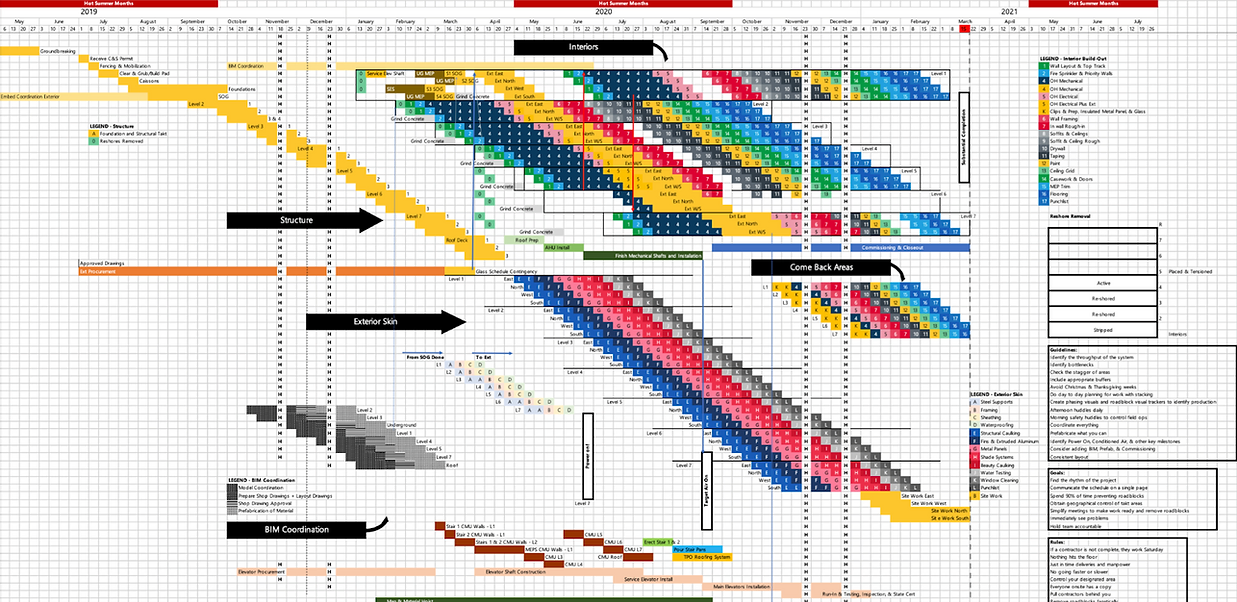
- Be a visual schedule showing time and space — time across the top, location down the side.
- Show work, trade (value), and logistical flow — all three, not just the activities.
- Visualize the work per trade in different colors, so the train of trades is readable at a glance.
- Be scheduled on a rhythm for the whole phase — not a guess, not a calendar week, an actual Takt time.
- Be planned with the appropriate buffers — at the wagon, sequence, phase, and project levels.
- Stabilize the pace of work with one-process flow and limit work in process.
- Have a reasonable overall project duration — one that does not require overtime, stacking, or burned-out crews to hit.
If your plan does not meet these requirements, it is not a Takt plan. It might be a beautiful schedule. It might be color-coded and well-organized. It might even be useful. But it is not Takt, and it will not deliver what Takt delivers.
For Takt to Work Really Well
A “Takt” is a multi-dimensional unit for a construction project. It captures time and space at once, on a single page, in a format you can actually see. That single property — being multi-dimensional rather than just a list of activities — is what enables everything else. It is what makes Takt mathematically and scientifically scalable. It is what allows us to plan and execute work in hours and days, not just weeks.
Takt is the basis for production in manufacturing, and it should be the basis for production in construction. Companies in the automotive industry — Toyota, Volkswagen, and the rest — are all built on Takt or rate of flow, then pull. “Flow where you can. Pull when you can’t.” Takt streamlines the value-creation process and enables every pull system downstream of it to actually work. Without Takt feeding it, a pull system has nothing to pull against.
Because of this structure, a Takt plan creates stability, leveled work, and protected workers. It limits excess manpower. It limits excess material inventory. It produces smoother finishes, with less needed manpower, less material on site, and more margin — because rhythm creates a backbone the team can win against. The trades stop firefighting. The site stops swinging between empty and overcrowded. The schedule stops drifting. People go home at a reasonable hour, with the work done.
That is what “Takt working really well” looks like. None of it is achievable without the format underneath.
Schedule Health: The Three Parametrics
Once you have a plan that meets the requirements, the next question is whether it is healthy. A Takt plan can be technically valid and still be poorly built. The Takt Schedule Health Metrics are how you check.
There are three parametrics. Each is a ratio. Each has an ideal range. Together they tell you whether your plan is structured for value, efficiency, and stability.
The Value Parametric. The ratio of filled Takts to empty Takts in the plan. This measures how much of your plan is actively creating value versus how much is buffer or empty space. The ideal range is 0.5 to 2.5. Below 0.5, your plan is mostly buffer and not enough work — you are not delivering value. Above 2.5, your plan is overloaded and has nowhere for variation to go. In the band, the plan is structured to provide maximum value while still respecting reality.
The Efficiency Parametric. The ratio of Takt wagons to Takt sequences. This tells you whether the phase is structured for efficient flow or whether it is too lumpy in either direction. The ideal range is 0.3 to 3.0. Outside that range, you are likely to see stacking, gaps, or sequences that don’t move trades through the zones cleanly. Inside it, the wagons and sequences are balanced for optimum efficiency.
The Stability Parametric. The ratio of train buffers to end buffers. This tells you whether the plan absorbs delays the right way — inside the train, where they belong — or whether it leans too hard on a final cushion at the end. The ideal range is 0.5 to 2.0. A plan with too little train buffer cannot absorb in-flight variation. A plan with too much end buffer is hiding instability behind a final pad.
A Takt plan that lands inside all three ranges is structurally healthy. A Takt plan that misses one is fixable. A Takt plan that misses two or three is not yet a plan — it is a draft, and it should not leave pre-construction.
What Else a Healthy Plan Shows
A Takt plan that lands inside all three ranges is structurally healthy. A Takt plan that misses one is fixable. A Takt plan that misses two or three is not yet a plan — it is a draft, and it should not leave pre-construction.
The parametrics are the math. The list below is the qualitative checklist. To be reliable, your plan must also:
- Have trade buy-in. A plan the trades did not help build is a plan the trades will not follow.
- Include buffers according to the risk analysis — not generic padding, but buffers sized to the actual risks of the phase.
- Have the proper percentages of flow: greater than 80% for trade flow, greater than 60% for workflow.
- Include all ancillary, infrastructure, and support activities — not just the headline scopes.
- Show critical milestones and exactly where they land in the schedule.
- Show come-back areas — the places where a trade has to return after another trade has gone through.
- Show the status of the work during the project, not just the plan at day one.
- Show the impact of weather on the Takt plan, with weather buffers built in where they belong.
- Be reviewed with a wider team before use, as part of a formal risk and opportunity analysis.
If your plan does not have these, it is not healthy, and it should not be considered a complete Takt plan.
Why the Bar Has to Be This High
Some of this will sound exacting. It is supposed to. The cornerstones are the line between a system that delivers and a system that merely looks like it does. We have spent decades in this industry treating that line as optional — calling things Takt that aren’t, calling plans complete that aren’t, calling buffers padding and stripping them out, calling weather an act of God instead of a quantity that belongs in the schedule.
The cornerstones close that gap. They are the answer to “how do we know whether what we have is real?”
Use them as a checklist. Run them on every plan. If a plan passes, you have something you can build with. If it does not, you have something to fix before the dirt moves. Either way, you know.
This guide will be updated as the industry sharpens its practice. We are looking forward to your feedback.
Takt Requirements
In order for Takt to achieve its promises, it has to be created and managed in specific ways. The section below provides the minimum requirements for a scheduling system to be considered Takt Planning and Takt Control:
- Be a visual schedule showing time and space
- Show work, trade (value) and logistical flow
- Visualize the work per trade in different colors - colors stands for trades
- Be scheduled on a rhythm for the whole phase
- Be planned with the appropriate buffers
- Stabilize the pace of work with one-process flow and limiting work in process
- Have a reasonable overall project duration
If your plan does not meet these requirements, it is not a Takt plan.
For takt to work really well...
Schedule health
- The Value Parametric - The value parametric divides the Takts that are used in a Takt plan by the empty Takts. This parametric tracks the value being provided in the flow of the work which should range between .5 and 2.5 when calculated as an ideal. This ensures the Takt plan is structured in a way to provide maximum value.
- The Efficiency Parametric - The efficiency parametric compares the number of Takt wagons and Takt sequences and ensures the phase does not have over a 1:3 ratio in the number of each in comparison to each other. The ideal metric should be .3 to 3.0 when calculating the metric. This ensures the Takt sequences are structured ideally for optimum efficiency.
- The Stability Parametric - The stability parametric divides the train buffers by the end buffers. The ideal metric for this is .5 to 2.0 ideally and this metric ensures you have a Takt plan that is stable with the appropriate ratio of buffers.
- Have trade buy-in.
- Includes buffers according to the risk analysis.
-
Have the proper percentages of flow:
>80% for trade flow
>60% for workflow - Have all ancillary, infrastructure, and support activities included in it.
- Show interdependence ties between phases.
- Show critical milestones and where they land in the schedule.
- Show come-back areas.
- Show the status of the work during the project
- Show the impact of weather on the Takt plan.
- Be reviewed with a wider team before use as a part of a risk and opportunity analysis.