
Takt Planning Fable 1
The Fable - Flow Builders
The Railroad - An Analogy for the Takt Production System
Stasis
The Director
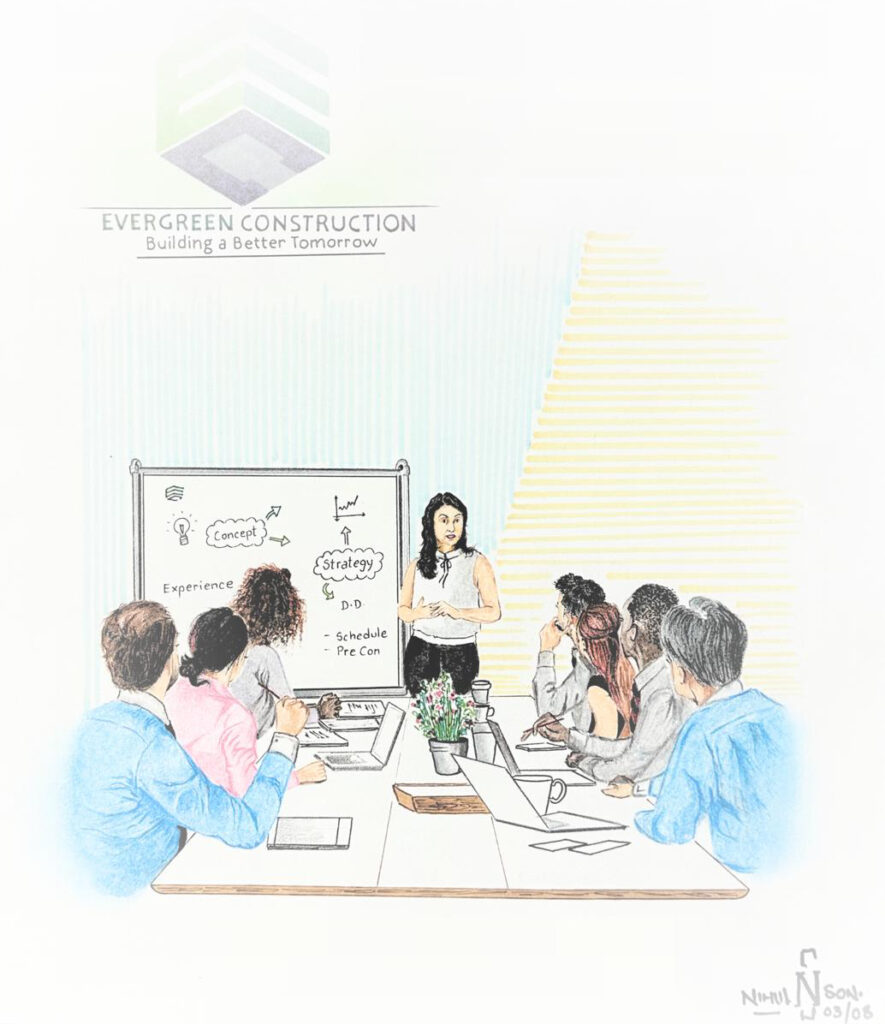
Olivia was the youngest director at Evergreen Construction but not because she was favored or especially lucky. Her performance was almost always spot-on, and she had a rare ability to disarm even the most volatile of situations, connect with people on a deeper level, and create a sense of calm. She loved her work and her unique high energy permeated her projects. When she was on the job or over the job, everyone felt compelled towards better performance. Being a fifth-generation builder, she firmly believed that building was in her blood. By all accounts, Olivia was born to be a builder. She knew what she was doing and she expected her team to as well. Close observers in the company realized that she was destined for higher levels of success and authority, but even competitive colleagues didn’t seem to resent it—probably because she always cared for and worked with people. She was open to her team both emotionally and intellectually. When getting things done, there were never any casualties and few deviations or missteps.
Olivia took pride in her ability to leverage her team and pull in resources as necessary. She was masterful when organizing the chaos and madness of a project and turning it into a success, but right now she found herself concurrently overseeing eight projects, and her presence was stretched too thin to be effective. While her supervisors had complete confidence in her, she was becoming uncharacteristically stressed and uncertain. How could she maintain success on so many projects at once if she wasn’t physically present? How could she train and mentor others to lead these projects in a way that would replicate her stability and create a reassuring atmosphere for the teams and owners?
The Project Team
The Start
The project had gone well from the start and things mobilized quickly. The team worked cohesively, and Olivia was once again credited for driving the success in overcoming project obstacles and roadblocks. In fact, she had been sold as the senior project manager on the project and was the main reason the company had won the proposal. However, as authority began to transition from Olivia to the onsite superintendent and project manager, things began to unravel. Undetectable at first, the drift toward instability became obvious as certain deadlines slipped, the team morale started to decline, and they began to have safety incidents. As new projects demanded her attention, Olivia was only able to stay with the team for about three months. Olivia and the Evergreen CEO were in agreement that Brad and Paul would have to step up.
The Trigger
Safety Reporting
Frustration
Despite the fact that Olivia should be focusing on the upcoming bid proposal and interview, Jeff’s call overshadowed everything else that day. It was difficult not to be angry about the situation; the team had all the skills they needed, they had the training, they had past successes. They had implemented Last Planner® and Scrum concepts. Contracts were in place and the best trades were selected. So what was the problem? Olivia had all the pieces to the puzzle laid out in front of her but she couldn’t fit them together.
The Interview
When the selection panel entered, the tension in the room was palpable. Abby, with her infectious laugh that often helped set the tone for the rest of the team, was oddly quiet. She’d seemed down this morning, but Olivia hadn’t taken the time to chat and now wished she would have. Juan still seemed flustered about his late arrival. The energy that Olivia had come to expect from this team was missing. No inroads were made with the stiff members of the selection panel. By the time introductions were made and everyone took their seats, Olivia was certain that Evergreen would not be asked to partner with Encompass Medical. The group wasn’t functioning as a team; they seemed more like uncomfortable strangers who had been thrown into a room together. Though Olivia and the team members began to find their footing, she had a sinking feeling that it was too late; they could not overcome their dismal first impression. She was pleased that Evergreen finished strong and left with their heads held high, but the parting “thank yous” from the selection panel seemed perfunctory, rather than congratulatory. They sounded more like goodbyes and condolences. The team just knew.
He smiled for the first time all morning. “Absolutely. Right now?”
The Quest
Lunch
The Weekly Work Planning Meeting
People Problems
The Consultant
The Phone Call
Hiring Elevate
Olivia sounded more confident than she had during their previous conversation. David was excited about the opportunity to work with Evergreen, but he felt the need for caution as well. Olivia had wanted to move fast through the initial call and consultation, which indicated big issues. David was confident in his ability to help solve problems, but he knew he could face a possible combination of stubbornness, pride, and even fear that would be an obstacle to them accepting his help.
The Surprise
The Trip
On the way up to the rafting tour’s headquarters, David and Olivia talked about her experience, the status of the projects she oversaw, and some of the background behind the problems they were facing at OneCare. Once the entire team was assembled, the guide began his safety instruction and everyone rechecked their gear and supplies. The group then rode the shuttle to the launch site. David took the opportunity to watch the team which consequently took his mind off his own trepidation about the rapids. And there was trepidation. Though he and his wife had lived in the area for over twelve years and taken their kids on many outdoor adventures, they had never been whitewater rafting. Their older kids would love it though. They had been excited for him to go. That thought gave him a boost of confidence in the experience. Maybe he would enjoy it enough to put it on the family adventure list. It was so much cooler up in the woods, which would be a nice break from the Phoenix temperatures, and it was only three hours from home.
The more David watched Olivia’s team, the more he appreciated the characteristics he was witnessing. They were confident, safe, open, and high functioning. Even the project engineers would joke with Olivia, and there did not seem to be any excessive hierarchy among them. As he observed, he began to rule out that it was an Evergreen team issue. Even Brad seemed like a remarkable leader—all too unusual in a superintendent. David had no clear idea what the root of the problem was but was pleasantly surprised that there wasn’t a lot of unhealthy contention within the group. As a consultant, his job could involve heavy pressure when pointing out specific individuals.
“I’ve never felt so much exhilaration in so much chaos. We could’ve flipped over at any minute, but I felt that adrenaline kick in and I was in the zone!”
“That’s what happens every time I go,” Olivia said. “For me, the rush comes from being near the danger. That’s why I do white water rafting; calm rivers are no fun. You don’t know when you’re about to come up against a rock; you’re always ready for anything. You knock into something and you trust the guide and then eventually, you’ll start to be able to trust your own skills.”
The Campfire
Onsite
The Problem
Olivia looked at David and said, “Now that you’ve explained it a little bit, we’d like you to present a more detailed plan for implementation of Takt. We need to see what that would look like. Is that doable?
Trains
The Meeting
“Thanks, Olivia,” David said as he positioned himself next to the projector’s screen. “The word Takt means rhythm; it indicates the beat or the rate of flow for something. Takt planning is essentially a planning system that incorporates flow, stability, and a certain amount of predictability. If you use this system for preparing work and setting milestones for the Last Planner® and Scrum teams, they will have targets they can hit and a game they can win.
Olivia made some train analogy notes:
- Land Survey = Determining Takt time and throughput
- Design of the railway system = Takt plan
- Clearing the path and making a level track = Leveling trades
- Railroad ties = Operations, or how the site is run
- Rails = Prefabrication
- Cowcatcher = Roadblock removal
- Front engine = Pre-planning team
- Engineers = A high performing team
- Takt wagons = Workers, information, and equipment
- Contents of wagons = Work product
- Caboose = Finish as you go
- Speed of the train = Takt time
- Arrival sequence of trains to the station = Throughput
- Mountains = Constraints
- Weather = Burden on the system
Plan:
- Create project Takt plan
- Discuss with OneCare
- Rally trades
- Issue zero-dollar change orders
- Implement fast
- See that everyone’s heading in the same direction
Method:
- Improve worker conditions
- Stabilize all operations
- Measure continuous improvement
Dissension:
Olivia appreciated his frankness and knew it was time to give everyone a reason to unify. “Team, I had a difficult conversation this afternoon. Jeff spoke to Brian this morning. David, Jeff is the senior VP over OneCare. We won’t be shortlisted for any future work until we’ve come up with a permanent solution to the problems we’ve been having. Evergreen’s image is suffering, our reputations are on the line, and there is no easy way out of this. I want everyone here tomorrow morning at eight, ready to make a decision, weigh in, and buy in completely. I’m meeting Brian for lunch, and I want to give him our plan.”
The Critical Choice
The Discussion:
“Alright.” David was in his element. He looked at the group, excited at the challenge they faced. “Let’s do this! The first step is to establish a plan with flow and then get everyone on the same page
Reversal
The Switch:
- Wall framing
- Electrical and plumbing wall rough-in
- Ceiling, soffit framing, and inspection
- Hang drywall
- Tape and finish drywall
- Paint
Creating the Plan:
The “Fresh Eyes” Meeting:
- Confirm procurement for separated phases - Brad, 1 week.
- Can the OFCI equipment dates be leveled according to the new plan? - Olivia, 7 days.
- Create an org chart by functional area to send out to the trades - Juan, 2 days.
- Does the schedule have weather and schedule contingency?
- Have trade partners vetted their durations in some form?
- Are there any owner activities that the contract requires be included in the construction schedule?
- Has the early or long lead procurement been identified?
- Have we included mockups?
- Does the exterior mockup trigger the release of all materials or is it an assembly mockup and not performance mockup?
- Will field measurements be required before material (counter tops, metal panels, glass, etc.) are ordered?
- Is it appropriate to guarantee openings in order to eliminate long lead times late in the project?
- Have we accounted for the procurement duration of owner provided items and can we tell them when they need to be ordered and delivered? Will the owner provide these?
- Is procurement strategically entered, has the PM reviewed and confirmed durations, and is it leveled for the designers?
- Make sure all dry-in ties are correct.
- There were reminders interspersed with more questions.
- Look at the completion of exterior to interiors and ensure there are no come-back areas.
- Look at the staging of the elevator on level 1 or basement. Do not plan on building that area right away.
- Level 1 will always be torn up during construction. Can you go top down?
- Have we coordinated the schedule with the steel erector so we represent the sequence in which the building will be erected? Will the rest of the building will sequence off this plan?
- Do we have a plan for when the permanent power will be turned on for the building?
- Will there be a need for a temporary roof?
- Does the flow incorporate specialty rooms (restrooms, IDF, MDF, mech, fire rise, SES, etc.)? Would it make more sense to break these up?
- Ensure the skin and roof are complete enough by the time drywall or insulation starts.
- Ensure exterior skin is in place in time for interior framing and drywall to connect to it. If not, are there comeback areas?
- Is there some form of climate control functioning before high-end millwork is installed? If not, is there a risk plan to manage?
- Have we accounted for time for wood products to acclimatize to the building?
- Ensure commissioning is detailed enough at the end of the schedule.
- Is the path for turning power on built in the schedule?
- Do we show the path to air on, and is it linked back to finishes?
- Preconstruction efforts
- Lean in contracts
- The use of LPS® and Scrum
- Prefabrication
- Winning over the workforce
- Team building onsite
- Worker orientations
- Visual interaction spaces
- Stable logistics
- Their new meeting system
- Their procurement plan
- Their quality program
- How they were going to correct issues daily
- Roadblock removal
- Zero tolerance
- The grading of contractors onsite
- And how foremen would be better able to control their production and improve based on the system
- Winning over the workforce
- Safety orientations
- Zero tolerance
- Contractor grading
Olivia knew Brad wanted to ensure everyone in this room knew how this system would support and maintain better safety standards and practices. The positive reactions to these concepts during the meeting were evident.
Jeff nodded, impressed. “Okay, we’ll meet three weeks from now to assess—as long as our insurance walks show excellent for the next three weeks,” Jeff said. “If not, I’ll be back sooner to discuss this.”
“Thank you Jeff and thank you team for your time and efforts here today,” Olivia said, and she closed the meeting.
- Clean bathrooms
- An air-conditioned lunch area
- A redesigned conference room area
- Every contractor working from one schedule with the zero-dollar change order
- A meeting system of planning the next day and huddling daily with the workers
- Less worker counts onsite due to more flow efficiency
- Clean areas that crews controlled as a part of their sequence
- A project team holding people accountable
- An office team with more ability to stabilize procurement with consistent datesAn office team with more ability to stabilize procurement with consistent dates
Takt is a holding system, not a push system. When people try to keep pushing they lose the genius of the system. Holding means flow. When you flow, you go fast. Much like the Navy Seal saying, “Slow is smooth, and smooth if fast,” with Lean, “Holding is smooth, and smooth is fast.” When Jeff visited the site six weeks after that OAC meeting where they began to implement their Takt plan for OneCare, he saw an entirely new jobsite.
In Spite of...
Starting with Takt
- Takt—up and to the CD phase
- Implementing “fresh eyes” meetings
- The buyout of Takt and Lean in contracts
- Setting up logistics to support Takt
Future Projects:
- Intentional Pre-construction Efforts - All projects are to follow the Evergreen First Planner System leading up and to a “fresh eyes” meeting for every project.
- Lean in Contracts - Takt, LPS® and Scrum in addition to Lean behaviors and systems are to become a part of the master subcontract agreement and be included in work authorizations.
- The Last Planner® System - The Last Planner System® is to be standardized with modifications needed to merge it with the Takt planning process.
- Prefabrication - Prefabrication will become the default for projects. Stick-built work is to be done only when authorized.
- Win Over the Workforce - Worker bathrooms, lunchrooms, barbeques, parking, smoking areas and morning huddles are to be Evergreen standard for all projects as the minimum.
- Orient People Well - Orientations will onboard workers and foremen to Takt, LPS®, Scrum, and concepts of flow. Foremen are to be trained monthly on these systems.
- Design Remarkable Interaction Spaces - Interaction spaces are to be standardized for Evergreen projects to support integration and e traincollaboration.
- Implement Zero Tolerance - A company approach to zero tolerance is to be coordinated with field ops so projects can focus on executing work in a safe manner.
- Grade Contractors - Contractor grading is to be scaled generally, with reporting that enables leadership and estimates to see how trades are performing.
Here is where we leave them behind and you become the main character of the book. The rest of our book describes the steps David taught the team for their Takt journey, and we’d like to welcome you to take the same journey. What will you do to implement Takt on your project? Whatever your next move is, we want you to know we’re cheering you on as you begin your fight against waste and variation. Every week, month, and year of learning Takt will become more and more exciting. Once you and your company begin implementing Takt planning and Takt control, you will begin to see huge gains in production which will lead to increased profits and shorter overall project durations—not to mention the stability and flow that will protect families and people on our job sites. Stay with it. On we go!