
There’s no such thing as a non-Takt, pre-Takt, or post-Takt area of a project. Takt is defined by two things only: Trade Flow — trades sequenced through zones with the fewest stops and restarts — and Buffers, intentional stabilization time that absorbs variation. Any scope you can break into zones, sequence, and buffer — underground utilities, MEP rough-in, closeout — is already Takt. What’s missing isn’t a different methodology. It’s the time-by-location format.
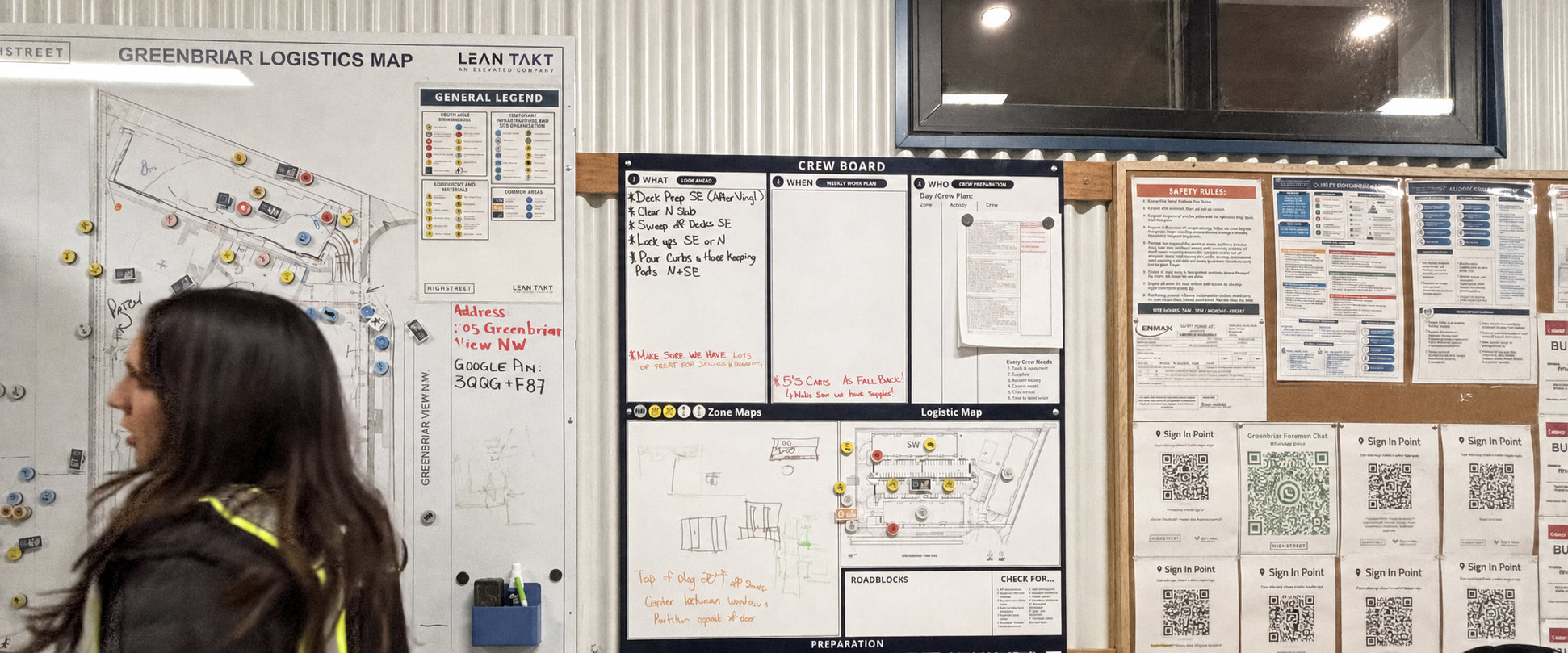
A real jobsite photo of a phase teams usually call “non-Takt” actually running on a visible Takt system — e.g., a utility-trench or site-logistics crew working a marked zone map, or a closeout/commissioning team working a System Readiness Board. Not a generic hard-hat stock photo.
The Myth That Won’t Die
“That area’s out of Takt.” “We’ll handle pre-Takt separately.” “This phase is non-Takt — it doesn’t fit the rhythm.” “Once we hit post-Takt, we switch back to CPM.” You’ve heard at least one of these on a jobsite. Every one of them is wrong — not debatable, not a matter of style, just wrong. And the mistake traces back to the same root: treating Takt time as the whole system instead of one part of it.
Every part of your project can be tacted. The fallacies survive because teams confuse one visible feature — uniform Takt time — with the whole production system.
What Is Takt Planning, Actually?
Takt Production rests on two non-negotiables: Trade Flow and Buffers. Trade Flow is trades moving through zones in a deliberate sequence with the fewest stops and restarts possible. Buffers — sometimes called Stabilization Time — are intentional protection that lets the system survive the variation real construction always produces. Time-by-location, zones, trains, wagons, and Takt time itself are the planning structures used to make those two conditions visible and controllable — not additional non-negotiables of their own.
Ask three questions: Can the work be divided into zones, stations, or work packages? Can trades move through them deliberately? Can that movement be protected from unnecessary stops and restarts? If yes, the work can be represented and managed in Takt. There’s no principled reason to say yes for one part of the building and no for another.
Where Did Takt Come From, and Why Does the Definition Matter?
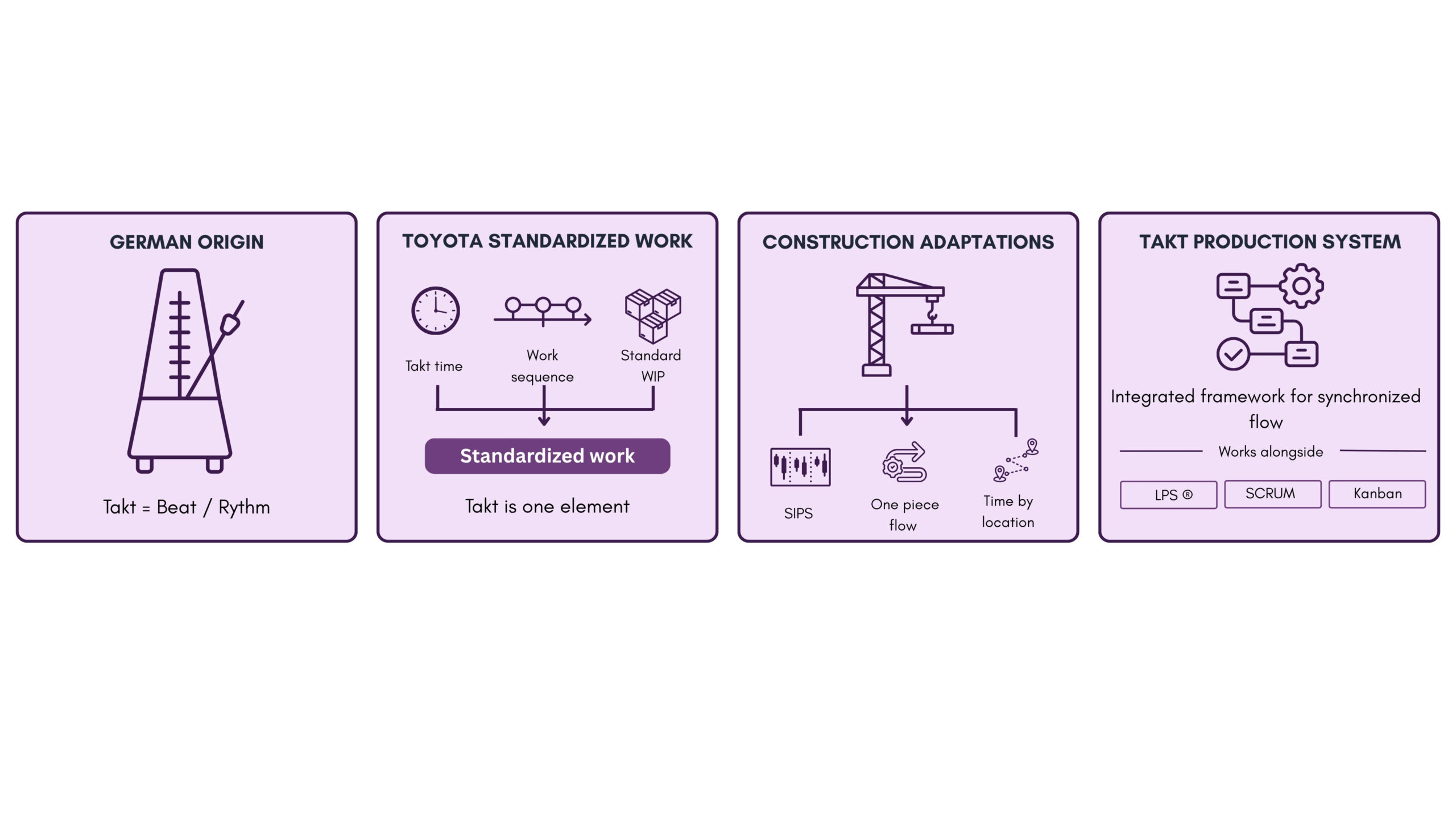
The myth that Takt only counts when a whole project runs one uniform beat didn’t come from the people who built the methodology. It came from people who read one part of it and stopped. Taiichi Ohno treated takt time as one element of a larger production system built around flow, sequence, and standard in-process inventory — not a single rigid rate stamped over every operation in the plant (Ohno, 1988).
The German word Takt means beat or rhythm — the term construction borrowed for time-by-location scheduling comes from decades of manufacturing practice built on synchronizing flow, not on locking every station to an identical cycle time (Binninger, Dlouhy & Haghsheno, 2017). Toyota’s own standardized work treats takt time as one of three elements — alongside work sequence and a standard amount of in-process work — not as a number that overrides everything else (Liker, 2004).
In construction, the same underlying idea has surfaced under different names: Short Interval Production Scheduling at Hensel Phelps, one-piece-flow scheduling elsewhere. The Takt Production System pulls these lineages into one framework. It runs alongside the Last Planner System®, Scrum, and the Kanban Method — not instead of them. What it never does, in any honest reading of Ohno, Toyota, or the German origin, is collapse into a single rigid Takt time forced across every flow on the job. That collapse is a misreading, and it’s the root of every fallacy below.
A single Takt-train diagram spanning the full project timeline — site prep and utilities on the left, structure and MEP rough-in through the middle, closeout and commissioning on the right — all shown as one continuous train of trades moving through zones, making the “it’s all one Takt plan” argument visible rather than argued.
Fallacy #1 — Is This Area Really “Non-Takt”?
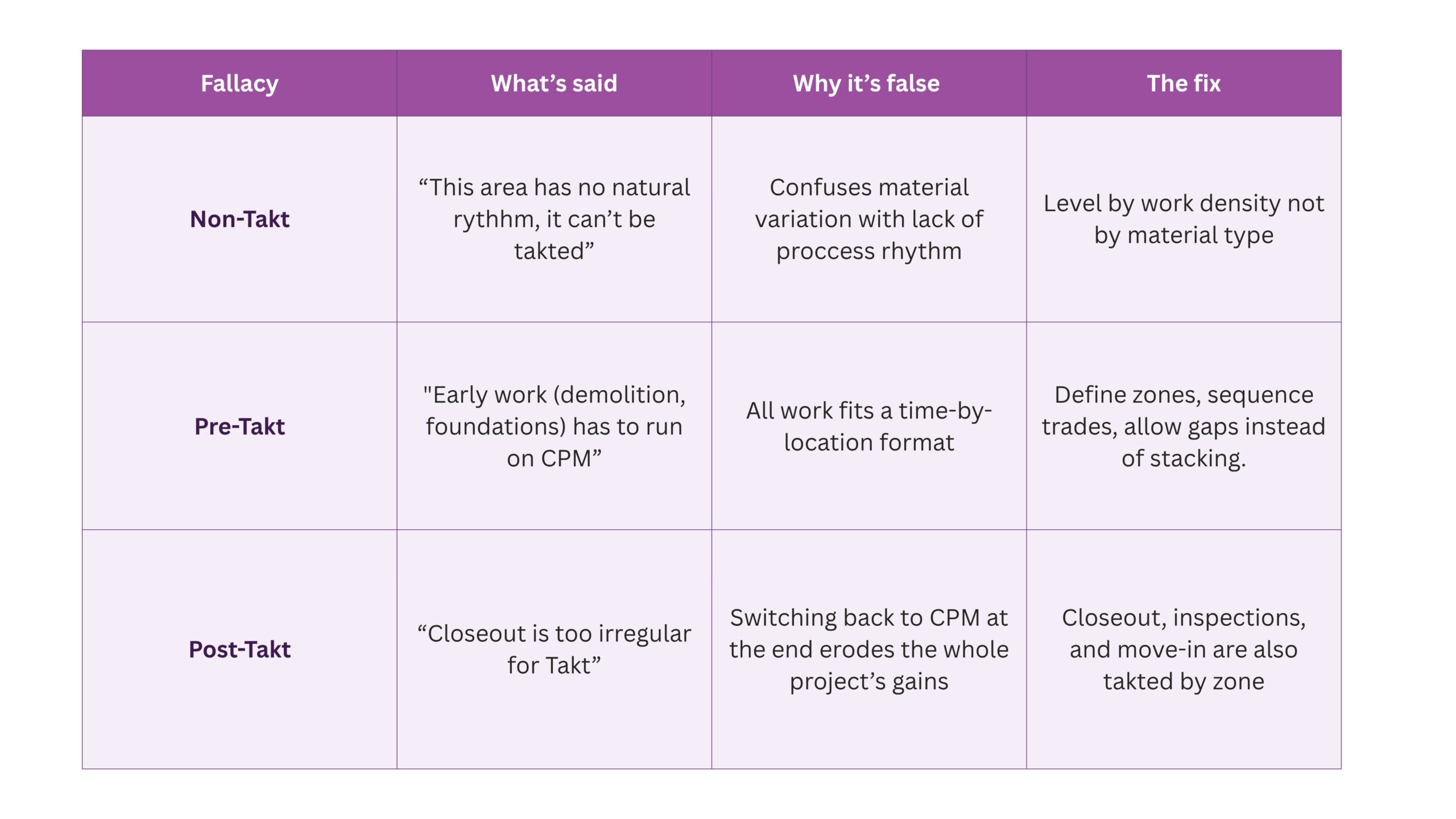
The claim usually sounds like this: this part of the job doesn’t have a natural rhythm, so it can’t be takted. That’s the material-thinking fallacy — mistaking variation in materials or finishes for a lack of process rhythm.
Construction already handles this kind of variation everywhere else. CSI MasterFormat doesn’t reclassify Division 26 as something else because one area runs rigid conduit and another runs MC cable. It’s still electrical. Same trade, same process, different material.
Takt works the same way. Every room has structure, in-wall and overhead MEP, flooring, and finishes — the process repeats even when materials don’t. A flooring crew installing carpet tile in one zone and vinyl tile in the next is still one crew flowing through the work at a different work density. Level by density, not by material, and the “non-Takt area” disappears. What’s left is just work you haven’t sized yet.
Fallacy #2 — Is This Really “Pre-Takt” Work?
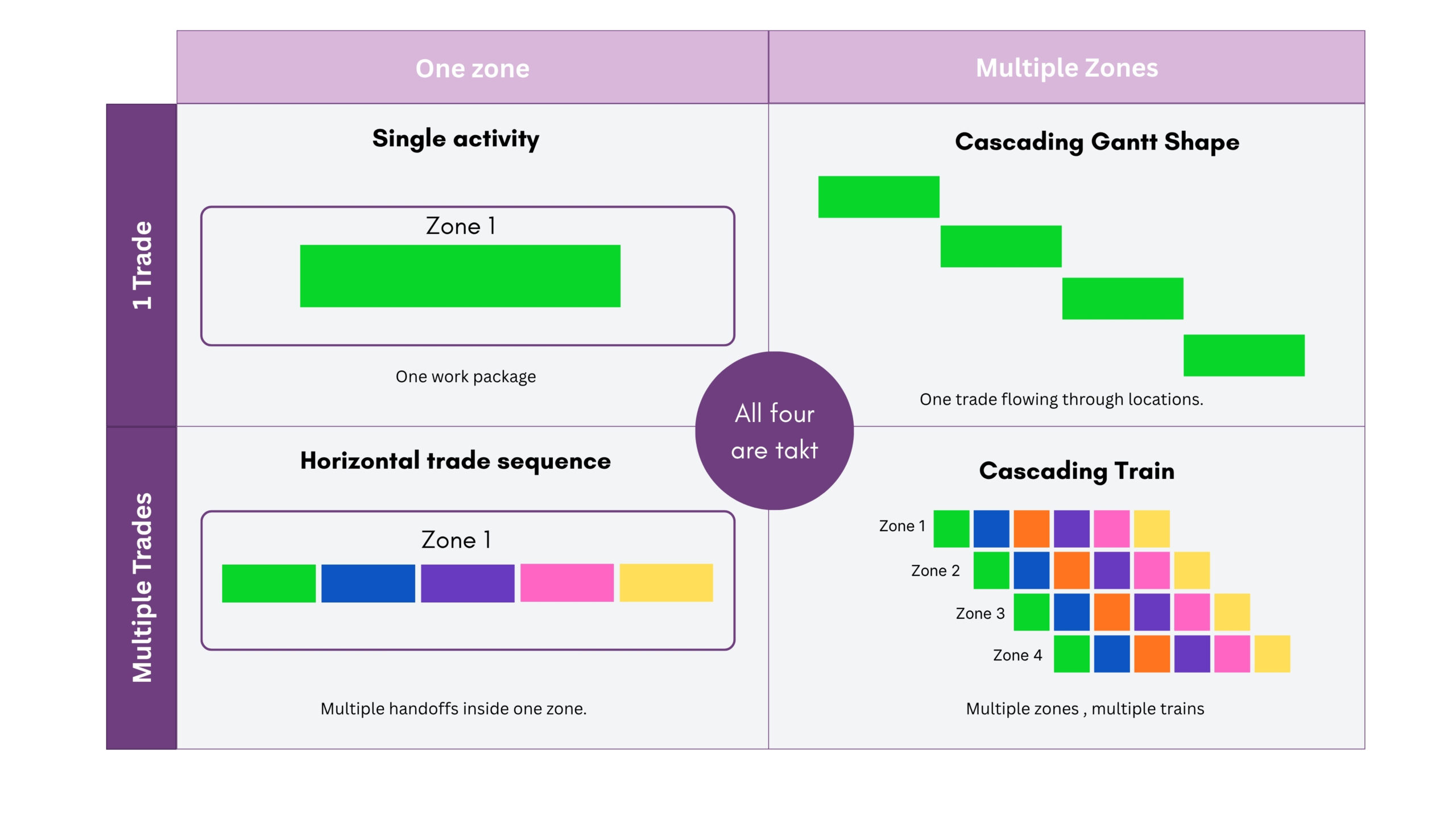
“Pre-Takt” usually means early site work — demolition, underground utilities, foundations — scheduled the traditional way with CPM until the “real” Takt phase starts. Wrong, for a structural reason: a Takt plan is a time-by-location view, and the ratio of trades to zones changes its visual shape without changing what it is.
- Multiple zones, multiple trades → a classic cascading train.
- Multiple zones, one trade → a cascading Gantt chart.
- One zone, multiple trades → a horizontal sequence.
- One zone, one trade → a single activity.
All four can live inside a Takt plan — same format, same principles, different shape.
Site prep, underground work, and foundations simply occupy one of those shapes. When a process step skips a zone, that’s a gap — and a gap preserves rhythm. It keeps the trade sequence honest instead of pulling downstream work forward just to fill the visual space. CPM-style stacking doesn’t leave that gap visible; it hides it and lets it compound.
Fallacy #3 — Should You Switch Back to CPM for Closeout?
“Post-Takt” is the mirror image — punch list, commissioning, owner training, final inspections, move-in. The claim: too one-off, too dependent on outside parties, so drop back to CPM for the final stretch.
Two problems. First, dropping Takt at the finish line is one of the most reliable ways to lose everything the project spent months building. The moment sequence and buffers stop being respected, the path of critical flow becomes a critical path again — variation cascades, buffers get consumed silently, and a project that ran clean for a year and a half blows its final 90 days.
Second, closeout fits the Takt format fine. Commissioning runs in zones. Punch list runs in zones. Move-in runs in zones. The ratios flex — one zone with multiple stakeholders, or multiple zones with a single closeout trade — but that’s the format flexing, not the methodology failing. Tact it. Buffer it. Flow it.
Why Isn’t Takt Time the Same Number Everywhere?
Some of the “non-Takt” confusion comes from software and teams that assume a Takt phase has to run on one Takt time. It doesn’t, and it never did. Inside a single Toyota plant, final assembly runs to its own takt time while feeder cells and subassembly lines run their own cycle times — synchronized to feed final assembly, not locked to an identical number (Ohno, 1988).
Construction works the same way. A Norm Takt plan can run single-train sections for repetitive work, multi-train sections where parallel crews cover different scopes, different Takt times for different trains in the same project, and different zone-to-trade ratios as the work shape changes. “One phase, one Takt time” is a tooling limitation and a misreading — not a rule of the methodology. A real Takt plan flexes its shape to match the work. The work never has to flex to match the software.
How Do You Spot These Fallacies on Your Own Project?
Listen for these on your next schedule review:
- “That phase isn’t really tacted, it’s just scheduled.”
- “We’ll run CPM for the first three months, then switch to Takt.”
- “This phase has too many one-off activities for Takt.”
- “There’s no rhythm here, so Takt doesn’t apply.”
- “We left this area out — the materials are too varied.”
- “Closeout is CPM only; the main build is Takt.”
- “The whole phase needs one Takt time or we can’t tact it.”
Every one of those is the same misunderstanding wearing a different jobsite. The fix doesn’t change: put the work in time-by-location format, identify the zones or work packages, sequence the trades through them, level by work density rather than material similarity, allow multiple Takt times and trains where the work calls for it, size buffers for the section intentionally, and protect Trade Flow through it. Do those seven things and you have a Takt plan — regardless of where it sits on the timeline or how irregular it looks on paper.
The Field Takeaway
This week, open your current project schedule and mark every section labeled “CPM phase,” “pre-Takt,” “non-Takt,” or “post-Takt.” Pick one. Put it into time-by-location, identify its zones or work packages, and show where Trade Flow and Buffers live. If you cannot, the area is not exempt from Takt. Your production design is incomplete.
Close one this week. That’s the whole exercise.
There’s a Lean principle behind all of this: where there’s no standard, there’s no improvement. Put the standard in place — every zone, every phase — and the improvement follows.
On we go.
If your project needs superintendent coaching, project support, or leadership development, Elevate Construction can help your field teams stabilize, schedule, and flow — and build the Takt discipline that protects every phase of the project from groundbreaking to final inspection.
Frequently Asked Questions
What makes something a Takt plan if Takt time doesn’t have to be uniform across the whole project?
A Takt plan sequences work through zones and protects that flow with intentional buffers. The trains do not need identical wagon lengths or one universal Takt time.
Why is switching back to CPM for closeout such a common mistake?
Because it silently destroys the Trade Flow the team spent the whole project protecting. The moment sequence and buffers stop being respected, variation cascades without protection, buffers get consumed silently, and a project that ran clean for months loses its gains in the final stretch.
If materials vary from zone to zone, how can you still apply Takt?
By leveling zones based on work density rather than material similarity. A flooring crew installing carpet tile in one zone and vinyl tile in the next is different material, same trade, same flow logic. Size the wagon by effort and work density, not by material type, and the Takt format works regardless of what’s being installed.