
Project Production Management explains how flow, capacity, Work in Progress, variability, bottlenecks, and handoffs determine construction performance. Takt planning turns that production-system understanding into a visual, time-by-location method for sequencing and controlling work in the field.
There are two ways to look at a construction schedule. The first way is to treat it as a set of dated activities with start dates, finish dates, and a Path of Critical Flow running between them. The second way is to ask what physical system of flow, people, materials, handoffs, and queues is actually causing those dates. The first view tells you what the schedule says. The second view tells you what the schedule actually is, and more importantly what to change when it is not performing.
Project Production Management is the discipline that lives in that second view. Takt planning is the method that makes it visible and executable on a real jobsite. They are not competing philosophies. They are the same production science expressed at two different altitudes. One explains why the schedule behaves the way it does. The other gives a superintendent the tools to actually change it.
What Is Project Production Management Actually?
Most project schedules describe dates. Project Production Management describes systems. The shift is this: instead of asking whether activities are early or late, PPM asks what physical flow of work, people, materials, equipment, queues, and handoffs is producing those outcomes.
A PPM practitioner treats a construction project like a factory. Work enters the system, waits, gets processed, waits again, moves to the next step, and eventually becomes completed work. The schedule is not just a document of dates it is the result of how much work has been released into the system, how fast the bottleneck can process it, how much unfinished work is sitting around, how variable the work is, how big the handoff batches are, and how much waiting and rework exist. Change those variables and you change the schedule outcome. Move dates on a Gantt chart and you change nothing the system will produce whatever it is capable of producing regardless of what the document says.
How Do Throughput, Work in Progress, and Cycle Time Interact?
Three production variables govern everything in Operations Science, and every builder who wants to understand why schedules behave the way they do should internalize them.
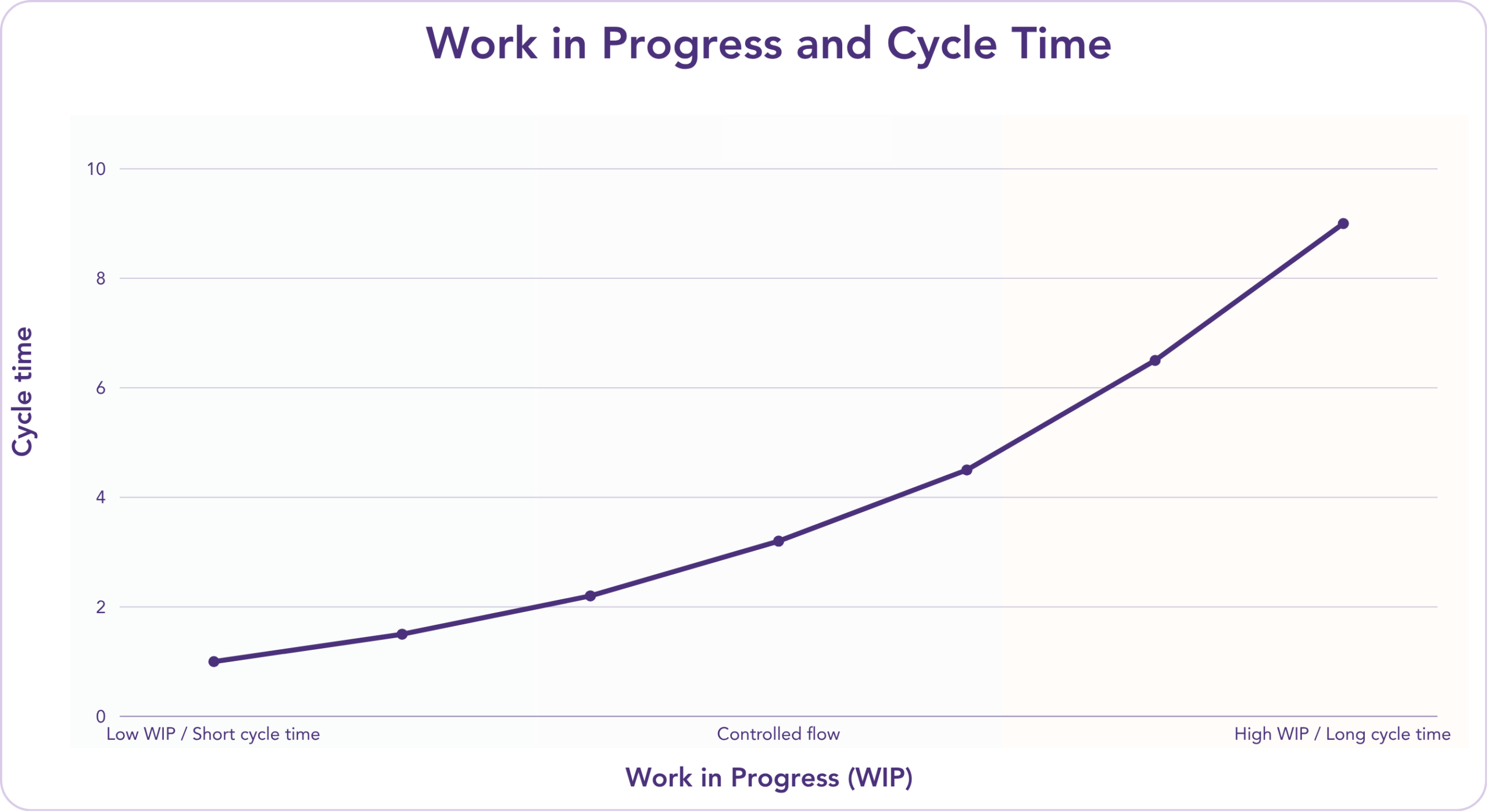
Throughput is how much completed work comes out of the system per day or per week. Work in Progress (WIP) is the unfinished work already released into the system. Cycle time is how long one unit of work takes to move through the system from start to finish. Those three variables are bound by one equation: Cycle Time equals WIP divided by Throughput. This is Little’s Law, and it is not a construction theory or a scheduling preference. It is a mathematical law of flow that applies to every production system ever built.
The implication of Little’s Law is brutal and counterintuitive for most construction teams. If throughput is capped by a bottleneck, releasing more WIP does not make work finish faster; it makes each unit take longer. More released work, same output rate, longer cycle time. The work does not get done sooner. It sits around longer, creating congestion, handling waste, rework risk, and management noise. The common instinct when a project is late is to release more work. Operations Science says that instinct is often exactly wrong.
Where Is the Bottleneck in the Production System?
The most important insight in PPM is also the most consistently ignored in practice: the schedule is controlled by the bottleneck. Not by the overall team’s effort. Not by how busy everyone is. By the single step, crew, piece of equipment, approval, or process center that limits how much completed work the whole system can produce.
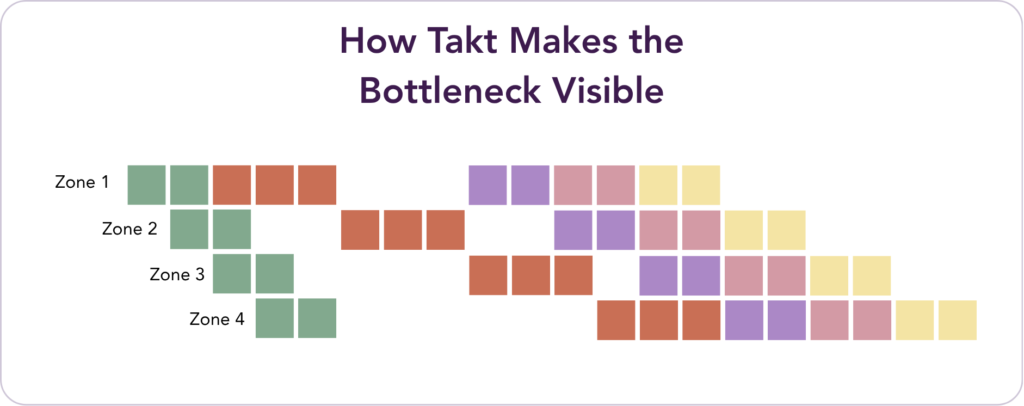
The one-lane bridge image makes this clear. Adding more cars before the bridge does not get more cars across; it creates traffic. Bad scheduling practice keeps adding cars before the bridge and then wonders why the project is late. PPM asks: where is the one-lane bridge? Takt answers it visually. The bottleneck is the zone or trade where the work cannot keep pace with the Takt time. It is visible on the wall, where everyone can see it and where the team can actually do something about it.
This is also why adding more people often fails. If the bottleneck is inspection, a crane, engineering approval, or a specialized crew, adding general labor does not increase output; it increases WIP. The constrained step never changes. Throughput never rises. The schedule does not improve. PPM prevents this trap by requiring that capacity additions be targeted specifically at the constraint, not distributed across the whole project in response to schedule pressure.
How Does Takt Operationalize PPM Concepts?
Every core PPM concept has a direct Takt mechanism. This is the mapping that makes the relationship between the science and the practice concrete. When PPM says “find the bottleneck,” Takt says “look at the zone where in-zone cycle time exceeds the Takt time.” When PPM says “control your WIP,” Takt says “maintain Trade Flow: work moves through zones; it does not pile up in them.” When PPM says “reduce batch size,” Takt says “make the zones smaller and level them by work density.” When PPM says “control the work release rate,” Takt says “the Takt rate governs how fast new work enters the system.”
The PPM workflow runs in six steps: define the production system, map the flow, build the data model, analyze where the system is choking, configure the system to change those conditions, and then control execution to prevent the system from drifting back into chaos. In Takt terms: identify the product and the zones, build the time-by-location wall, do the work density leveling and Takt time calculation, expose trade stacking and overloaded zones visually, re-level zones and resize buffers, and then use the Last Planner System and weekly work plans to hold the production rhythm. The PPM method and the Takt method are the same loop. Takt gives it a visual, foreman-ready, jobsite-executable form.
Which Three Curves Should Every Builder Understand?
Operations Science describes three relationships that govern production system behavior. They have direct implications for every project being built right now.
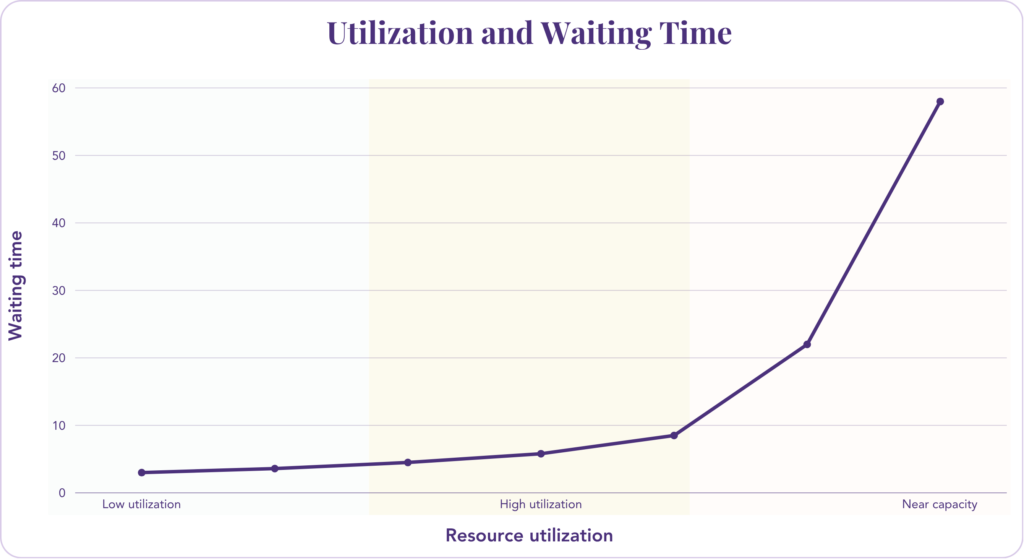
The first is the utilization versus waiting time curve. As a resource approaches 100% utilization, waiting time increases exponentially especially when work is variable—and construction work is always variable. A crane, welder, inspector, or permit process running at 95 to 100% utilization becomes fragile: any disruption creates a queue behind it that is much longer than the disruption itself. The right question is not “are people busy?” It is “are the right resources operating at the right level of utilization, without creating cascading queues?” Takt addresses this by comparing in-zone cycle time to the Takt time and confirming that critical crews are not spread across too many zones or burdened with too much simultaneous work.
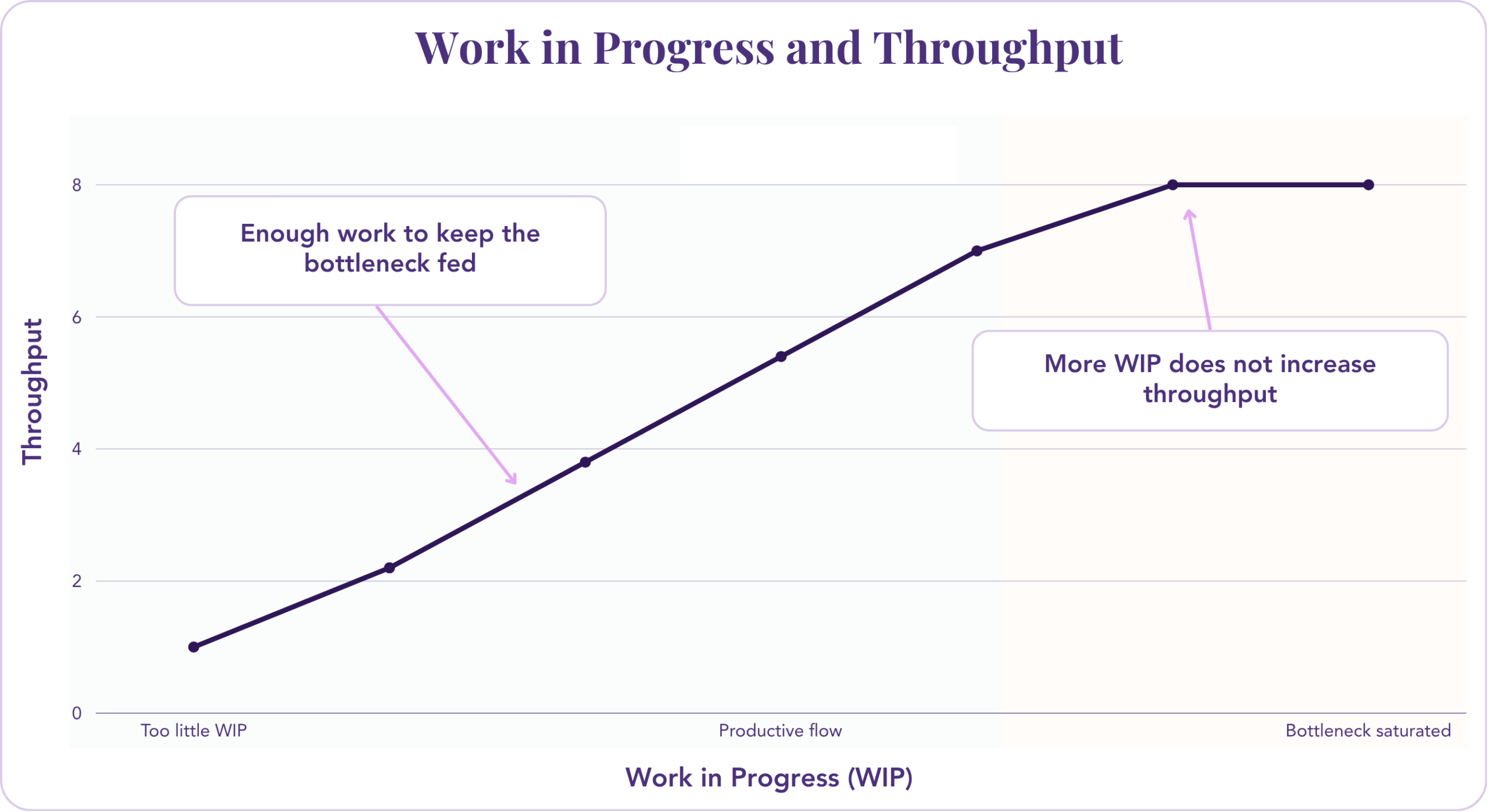
The second curve is WIP versus throughput. Adding WIP helps initially; it keeps the bottleneck fed. But past a certain point, adding WIP does not raise throughput because the bottleneck is already saturated. There is a sweet spot where the system is fully productive without being congested. Takt controls WIP by maintaining Trade Flow: the train keeps just enough work in front of each crew to stay productive without dumping the whole project into the field at once.
The third curve is WIP versus cycle time. As WIP rises, cycle time rises the more unfinished work floating around the system, the longer each unit takes to complete. This is the exact opposite of how most teams behave under schedule pressure. The common response to being late is to release more work. That response increases WIP, which increases cycle time, which makes the project later. Takt finishes work as it goes, in one-process flow. Low WIP by design means short cycle time by design.
What Warning Signs Show the Production System Is Failing?
Before the project looks to the schedule for answers that only the production system can provide, watch for these signals:
Activities are being crashed more labor, more overtime, more parallel starts without any analysis of whether the added capacity is at the bottleneck or upstream of it.
The schedule is showing work completing on time at the activity level while the project as a whole keeps slipping, because the bottleneck is not being exposed.
Work has been released into multiple zones simultaneously and the site feels chaotic even though everyone is busy, because WIP is clogging the system rather than flowing through it.
The instinct when falling behind is to start more things rather than finish the things already started, which is the operational definition of losing Trade Flow.
Handoff batches between trades are large one trade completes an entire floor before the next trade mobilizes creating long waiting periods that look like schedule progress but are actually queue time.
Every one of those signals is a production system problem. Moving dates on the schedule does not fix any of them. Redesigning the system through the PPM diagnostic framework and the Takt production model is what fixes them.
What Does the Pile-Driving Example Show About PPM?
Internal experience-based case — not independently documented
A piling operation analyzed through PPM produced a striking comparison based on internal field experience. Actual performance was approximately two piles per day. Standard Lean improvement reached approximately three piles per day. PPM analysis—decomposing the operation into specific steps, identifying which step controlled the output rate, and targeting the Constraint specifically—reached five to six piles per day.
The improvement did not come from working harder or longer. It came from identifying that welders were highly utilized while the crane and driver sat idle, and from decoupling the work from the crane by adding a second set of slings. The bottleneck was not generic effort; it was the specific interface between welding and crane availability. Once that interface changed, the system’s throughput rose without anyone working harder. That is what PPM produces: not pressure, but redesign.
How Do PPM and Takt Work Together?
Traditional project controls answer one question: are we on plan or off plan? PPM asks a different question: what is limiting completed output, and what do we change to raise it? The two are not the same question, and they do not produce the same answers. A progress curve can tell you that you are late. It cannot tell you whether the bottleneck is overloaded, whether too much WIP was released, whether batching is delaying handoffs, or whether adding people will help or make things worse.
Takt planning is how construction implements the answers PPM produces. It is the visual, time-by-location, foreman-owned expression of the same production science—Operations Science, Little’s Law, the Theory of Constraints, and PPM—that has informed manufacturing, healthcare, and logistics for decades. This is a general observation about where the science has been applied, not a claim about one specific study. The science tells you what to change. Takt is how you change it, see it, and hold it through the life of the project.
If your project needs superintendent coaching, project support, or leadership development, Elevate Construction and LeanTakt can help your field teams stabilize, schedule, and flow including the production system design that makes the Takt wall a real management tool rather than a visual decoration.
We are building people who build things. The builders who understand the science behind the schedule are the ones who can change it rather than just report on it.
What Should Builders Do This Week?
Find the bottleneck on your current project this week. Not the activity that is behind the step, crew, equipment, or approval that is limiting how much completed work the whole project can produce per day. Name it specifically. Then ask whether the current response to schedule pressure is adding capacity at that bottleneck or adding WIP upstream of it. If the answer is upstream, the schedule is about to get worse. Redesign the system around the constraint. That is PPM. That is Takt. That is the work.
A line commonly attributed to W. Edwards Deming captures the principle: “Without data, you’re just another person with an opinion.” The attribution is widely circulated, but the operational lesson here is ours: use data to identify the Constraint instead of arguing from impressions.
On we go.
What Questions Do Builders Ask About PPM and Takt?
What is the difference between Project Production Management and traditional project controls?
Traditional controls tell you whether you are on plan or off plan the what. PPM tells you why the schedule is performing the way it is and what to change the why and the how. PPM treats the project as a production system and optimizes the system, not just the document. Takt is how that optimized system gets built and held in the field.
What is Little’s Law and why does it matter for construction scheduling?
Little’s Law says that Cycle Time equals WIP divided by Throughput. It means that when throughput is capped by a bottleneck, releasing more work into the system does not make work finish faster it makes cycle time longer. Construction teams under schedule pressure instinctively release more work; Little’s Law says that instinct often makes the schedule worse, not better.
How does Takt planning connect to the bottleneck in a production system?
The bottleneck is the zone or trade where in-zone cycle time exceeds the Takt time and it is visible on the Takt wall. Once visible, it can be targeted: add capacity specifically at that zone, re-level the work density around it, or adjust the handoff sequence to keep it fed without starving upstream trades. Takt makes the bottleneck a management problem instead of a mystery.
What Is the Plain-English Summary of This Article?
A construction schedule is the visible result of a production system. If a bottleneck limits output, adding more work or more general labor can increase Work in Progress without increasing throughput. Project Production Management diagnoses those conditions. Takt planning turns the diagnosis into zones, a time-by-location plan, Trade Flow, and a production rhythm the field team can see and manage.
Sources and Further Research:
Wallace J. Hopp and Mark L. Spearman, Factory Physics, 3rd ed.