
Find your trade and zone bottlenecks. Show them on the wall. Place a buffer immediately ahead of the constraint. That’s how the train of trades actually keeps time.
What Is Drum-Buffer-Rope, and How Does It Apply to a Takt Plan?
Drum-Buffer-Rope (DBR) is the mechanism behind every healthy Takt plan. The drum is the constraint setting the sustainable beat of the project. The buffer is the protection — typically a wagon of ready work or a deliberate cushion of time — placed immediately ahead of the constraint so it never starves on upstream variation. The rope is the discipline of releasing new work only as fast as the constraint can absorb. Together they make the train of trades self-regulating.
The rest of this post is the why and the how.
Finding the Pace-Setter Isn't Enough
Once the constraint is known, the team must set the system’s pace to it, protect it from starvation, and control release. There’s a single idea that does all three at once, and it traces back to Eliyahu Goldratt’s 1984 business novel The Goal, which introduced the Theory of Constraints through the story of a Boy Scout troop and its slowest hiker, Herbie (Goldratt, 1984). Drum-Buffer-Rope — the method that formalizes how to set the pace, protect the constraint, and control release — was named two years later, in Goldratt and Robert Fox’s The Race (Goldratt & Fox, 1986).
From Goldratt's Herbie Story to Drum-Buffer-Rope
Goldratt’s hiking story establishes the constraint and the need to subordinate the group to its pace. The Drum-Buffer-Rope extension below applies that lesson to a situation the original story doesn’t cover: what happens when the pace-setter can’t physically lead the line.
Picture a troop of Boy Scouts strung out along a narrow mountain trail, single file, no room to pass. Within twenty minutes, the fast kids up front are pulling away. Somewhere back in the line is a hiker named Herbie, carrying the heaviest pack — slower than the others, not from lack of effort but from load. The gap keeps stretching until the troop is smeared across half a mile. Here’s what the trip leader figures out: the troop only truly arrives when Herbie arrives. So the leader moves Herbie to the front of the line. Now the whole troop walks at Herbie’s pace, because nobody can pass him. Everyone subordinates to the slowest, most limiting hiker — and the troop moves up the mountain together, faster than it ever did strung out. That’s Goldratt’s lesson: find the constraint, and subordinate the system to it.
But what if Herbie can’t physically lead the line — say the scout leaders have to stay out front by policy? That’s the situation Goldratt’s story doesn’t resolve, and it’s where Drum-Buffer-Rope becomes useful.
Drum — Herbie Still Sets the Pace
Herbie’s sustainable rhythm is still the beat the whole troop marches to, whether he’s physically first in line or not. That’s the drum.
Buffer — Trail Ahead of Herbie
The leaders staying out front still need to leave Herbie a clear stretch of trail. If one of them stops to tie a shoe and Herbie has to stop too, the constraint just went idle — and an idle constraint is lost throughput the whole troop can’t get back. So there’s always open trail in front of Herbie, no matter who’s ahead of him. That’s the buffer.
Rope — Tying the Leaders Back
The leaders can’t be allowed to drift too far ahead either, or the troop separates again — the same problem the story started with. A rope ties their pace to Herbie’s: they can open up the buffer, but no farther, before it must tighten back toward his pace. That’s the rope.
Drum, buffer, rope. Herbie sets the beat, the open trail protects him, the rope keeps the leaders from tearing the troop apart again. Even when the pace-setter can’t be first in line, the troop moves as one body, at a pace it can sustain. That is a system keeping time.
The Train of Trades Is the Troop on the Trail
In Takt, the troop becomes the train of trades. Each wagon is a trade, each station is a zone, and one wagon or zone usually sets the system’s sustainable pace — that’s the drum. A trade bottleneck is capacity-limited across the whole train; a zone bottleneck is a specific area — odd geometry, more density, more interfaces — that slows every trade passing through it. Both need to be named, not felt. Find the bottleneck, set the beat to it, protect it with a buffer, and rope the rest of the train at its pace.
The three asks of every Takt team
- Know your trade and zone bottlenecks.Walk the line of balance and find the wagon whose in-zone cycle time runs longest. Walk the zone map and find the area where every trade slows down. Both should be named — by trade, by zone — not a fuzzy feeling.
- See them visually on the plan.The bottleneck doesn’t exist if it isn’t on the wall. Mark the constraining wagon and zone in red, label them as the drum, review them every week. A bottleneck buried in a spreadsheet is a bottleneck nobody is protecting.
- Protect it with a buffer.Construction’s own version of this idea has a name: Glenn Ballard and Gregory Howell called it shielding production, and the ready work held for it a workable backlog (Ballard & Howell, 1998) — a stock of vetted, sequence-safe work a crew can turn to when its planned assignment isn’t ready. One vocabulary note: Ballard and Howell’s Last Planner literature calls removable look-ahead obstacles “constraints.” TPI calls them Roadblocks, reserving Constraint for systemic limits addressed at or before the pull plan.
Drum — The Constraint Sets the Beat
The drum is the pace-setter’s rhythm, adopted as the rhythm of the whole system. Once you’ve identified your constraint, stop asking “how fast could each part go?” and start asking “how fast can the constraint sustainably go?” — then make that the beat everyone marches to.
On the Takt plan, the drum determines the Takt time: the train’s beat is set from the pace-setting trade or zone’s sustainable capacity — not the easiest trade’s pace, not an average, the pace-setter’s pace.
Buffer — Protect the Drum, Ahead of It, So It Never Starves
A buffer is deliberate protection placed immediately ahead of the constraint, so that when something upstream hiccups — as it always will — the constraint still has something ready to work on. Idle time at a non-constraint doesn’t automatically cost the project; idle time at the active constraint usually does, and it doesn’t come back.
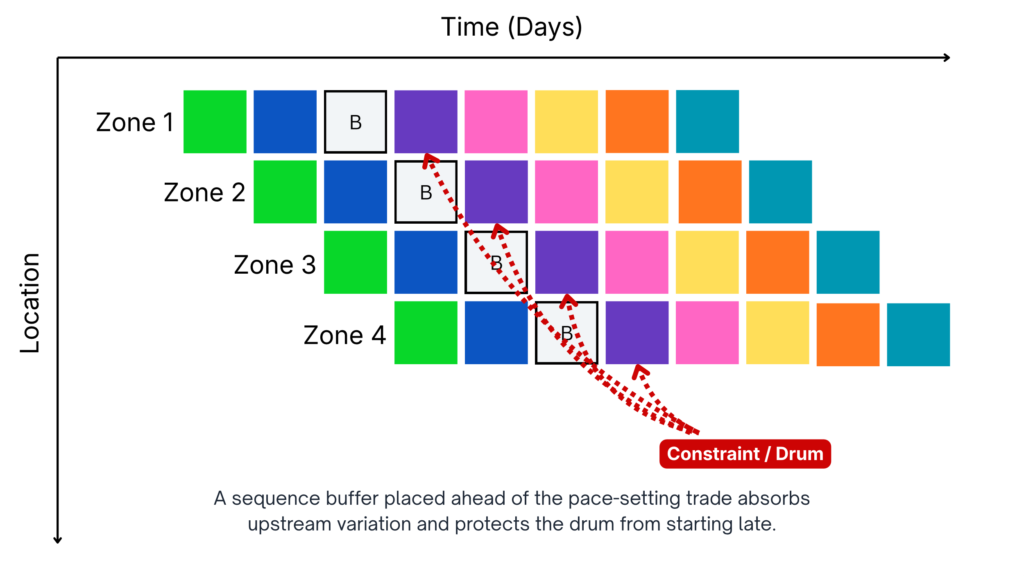
The placement rule: ahead, not nearby. The clear stretch of trail in the analogy sits in front of Herbie, not behind him and not somewhere else in line. On a Takt plan, this is the sequence buffer — the one built to protect the constraint — and it goes immediately ahead of the bottleneck wagon or zone, shown diagonally in the train. Other buffer types protect other things: a Takt-time buffer protects the beat, a phase or end buffer protects a milestone or the calendar — different job, different placement. A sequence buffer downstream of the constraint, or scattered across the plan, protects the wrong thing.
How big should that cushion be? Not a guess. British mathematician John Kingman’s 1961 work on queues in heavy traffic (Kingman, 1961) shows why wait time at any resource explodes as two things rise together: how close it runs to full capacity, and how much variability feeds it. A steady, predictable trade needs almost no cushion. A trade fed by variable upstream work — different crews, shifting deliveries, weather-exposed sequences — needs a real one, sized to the variation it actually sees, not a token gesture. Size the buffer to the variability feeding the constraint, and the math backs up what the trail already taught you.
In Takt vocabulary, that protection takes a few related but distinct forms: a dedicated buffer wagon staged immediately ahead of the pace-setter, a workable backlog of alternative ready work the constraining trade can swing into, or a deliberate time cushion built into the schedule ahead of the constraining zone. They’re not interchangeable — a time cushion protects the schedule, a workable backlog protects the crew’s utilization — but every one of them exists to do the same job: keep the drum fed.
Rope — Release Work at the Pace of the Drum, Not Faster
In the hiking story, the rope ties the leaders’ pace to Herbie’s, so they can’t drift too far ahead of the buffer protecting him. On a project, there’s no literal rope. The rope is the release rule: it prevents upstream or leading work from advancing farther than the constraint can support. New work enters the system only as fast as the constraint can consume it — pull in its earliest form. On a Takt plan, that’s releasing each zone of work at the Takt beat instead of dumping it all in early.
How Drum-Buffer-Rope Maps onto a Takt Plan
Remove any one of the three and the system loses pace, protection, or release discipline. Put all three together and it becomes self-regulating. A Takt plan, built properly, is Drum-Buffer-Rope wearing construction clothes — here’s the mapping: In the hiking story, the rope ties the leaders’ pace to Herbie’s, so they can’t drift too far ahead of the buffer protecting him. On a project, there’s no literal rope. The rope is the release rule: it prevents upstream or leading work from advancing farther than the constraint can support. New work enters the system only as fast as the constraint can consume it — pull in its earliest form. On a Takt plan, that’s releasing each zone of work at the Takt beat instead of dumping it all in early.
| Drum-Buffer- Rope |
What it is | How it shows up in the Takt plan |
Field signal |
|---|---|---|---|
| Drum | The constraint sets the sustainable beat for the whole system. | The Takt time of the train of trades is the drum — set to the pace-setting trade or zone, not to a wish. | Pace deviation from Takt time |
| Buffer | Protection placed ahead of the constraint so it never starves on upstream variation. | A buffer wagon, workable backlog, or time buffer sized to the variability feeding the pace-setting trade or zone. | Backlog consumption / drawdown rate |
| Rope | Release work only as fast as the constraint can absorb it. | Releasing zones at the Takt cadence — pulling the next wagon when the drum is ready, not flooding the site early. | WIP release rate vs. constraint capacity |
If you already run a Takt plan, you may have been running Drum-Buffer-Rope without calling it that.
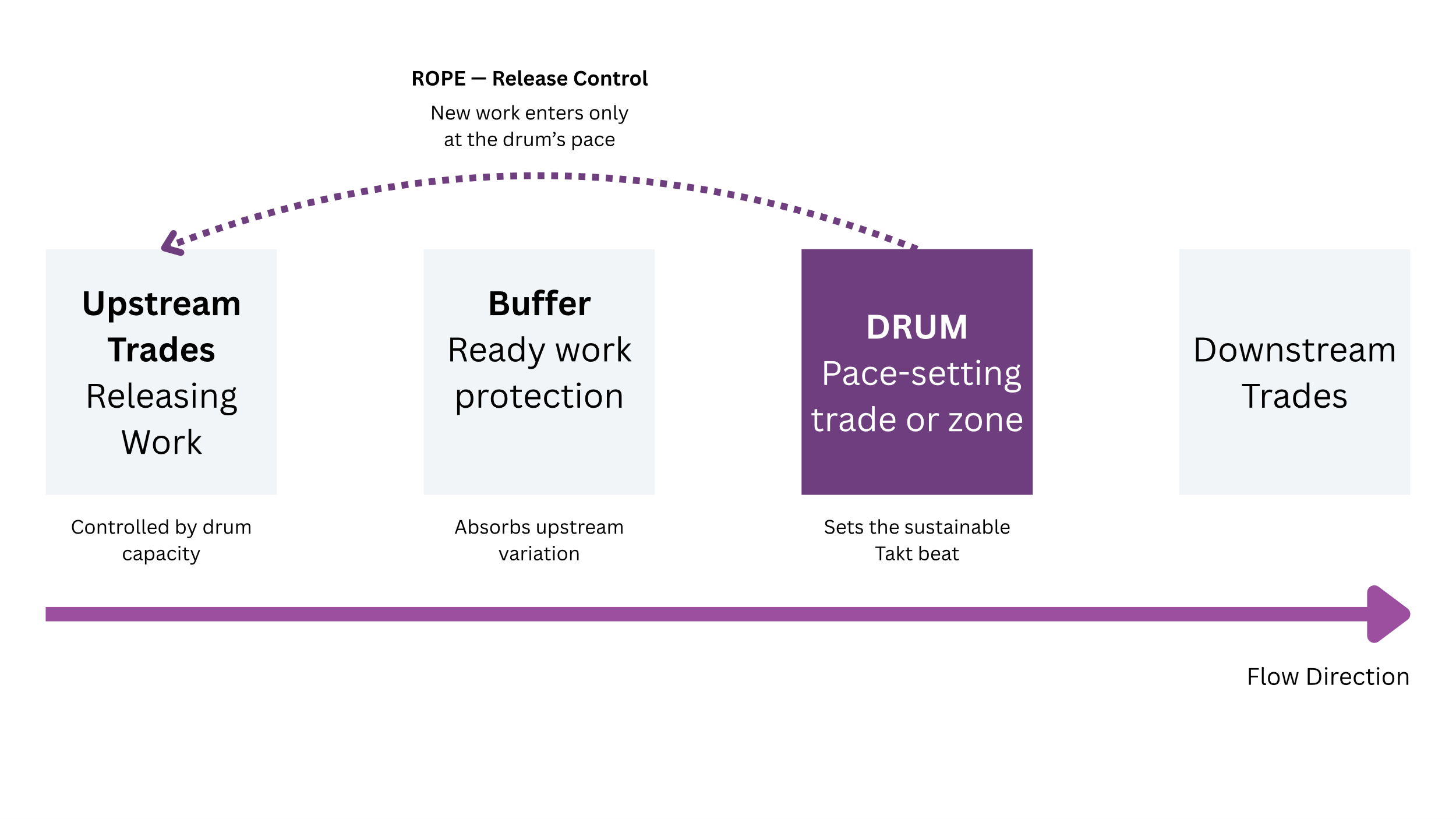
The drum sets the Takt beat, the buffer keeps it fed, and the rope controls how quickly new work enters the train.
Why Releasing Faster Than the Drum Only Builds Chaos
This is the single most counterintuitive piece, because every instinct on a deadline-driven team fights it: the way to go faster, instinct says, is to start more, push more in, keep everyone busy. In 1961, MIT’s John Little proved the opposite with a simple relationship that’s since become known as Little’s Law: the work in progress in a system, divided by how fast it flows out, determines how long things take to get through (Little, 1961). Flood the system with more released work and you don’t get more finished work — you get more work sitting in the system, taking longer to come out the other end. The constraint sets the rate of finished work, period. Everything released beyond what it can absorb just becomes inventory in front of it, aging, hiding defects, making the job feel frantic while it actually moves slower — the exact Work in Progress mess Takt planning exists to prevent.
The team that holds the rope ends up with a calmer site and a faster project than the team that floods the front of the line and calls the pile-up progress.
Drum-Buffer-Rope on Real Construction Projects
The crane as drum
On a constrained high-rise, the tower crane is the pace-setter — the whole job’s rhythm is set to crane capacity. The team protects it with a buffer of staged, rigged, ready-to-fly lifts, so the crane never hangs idle waiting on someone to finish prepping a pick. And they hold a rope on the deck: trades aren’t allowed to flood the floor with more material than the crane can place, because a deck buried in staged material faster than it can be set is just Work in Progress in the sky. Drum, buffer, rope — the crane runs full, steady, unstarved all day.
The buffer that saved the constraint
A pace-setting trade partner is given a deliberate cushion of ready work immediately ahead of it — a small backlog of fully prepared zones. Midweek, an upstream trade hits a snag and falls a day behind. On a no-buffer job, the constraint would have gone idle and the project would have lost that day for good. Instead, it kept working off its buffer of ready zones, never broke stride, and the upstream trade caught up before the cushion ran out.
The broken rope
A team with no release discipline lets every trade push work in as fast as possible — start everything, everywhere, as early as possible. The site feels frantic and looks busy, and it crawls. The constraint drowns under started-but-unfinished work, defects hide in the pile, nobody finds flow in the congestion. The fix wasn’t more people or more hours — it was a rope. They throttled the release of work back to the pace the constraint could absorb, the pile drained, and the job sped up by slowing the release down. It felt backward. It worked.
The Field Takeaway
Don’t just read this and nod. This week, before your next look-ahead: walk your zone map and name your drum out loud — the specific trade, the specific zone. Then go find its buffer. Not “we probably have some slack somewhere” — point to the actual workable backlog, the actual buffer wagon, the actual cushion of zones staged ahead of it. If you can walk straight to it, you have a buffer. If you must go looking, you don’t have one — you have a hope, and hope isn’t a protection strategy. Fix that gap before Friday, not after the constraint starves on the next hiccup.