
A Takt + Advanced Work Packaging (AWP) field guide condensed to the work that decides whether a phase succeeds before the first crew ever steps off. This is the Quick Read: the countdown, the five workstreams, and the field checklists required to release a phase on evidence. For the full treatment of why each move matters, see the full-length companion post, Before-Phase Planning.
The whole system is wasted if you release a phase on promises. Material “on the way.” An RFI “should be back any day.” A crew that’s “probably” the right size. None of that is readiness — it’s hope wearing a hard hat. And hope is not a make-ready strategy.
Before-phase planning is the work that makes every condition a Takt phase needs verifiably true before it’s released: the sequence and packaging validated on paper, every roadblock cleared in front of each trade, and the method proven on a mockup or first run. A confirmed plan proves the phase is right. Before-phase planning is what makes it run. They are two different jobs — and the second one is where the time is won or lost.
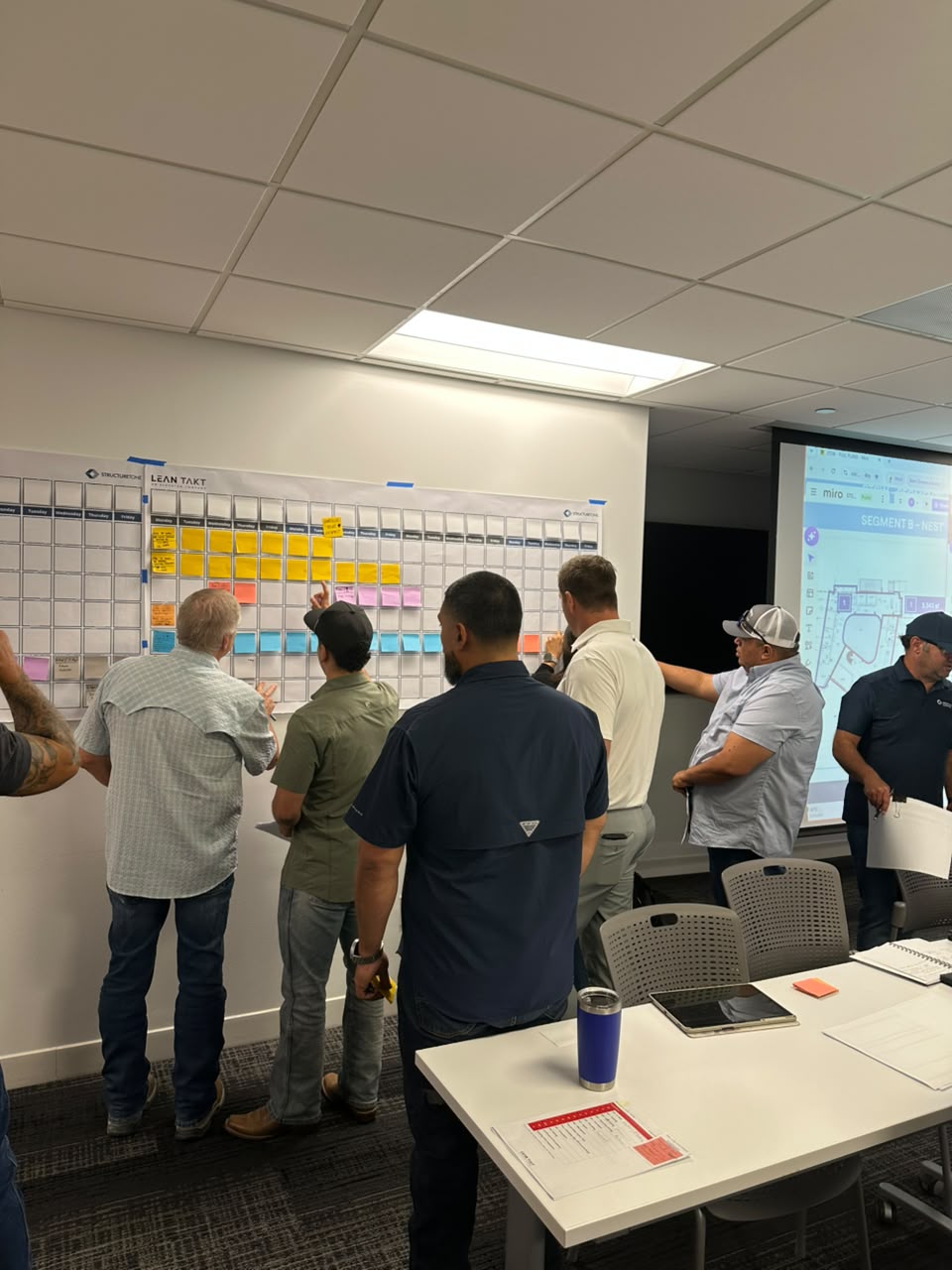
Before-phase readiness is verified collaboratively at the wall, where the team can see the sequence, commitments, and remaining gaps before release.
What’s the Difference Between Confirming a Plan and Preparing a Phase?
A pull plan tells you the sequence is sound. Before-phase planning verifies that the trades, materials, information, access, and approvals will actually be ready when the phase starts.
Glenn Ballard and Gregory Howell’s Last Planner® literature calls removable look-ahead obstacles “constraints.”¹ TPI calls them Roadblocks and reserves Constraint for systemic limits addressed earlier, at the pull plan. A Constraint is designed around. A Roadblock is cleared before release.
Constraint (TPI): a systemic limit that can’t be removed — planned around at the pull plan, ahead of time.
Roadblock (TPI): a removable obstacle blocking one already-planned activity — cleared in the look-ahead, right before release.
What’s the One Idea Behind Before-Phase Planning?
A Takt phase is a train. Once it leaves the platform, the next wagon is right behind the last one, so everything that decides whether the phase succeeds has to be decided before departure. Preparation is three jobs running at once:
- Validate — stress-test the sequence and packaging on paper, where changes are free.
- Make ready — remove every roadblock so nothing waitson information, materials, access, or approvals.
- Prove — rehearse the method and set the standard before the first cycle hardens into the way it gets done.
The five workstreams below are how those three jobs get carried out in the field.
What Has to Already Be Running Before Before-Phase Planning Starts?
Before-phase planning sits on top of your Lean planning system, not in place of it. If these three foundations aren’t running, fix that first — everything below assumes them.
| Foundation System Already in Place | What It Provides |
|---|---|
| Pull plan complete (~3 months ahead, adjusted to phase complexity and procurement risk) | Trades own the sequence and the promises |
| Pre-con meeting (~3 weeks before each trade mobilizes) | Scope, predecessors, conditions of satisfaction, constraints |
| Look-ahead planning on a rolling window | Roadblocks surfaced and knocked down weekly |
How Do You Work Backward from Phase Start?
Anchor preparation to the phase start date and work backward. Each gate has a deadline by which a slice of readiness is supposed to be true — miss a gate and the next one inherits the catch-up.
Match preparation to risk. The catalog below is a menu, not a mandate. A routine repeat phase with a proven crew may need only the three foundation practices plus a constraint countdown. A complex phase — new trade, long-lead equipment, concealed work — earns the full system. Prepare the dangerous parts heavily and the routine parts lightly.
| Workstream | ~12 weeks | ~8–10 weeks | ~5–6 weeks | ~4 weeks | ~2–3 weeks | ~1 week / Release |
|---|---|---|---|---|---|---|
| Confirm the Route | Route review | Assumptions checked | Sequence refined | Route confirmed | Production logic verified | Validated |
| Set the Standard | High-risk work identified | Standards defined | Mockup prepared | Method proven | Handoff standard confirmed | Accepted |
| Crew the Train | Trades identified | Rates verified | Manning committed | Crew confirmed | Lead crew confirmed | Ready |
| Stock the Stations | Long-lead needs identified | Orders placed | Kitting coordinated | Delivery plan verified | Lead materials confirmed | Staged |
| Clear the Track and Set the Signals | Roadblocks logged | Owners assigned | Early items cleared | Predecessor work confirmed | Full roadblock review | Go / No-Go |
What Are the Five Workstreams, and in What Order Do They Run?
The countdown tells you when readiness must mature. The five workstreams tell you what must mature. Inside the countdown, the moves group into five workstreams, ordered the way a railway prepares a line. Run them roughly in this order — in practice they overlap and feed each other. Tick an item only when it’s verifiably true, not promised, not ordered — true. Skip what a low-risk phase doesn’t need. Never skip by accident.
Workstream 1: Confirm the Route
Validate the sequence and packaging on paper — the cheapest place to find a mistake, the most expensive place to miss one. Resolve any remaining system Constraints here, while the plan is still on paper and changes are free.
☐ Fresh-eyes meeting held (outsiders stress-test the plan)
☐ Pre-mortem / risk register — mitigations and owners pre-assigned
☐ 4D sequencing reviewed against the model
☐ Advanced sequencing walked page by page through the drawings
☐ Advanced visualization used (foam, sand, physical / 3D model)
☐ CWP-to-IWP breakdown session held with the field; IWPs detailed
☐ IWP complexity classified low / med / high — prepare the high ones hardest
☐ Zone map + density / leveling analysis confirmed
☐ Buffers placed deliberately (capacity / time / space / plan)
☐ Multi-train design set — trades run at their natural rhythms
☐ Lego sheet built — the visual kit of parts and interfaces the phase is assembled from
☐ 3D model confirmed as the single source of truth
☐ Rules of Credit / Rules of Progress defined before day one
Workstream 2: Set the Standard and Rehearse the First Run
In a Takt phase, the first cycle is the template — a small early improvement multiplies across every zone after it. That’s the same logic Steven Spear and H. Kent Bowen documented at Toyota: treat every specification as a hypothesis, test it in the first cycle, and improve the method before it hardens into the standard.² Prove the method and fix “done” before that happens.
☐ Mockup built and reviewed — build it once before you build it a hundred times
☐ Benchmark / control sample + first-in-place inspection approved
☐ Conditions of Satisfaction / definition of done written and agreed
☐ Quality checklists per trade — quality built in at the wagon
☐ First Run Study planned — video the first cycle, improve the method
☐ Test-before-conceal sequencing checked (tested before backfill / close-up)
Workstream 3: Crew the Train
A phase runs at the speed of the crews in it, not the speed on the chart. Get the right people, at the right size, ready and committed.
☐ Non-participating trades identified and pulled into the room
☐ Trade crews visited on other sites — see the real rate, not the brochure
☐ Production rates verified — sustained, in your conditions
☐ Manpower commitment + ramp-up verified (manning histogram, not just a rate)
☐ Trade onboarding + workable backlog ready (a flex crew you can call)
☐ Foreman / trade replaced or supplemented if needed — decided before release, not three zones in
☐ AWP Champion + Workface Planning roles assigned and engaged (where AWP is part of the delivery system)
☐ Operations / commissioning team engaged early — build toward startup
☐ Pre-task planning / AHA / JHA + site-specific safety orientation done
Workstream 4: Stock the Stations
Make procurement feed production the way Taiichi Ohno described pull-based supply at Toyota: every station down the line stocked ahead of the next unit’s arrival, so nothing downstream ever waits.³ No wagon should ever wait on a material, a kit, or a fabricated assembly.
☐ Procurement aligned to phase dates — submittals approved, long-lead ordered
☐ Advanced kitting prepared per task / location / package — open a kit and work
☐ Room kitting coordinated on paper with all trades — load the room once, correctly
☐ Prefab / offsite fabrication confirmed — readiness, lead times, delivery in wagon order
Workstream 5: Clear the Track and Set the Signals (Go/No-Go)
This is the final make-ready — the countdown and the go/no-go. Every roadblock in front of every wagon gets removed and confirmed cleared before release, and “confirmed” means verified, not promised. The established name “constraint countdown” is retained here as the name of the process, even though most items tracked in this final look-ahead are Roadblocks in TPI terms. Run well, it plays a buffer-like role — protecting the phase start from unresolved variability the way Eliyahu Goldratt’s buffer protects a Theory of Constraints drum — not a formality you walk through on autopilot.⁴
☐ Constraint countdown running (6 / 4 / 2–3 / 1 week gates)
☐ Predecessor work complete — and the area punched and clean behind it
☐ Design info / RFIs answered and in hand
☐ Submittals & shop drawings approved — approved, not submitted
☐ Predecessor EWPs / PWPs closed — engineering issued, POs received
☐ Materials on site — verified and counted, not in transit
☐ Equipment staged and positioned where it will be used
☐ Scaffolding / access equipment staged — a step beyond “available”
☐ Tools, consumables, and full kit present — down to the fasteners
☐ Crew committed at the right size and start date — named, not assumed
☐ Information, permissions, and directives in hand
☐ Layout / control points set; survey control established
☐ Space and access available and committed to this work, this window
☐ Permits pulled — in hand, not in process
☐ Quality standard for the handoff defined and agreed
☐ GO / NO-GO poll passed on evidence
How Do You Actually Run the Go/No-Go Poll?
In the final week, call every item on evidence. Counted on site. Approved and in hand. Named and committed. Anything still phrased as “should,” “probably,” or “on the way” is a no-go. Clear it inside the buffer, or hold the start.
If your team needs help building this discipline: TPI provides the framework and education; LeanTakt and Elevate Construction support implementation, coaching, and project recovery. We are building people who build things, and the builders who hold the line at go/no-go are the ones whose first wagon rolls clean.
The Field Takeaway
On your next phase, print this checklist and walk it with the superintendent and the lead foreman two weeks before the planned start. For every item still marked as a promise rather than verified evidence, assign a name and a date to close it. If more than three items can’t be closed before the final week, the phase isn’t ready — hold the start, clear the items, and release only on evidence. Run that discipline consistently across three consecutive phases and you’ll see exactly how much time was being lost to first-wagon stops nobody was tracking.
As Jason says, “Plan it first, build it right, finish as you go.”
On we go.
Frequently Asked Questions
What is the difference between confirming a plan and preparing a phase?
Confirming a plan — checking the sequence, the line of balance, the buffers — tells you the phase is drawn correctly on paper. Preparing the phase is what makes it run: clearing every roadblock, verifying every resource, proving the method on a mockup. They’re two separate jobs, and the second is where the time is won or lost.
What is the go/no-go poll, and when does it happen?
The final verification gate, run in the week before the first wagon starts. Every item on the lead wagon’s checklist is called “go” only on verified evidence — material counted on site, RFI in hand, crew named. Any item still a promise is a no-go, and the start holds until it’s cleared.
How does a team match preparation to the risk of a given phase?
Start with the pre-mortem and buffer analysis to find where the phase is most likely to fail — a specific trade, a long-lead material, concealed work, a startup dependency. Classify IWPs low, medium, or high complexity, and prepare the high-complexity packages and high-risk trades hardest. Routine, low-risk phases need the three foundation practices and a constraint countdown.