
What Is Before-Phase Planning?
Before-phase planning is the work of making every condition a Takt phase needs verifiably true before the phase is released — validating the sequence and packaging, removing the roadblocks in front of each trade, and proving the method on a mockup or first run. Confirming a plan proves the phase is right; before-phase planning is what makes it run.
It sits on top of the lean planning system you already run — the pull plan, the pre-construction meetings, the look-ahead — and adds a risk-matched preparation effort across five workstreams, anchored by a constraint countdown and a go/no-go decision.
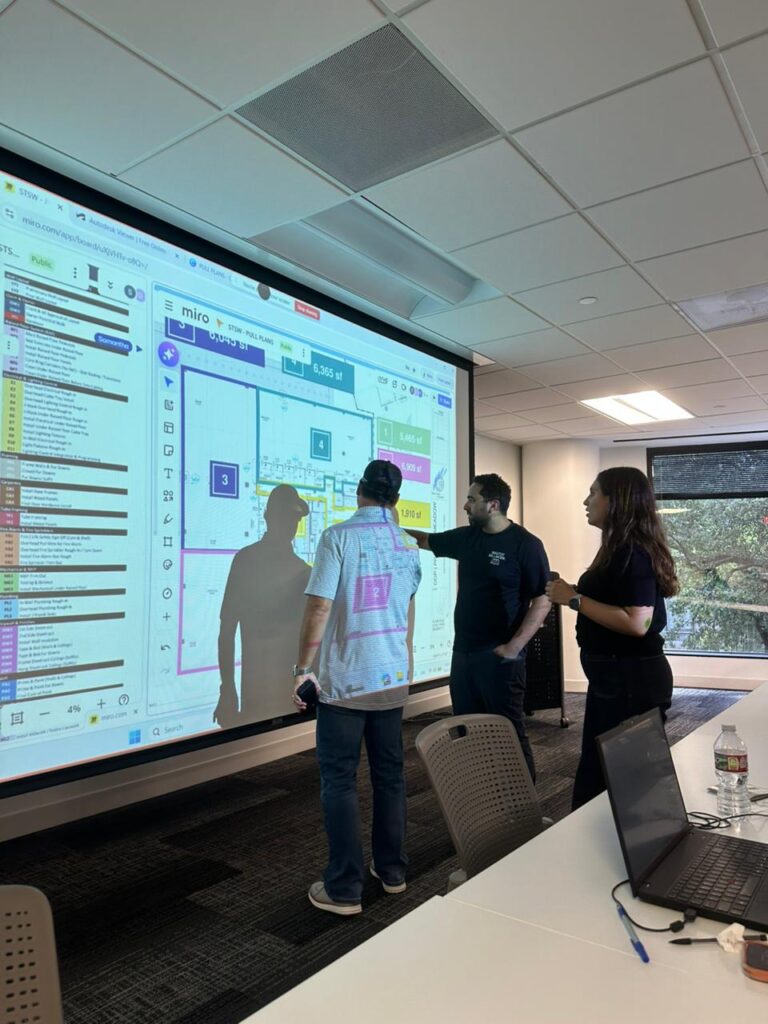
Before-phase planning begins by stress-testing the production plan with the people who will have to make it work.
The Departure Board
A Takt phase is a train running to a timetable. The wagons are your trades, the stations are your zones, and the cadence is the beat you set when you balanced the line. Once released, that train keeps moving — the next wagon is already right behind the last one. That’s the whole power of Takt: continuous, rhythmic flow through the building.
That power asks something in return. A crew that pulls into a zone and finds a forgotten bolt, an unanswered RFI, or a missing scaffold can’t wait it out without the whole train feeling it. Flow is a promise the whole line keeps together — kept before the train ever leaves the platform.
Think about how a railway actually operates. It doesn’t stock the dining car while the train is moving, or inspect the track with passengers aboard. Long before departure, someone walked the line: track clear and green, every station stocked and staffed ahead of arrival, the crew briefed, a dispatcher already war-gamed what happens if the weather turns.
The departure is the easy part. The preparation is the work.
That preparation has a name: before-phase planning. And it’s the single most underrated discipline in lean construction.
Why Is Preparation the Real Work?
Here’s the trap most teams fall into: they treat a confirmed plan as a finished plan — sequence checked, line of balance checked, buffers checked, phase called ready.
It isn’t. A confirmed plan and a prepared phase answer two different questions and mixing them up is how a well-drawn phase still stalls in week one.
By this point you’ve already done the hard analytical work:
- You confirmed the sequence from the pull plan.
- You confirmed the line of balance with the Takt calculator.
- You confirmed the buffers with a risk analysis.
- You optimized the phase by hunting bottlenecks and resolving system constraints.
All of that proves the phase is drawn right. None of it proves the phase will flow. The gap between a plan that’s correct on paper and a phase that actually runs is closed by one thing — preparation.
Takt makes readiness visible — and that's the gift
A traditional CPM schedule distributes float through a complex logic network, where it is difficult for field teams to see, protect, and manage deliberately. A crew that shows up unready can absorb the loss quietly, and the time disappears one day at a time until, somehow, you’re months behind and nobody can say when it happened.
A Takt phase is different in the best way: float is pulled out of the activities and parked deliberately in buffers, where you can see it and steer it. Eliyahu Goldratt made the same case for manufacturing in The Goal (1984), the book that popularized the Theory of Constraints: protect the system’s limiting point with a buffer placed on purpose, and you protect the whole system’s output. A Takt phase applies that logic zone by zone — readiness, or the lack of it, shows up early and clearly, while there’s still time to act.
That leads to the one question that governs everything: when the first wagon rolls into the first zone, is every condition it needs already true? Not promised. Not ordered. Not “being worked on.” True.
Before-phase planning is the systematic effort to make every one of those conditions true before release — and to prove the parts you’re least sure about before they can cost you anything.
Constraints vs. Roadblocks: A Definition Worth Getting Right
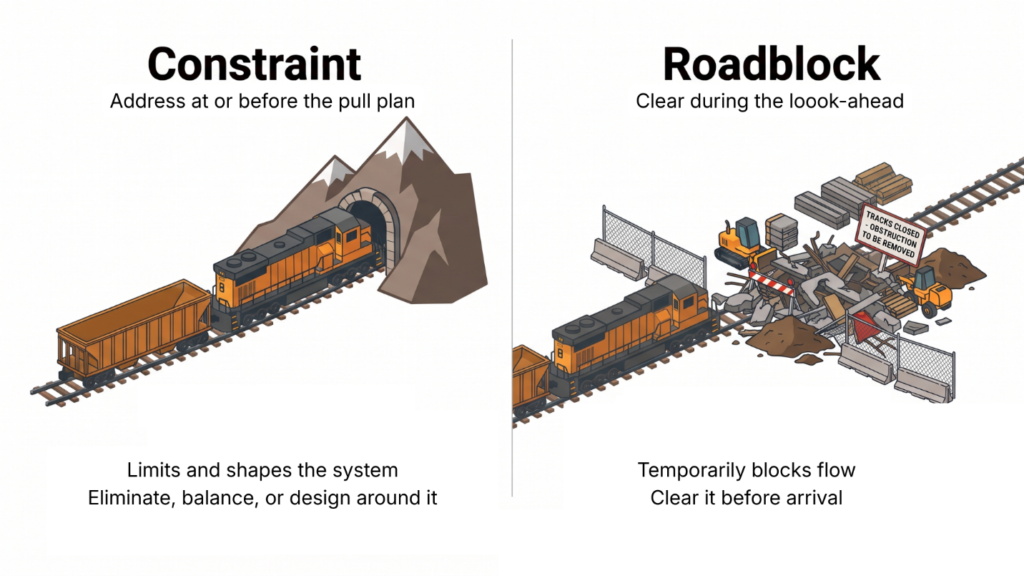
Constraints are system problems — sequence, Takt time, zoning, capacity, buffers — that are designed out and optimized ahead of the pull plan, as the production system is built. Roadblocks are temporary, removable items — an open RFI, a late submittal, a missing material, uncleared access — that surface after the pull plan and are knocked down week by week in the look-ahead. You optimize constraints once, up front; you remove roadblocks continuously, as make-ready work.
The distinction matters because the two are fixed at different times, by different means. A phase that keeps generating the same roadblock over and over is usually signaling an unresolved constraint underneath — fix the system, and the recurring roadblock stops appearing.
Worth naming the source, since the vocabulary diverges here on purpose. Glenn Ballard and Greg Howell, who built the Last Planner System and documented it in Shielding Production (1998) and Ballard’s The Last Planner System of Production Control (2000), use “constraint” for what TPI calls a Roadblock — their constraint analysis and constraint log both run inside the look-ahead. TPI splits the word in two: Constraint stays reserved for the systemic limits addressed at the pull plan; Roadblock names what Ballard and Howell’s look-ahead clears. Same discipline, sharper vocabulary for a phase-based system.
Three jobs running at once
It helps to see preparation as three jobs running in parallel:
- Validate — stress-test the sequence and packaging until you trust them, on paper, where changes are free. (Also where remaining system constraints get resolved.)
- Make ready — remove every roadblock in front of every wagon so nothing waits on information, materials, access, or approvals.
- Prove — rehearse the method and set the standard before the first real cycle hardens into the way the rest of the phase gets built.
Every move that follows lands in one of those three buckets.
What Three Practices Does Before-Phase Planning Assume?
Before-phase planning isn’t a replacement for the lean planning system you already run. It’s a layer that sits on top of it. Three practices are assumed to already be in place:
- The pull plan, about three months ahead. The trades build the handoffs backward from the milestone, so the sequence and the promises are theirs. This is where the phase first becomes real to the people who will run it — and where system constraints get designed out.
- Pre-construction meetings, about three weeks before every wagon. Each trade walks its scope, predecessors, conditions of satisfaction, and roadblocks before it’s due to start — not on the morning it starts.
- Look-ahead planning. The rolling six-week window where roadblocks are surfaced and knocked down week by week, so only ready work is ever committed.
If those three aren’t running, fix that first. What follows separates a team that merely schedules well from one that arrives ready.
The Before-Phase System: Five Workstreams
The moves are grouped into five workstreams, ordered the way a railway prepares a line. Run them roughly in this order, though in practice they overlap and feed each other.
1. Confirm the Route
Validate the sequence and packaging on paper, where changes cost nothing — and resolve any remaining system constraints here. This is the cheapest place to find a mistake and the most expensive place to miss one.
- Fresh-eyes meeting — outsiders who aren’t attached to the plan stress-test it; builders can’t see their own blind spots.
- Pre-mortem with pre-assigned mitigations — assume the phase failed, work backward to why, and assign the mitigation and owner now, not in the scramble later.
- 4D sequencing — tie the schedule to the model. Crane and laydown collisions invisible in a bar chart become obvious when you watch the building grow.
- Advanced sequencing, page by page — walk the area drawings at the detail the field will feel, not the level the bar chart shows.
- Advanced visualization — foam, kinetic sand, or physical models. A table the team can point at surfaces arguments a screen hides.
- Detailed IWP breakdown — break the work into Installation Work Packages a crew can finish in a known, short window with everything attached. Run it as a CWP-to-IWP session with super, general foreman, AWP manager, and field together; ownership is half the value.
- Classify IWP complexity — low, medium, or high. Complexity isn’t duration; a short package can still be high-risk.
- Zone map + density/leveling analysis — confirm zones are sized so work and manpower are level across them. A lumpy density map means the cadence fights you zone to zone.
- Deliberate buffer placement — decide where capacity, time, space, and plan buffers sit. Buffers aren’t float you forgot to remove; they’re protection placed on purpose.
- Multi-train design — let trades run at their natural rhythms instead of one forced beat. A fast and a slow trade on separate, offset trains beats jamming both into one cadence.
- Build your Lego sheet — the single coordinated reference showing how standardized work blocks stack and repeat across zones.
- Confirm the 3D model as the single source of truth — data tagged, quantities and IDs aligned, before anyone plans off it. Two different models means two plans.
- Define Rules of Credit — decide how percent-complete is earned before day one, or every status meeting becomes an argument about what “done” means.
2. Set the Standard and Rehearse the First Run
Prove the method and fix the definition of “done” before the first real cycle hardens into the way the whole phase gets built.
Steven Spear and Kent Bowen’s 1999 Harvard Business Review study of Toyota, Decoding the DNA of the Toyota Production System, found every task and handoff on the line specified in advance — content, sequence, timing, outcome — never left for the worker to interpret in the moment. Conditions of Satisfaction and handoff acceptance criteria are that same discipline, written for a jobsite handoff instead of an assembly station.
- Mockup — build it once, for real, before you build it a hundred times, while mistakes are still cheap.
- Benchmark / first-in-place inspection — approve the real standard on the actual first installation. Now everyone has a physical reference for “right.”
- Conditions of Satisfaction + handoff acceptance criteria — write down exactly what the receiving trade is entitled to expect. A handoff without acceptance criteria is a disagreement waiting to happen.
- Quality checklists per trade — turn the conditions of satisfaction into a checklist each trade signs off on its own work, so quality is built in at the wagon, not inspected in at the end.
- First Run Studies — video the first cycle of a repeating task and improve the method before it sets. That cycle becomes the template for every zone after it, so a five-minute fix multiplies across the whole line.
- Test-before-conceal check — flag any work that gets hidden, and confirm the test-and-accept step is sequenced before the concealment, not discovered after it.
3. Crew the Train
Get the right people, at the right size, ready and committed — because a phase runs at the speed of the crews in it, not the speed on the chart.
- Identify non-participating trades — find whose work touches the phase but isn’t yet in the planning room, before their absence becomes the bottleneck nobody owned.
- Visit trade crews on other sites — watch the actual crew on another job first. You learn real production rate and readiness far better on-site than from a bid.
- Verify production rates — confirm the rate your line of balance assumes is one the crew can actually hold, sustained, in your conditions, not a best-day number from a brochure.
- Manpower commitment and ramp-up verification — a manning histogram, not just a rate. The crew must ramp to the required headcount on the week it’s required, and hold it.
- Trade onboarding + workable backlog — a proven, trained, fully onboarded flex crew, plus a backlog of ready work to feed it. Capacity you can call on is a buffer; capacity you have to go find is a delay.
- Make the personnel calls early — if a foreman can’t hold the cadence or a trade can’t demonstrate the rate, decide before the phase, not three zones in.
- Assign the AWP Champion and Workface Planning roles — name who owns the packaging discipline and the workface plans, so the system has an owner, not just a binder.
- Involve operations and commissioning early — bring end-users and commissioning in before the phase so the work is built toward startup, not merely toward “installed.”
- Pre-task planning + safety orientation — every incoming trade plans the task, the hazards, and gets oriented before it starts. Safety readiness is phase readiness.
4. Stock the Stations
Make procurement feed production. Every station down the line is stocked ahead of the train’s arrival, so no wagon ever waits on a material, a kit, or a fabricated assembly.
Taiichi Ohno built this principle into Toyota at the parts-bin level, documented in his 1988 book Toyota Production System: nothing arrives before the line needs it, nothing sits staged waiting to be used. Kitting is that same discipline on a jobsite — material shows up in the sequence the wagons consume it, not the sequence it happened to get delivered.
- Procurement-feeds-production — treat procurement as a production input, not a back-office function. Submittals approved and long-lead items ordered against the phase dates, so arrival is pulled by the schedule, not discovered by it.
- Advanced kitting — pre-assembled, bagged, staged kits per task, location, or package. The crew opens a kit and works; it doesn’t hunt or stage mid-cycle.
- Room kitting — full material placement coordinated on paper, per room or zone, with all trades together, before anything moves. The room is loaded once, correctly.
- Prefabrication — mod walls, MEP racks, headwalls, and similar assemblies built offsite. Confirm fab readiness, lead times, and delivery sequence — prefab only helps if it arrives in the order the wagons consume it.
5. Clear the Track and Set the Signals
This is the final make-ready — the countdown and the go/no-go. Every roadblock in front of every wagon is removed and confirmed cleared before release. “Confirmed” means verified, not promised.
- Run the constraint countdown — work the look-ahead as a clock, clearing roadblocks against fixed gates: materials and scaffold at five to six weeks, prior work and permits at four weeks, a full review at two to three weeks, final validation at one week. (The ritual keeps its name, the “constraint countdown,” but the late-stage items it clears are roadblocks — the true constraints were resolved back in Confirm the Route.)
- Track predecessor work complete — and confirm the area is punched and clean behind it. “Done” but not clean is not ready.
- Confirm design info and RFIs answered — every question the work depends on is answered and in hand, not open in someone’s inbox.
- Confirm submittals and shop drawings approved — approved, not submitted. An unapproved submittal is a roadblock wearing a costume.
- Confirm predecessor EWPs and PWPs closed — engineering issued, purchase orders received; field readiness depends on the whole mini-project.
- Confirm the physical reality — materials verified and counted, equipment and scaffolding staged, tools and consumables on hand. Access you have to build is access you don’t yet have.
- Confirm the people and permissions — crew committed at the right size and date, directives in hand, survey control established, space and access committed, permits pulled.
- Confirm the quality standard for the handoff — the receiving condition written down and agreed before the work starts, so “done” is a fact, not an opinion.
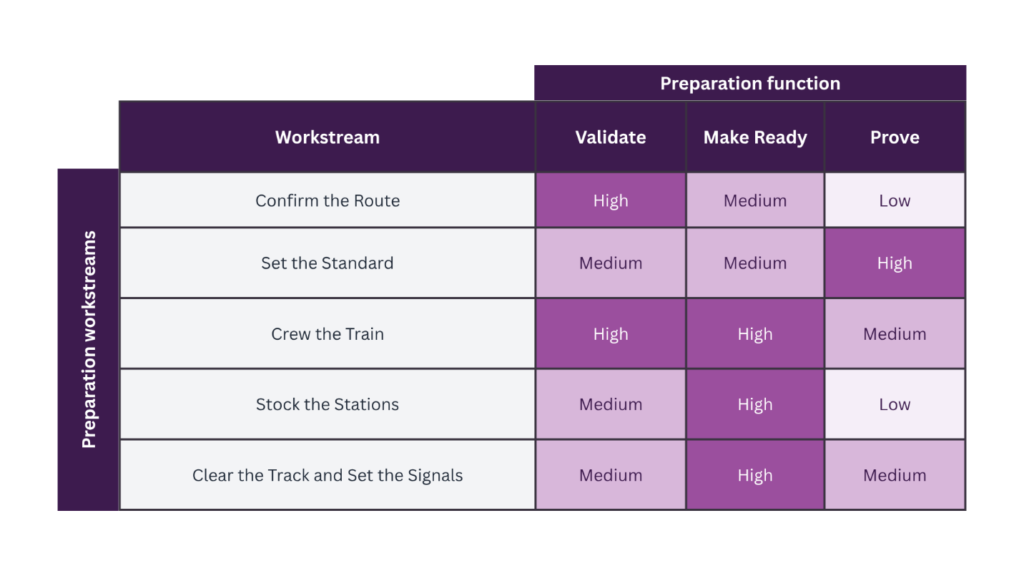
Before-phase planning organizes what must be prepared into five workstreams. Across them, teams validate the plan, make the work ready, and prove the method.
How Do You Actually Run Before-Phase Planning?
The catalog above is a menu, not a mandate. A simple, low-risk phase needs a handful of these moves; a complex, first-of-its-kind phase with a new trade needs most of them. The skill is matching preparation to risk.
Step 1 — Pick the phase and triage the risk
The catalog above is a menu, not a mandate. A simple, low-risk phase needs a handful of these moves; a complex, first-of-its-kind phase with a new trade needs most of them. The skill is matching preparation to risk.
Step 2 — Build the countdown
Anchor preparation to the phase start and work backward from it, gate by gate, so every workstream above lands at the moment it needs to.
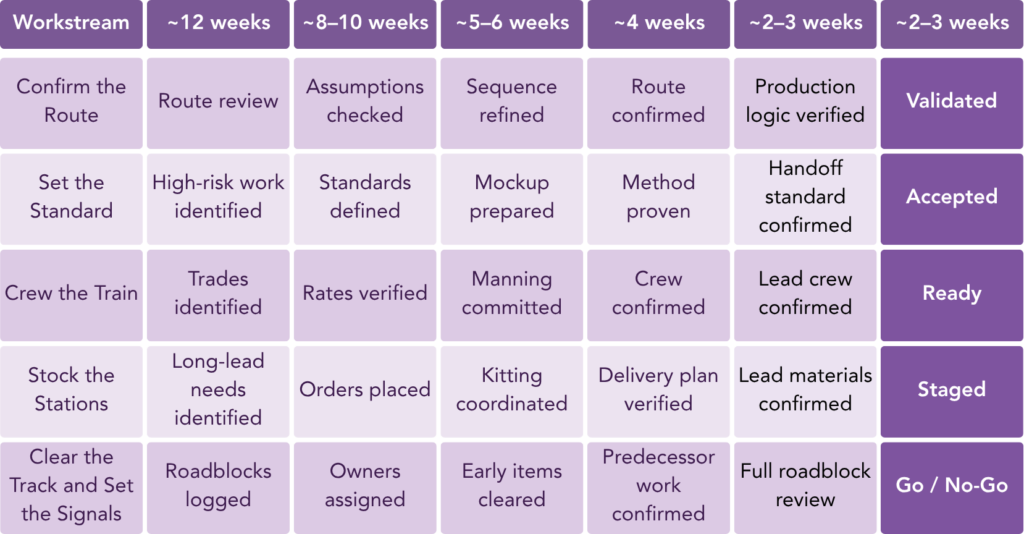
Five workstreams mature in parallel as the phase approaches release. Timing shown is a workable default. Match each gate to the phase risk and release only on verified evidence.
Step 3 — Run it as a standing cadence, not an event
Before-phase planning is a campaign, not a meeting. Put two questions on the agenda every cycle: what is the plan, and what is the logistics?
- Make it visible. A war-room board puts every phase, prep move, and open roadblock where the team can argue about it standing up.
- Give every item an owner and a due-clear date. “Confirm materials on site” isn’t a task until a name and date are attached.
- Track predecessor completion and area-clean-behind as living data. Readiness decays; a zone confirmed ready six weeks out can be cluttered again by the time the wagon arrives.
Step 4 — Hold the line at go/no-go
When the countdown reaches the final week, walk the lead wagon’s roadblocks item by item: material on site and counted, RFI answered and in hand, crew named and committed. What you don’t do is release the train and hope the station gets stocked while it’s rolling. Hope is not a make-ready strategy.
The go/no-go discipline: Treat the final week like a launch poll. Call each item “go” only on verified evidence. If an item is still a promise, it is a no-go — and a no-go is a decision to clear it or to hold, never to hope.
The Field Takeaway
Don’t just read this and nod. Run it.
Before your next phase releases, pull the lead wagon’s IWP list and grade every item — every material, submittal, RFI, crew commitment — red, yellow, or green, on verified evidence only. No “should be here Thursday.” No “the sub says it’s on the truck.” Green means you’ve seen it, counted it, or signed it.
Anything you can’t honestly call green two weeks out isn’t a schedule problem yet — it’s a preparation problem, and still cheap to fix. Leave it un-graded until go/no-go week and it becomes the roadblock that stops the whole train, and by then it isn’t cheap anymore. That one exercise, run honestly and early, is before-phase planning in miniature.
Appendix — The Before-Phase Checklist
A printable working checklist, grouped by workstream. Tick an item only when it is verifiably true — not promised, not ordered, true. Skip the moves a low-risk phase does not need; never skip them by accident.
Appendix — The Before-Phase Checklist
- Pull plan complete (~3 months ahead)
- Pre-con meeting scheduled ~3 weeks before each wagon
- Look-ahead planning running on a rolling window
Confirm the route (validate + resolve system constraints)
- Fresh-eyes meeting held
- Pre-mortem / risk register with mitigations and owners assigned
- 4D sequencing reviewed
- Advanced sequencing walked page by page
- Advanced visualization (foam / sand / 3D model) used
- IWPs detailed and broken down (CWP-to-IWP session held)
- IWP complexity classified (low / med / high)
- Zone map + density / leveling analysis confirmed
- Buffers placed deliberately (capacity / time / space / plan)
- Multi-train design set
- Lego sheet built
- 3D model confirmed as single source of truth
- Rules of Credit / Rules of Progress defined
Set the standard & rehearse
- Mockup built and reviewed
- Benchmark / control sample + first-in-place inspection done
- Conditions of Satisfaction / definition of done written and agreed
- Quality checklists per trade prepared
- First Run Study planned (video first cycle, improve method)
- Test-before-conceal sequencing checked
Crew the train
- Non-participating trades identified and engaged
- Trade crews visited on other sites
- Production rates verified (sustained, in your conditions)
- Manpower commitment & ramp-up verified (manning histogram)
- Trade onboarding + workable backlog ready (flex crew)
- Foreman replaced if needed
- Trade replaced if needed
- Supplemental manpower lined up if needed
- AWP Champion & Workface Planning roles assigned
- Operations / commissioning team engaged early
- Pre-task planning / AHA / JHA + safety orientation done
Stock the stations
- Procurement aligned to production dates (submittals approved, long-lead ordered)
- Advanced kitting prepared (per task / location / package)
- Room kitting coordinated on paper with all trades
- Prefab / offsite fabrication confirmed (readiness, lead time, delivery sequence)
Clear the track & set the signals — roadblock removal (go / no-go)
- Constraint countdown running (6 / 4 / 2–3 / 1 week gates)
- Predecessor work complete + area punched/clean behind
- Design info / RFIs answered and in hand
- Submittals & shop drawings approved
- Predecessor EWPs / PWPs closed
- Materials on site (verified, counted)
- Equipment staged and positioned
- Scaffolding / access equipment staged
- Tools, consumables, and full kit present
- Crew committed at the right size and start date
- Information, permissions, and directives in hand
- Layout / control points set; survey control established
- Space and access available and committed
- Permits pulled
- Quality standard for the handoff defined
- GO / NO-GO poll passed on evidence
If the first wagon rolls into the first zone and every box above that this phase needed is true, the phase will run the way it was drawn.