
How Do You Optimize a Construction Project So It Doesn’t Fall Apart?
This guide lays out the build order: the Six Foundations of Flow ready the people and the site, the Takt Rules of Flow ready the production plan, and production-system thinking tells you which lever to pull when you want to go faster.
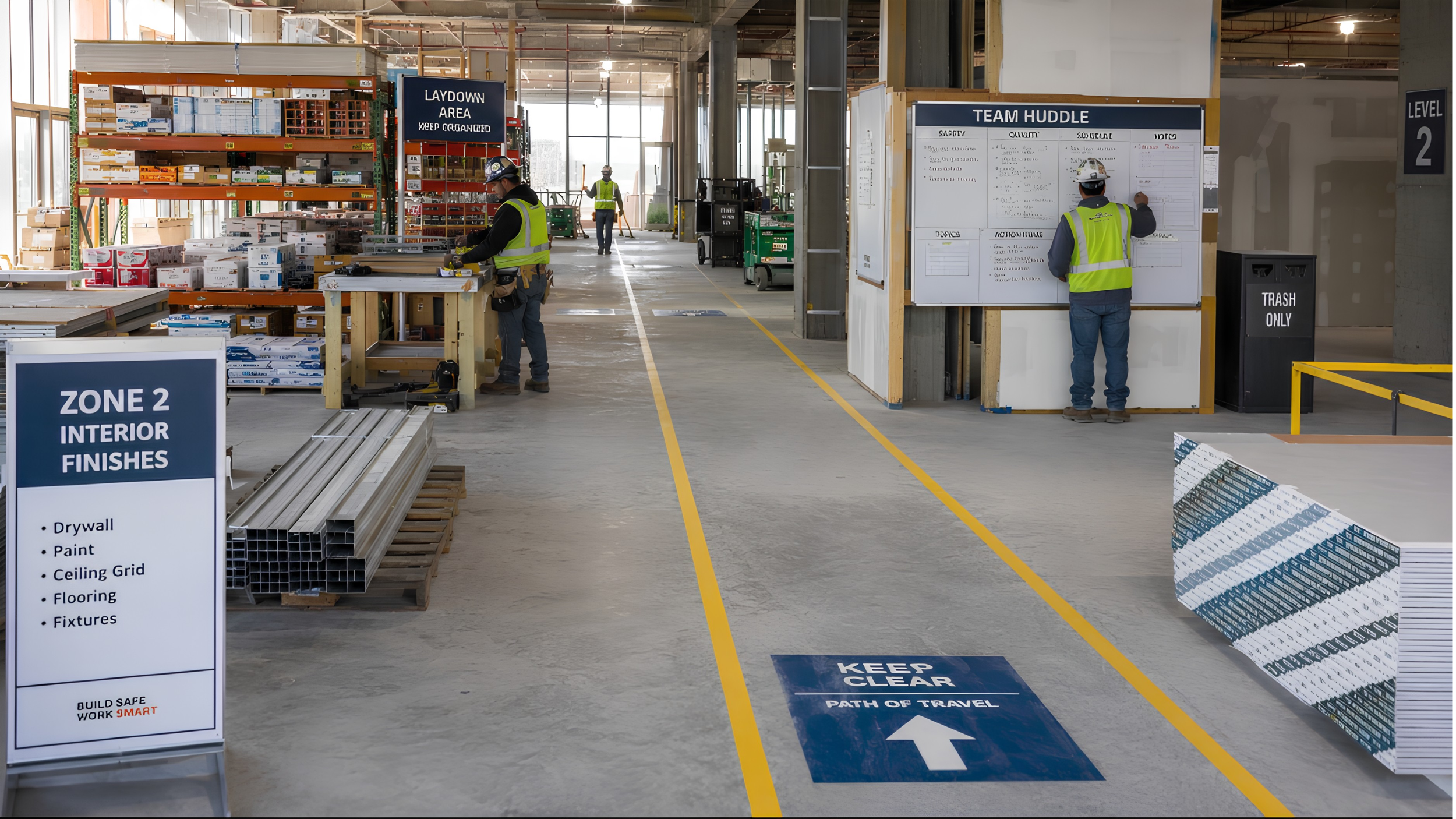
Flow starts with stability: a clean, organized site, visible zones, and information placed where the work happens.
There Are Only Two Ways This Job Ends
Every project ends one of two ways: optimized so it never falls apart, or recovered after it has. This post is about the first.
Under pressure, the instinct is to rush, push, and panic — add people, open more work, drive harder. The opposite premise built this framework: engineer the production system instead of typing more aggressive dates.
Here’s the hard truth underneath it: you will never have productivity above the stability of the jobsite. Stabilize first, then flow, then accelerate. Hold the job clean and steady and it finishes when the plan says it will. Rush, push, and panic, and it finishes late — there is no third outcome.
What’s the Difference Between Driving and Pushing?
You drive the project — you keep the calendar moving steadily and predictably. You do not push the people — you don’t advance the work at their expense. Healthy urgency isn’t intensity — it’s a clear, reliable rhythm the crew can count on and plan their day around.
A crew under a leader who drives goes home at a reasonable hour with its health and dignity intact. A crew under a leader who lets the job drift, then crunches at the end, loses its family time to rework and burns out. A system that flows protects people; a system that’s pushed grinds them down.
What Are the Six Foundations of Flow?
Every optimized project — and every successful recovery — rests on the same six Lean principles, applied in order. The first three are prerequisites, not options.
The Six Foundations of Flow, in order: Respect for People, Stability, and One-Process Flow (the prerequisites) — then Flow, Visual Systems, and Continuous Improvement (what compounds once those hold).
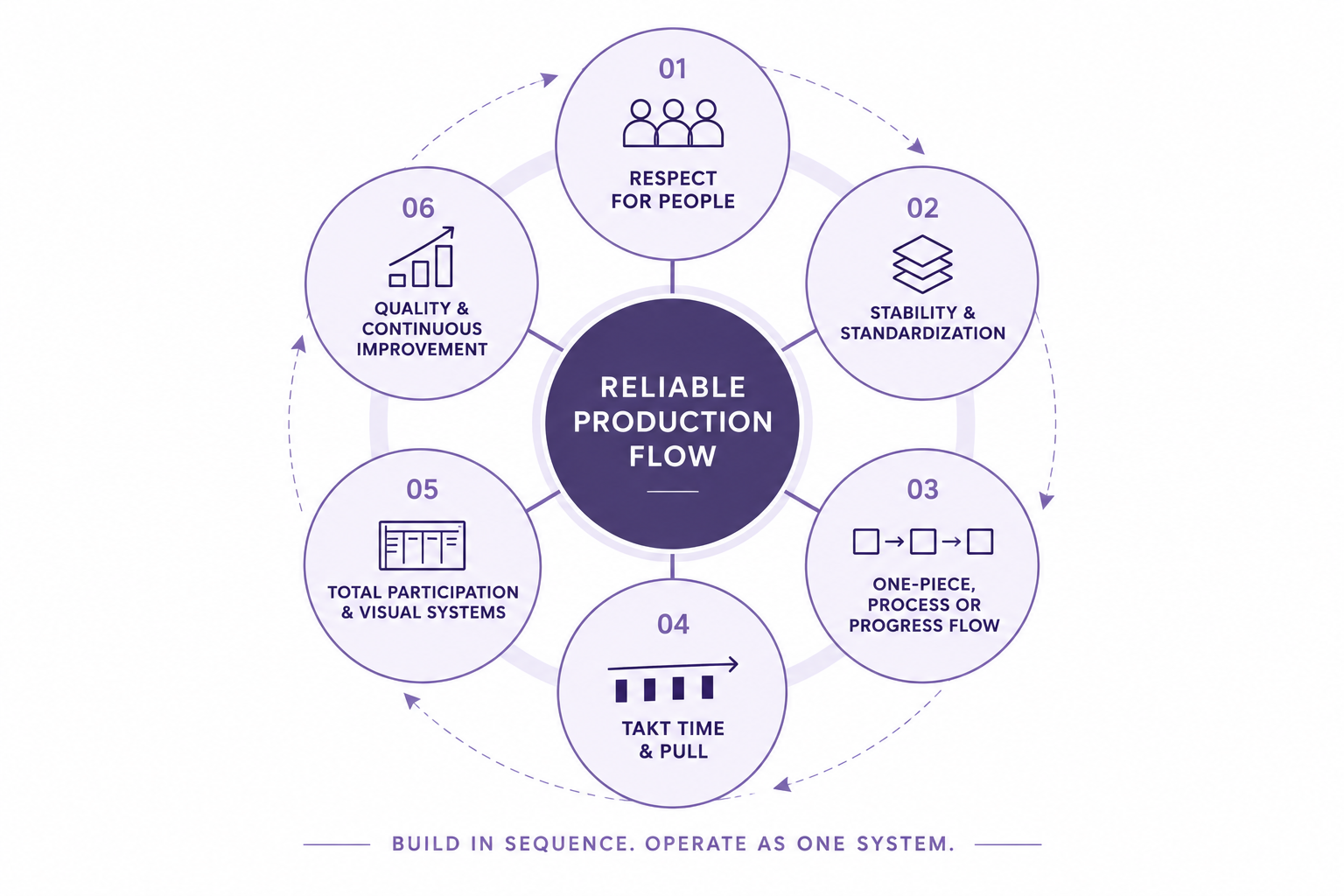
The Six Foundations must be built in order: respect, stability, and one-process flow create the conditions for flow, visual systems, and continuous improvement.
1. Respect for People
Pissed-off people will not help you build this job.
The moment you arrive, get every human system running: morning worker huddles, afternoon foreman huddles, clean bathrooms, a decent lunch area, an equal chance to raise issues. Celebrate milestones.
People who feel respected build something great with you; people who feel abused quietly let the job sink. That’s the precondition for every technique that follows.
2. Stability
You cannot build productivity on top of chaos.
Stability means clean, safe, and organized. If the site is dirty, stop and reset the whole jobsite before pushing any work — everybody stops, everybody resets. Run 6S: Sort what you don’t need, Set everything in its place, Shine the site, Standardize the system, Sustain the standard, and keep Safety at the center. This is the principle leadership attacks first: “We don’t have time to clean, just get them started.” Hold the line. Taiichi Ohno, in Toyota Production System: Beyond Large-Scale Production (1988), named overburden — muri — as one of the three enemies of flow, alongside variation and waste. A dirty site is overburden made visible, and it caps productivity before a single trade swings a hammer.
3. One-Process Flow
Plan, build, finish. Plan, build, finish.
One-process flow is the discipline of finishing what you start. Never start an activity, of any size, without a plan (a pre-con). Build to it, inspect as you go, finish before moving on.
The failure mode: people told to “go build stuff” with no plan, so it comes out wrong and gets abandoned unfinished — accumulating Work in Progress that only stretches the project. Get good at finishing, not starting.
4. Flow
When projects fail, there are people everywhere.
Re-establish flow by sequencing people through the building along a clear path. Best done on Takt time; if you can’t get there yet, at least run pull.
Above all: do not push one contractor on top of another. Let the predecessor finish the zone, then pull the successor in — trade-stacking is how you create the very chaos you’re trying to avoid.
5. Visual Systems
See as a group, know as a group, act as a group.
Once respect, stability, and flow are established, make the plan visible: huddle boards, a visual production plan, wayfinding signage. The goal is total participation — everyone sees the plan, sees their place in it, and acts on it as a group. Flow you cannot see is flow you cannot hold.
6. Continuous Improvement
Once the system is running, improve from there. Implement first, then refine. Respect, stability, and one-process flow are always the prerequisite; continuous improvement is what compounds the gains afterward.
What Are the Takt Rules of Flow?
The Six Foundations make the site and the people ready. The Takt Rules of Flow make the production plan ready — keeping work moving diagonally through the building, one crew per zone, the right distance apart, never stacked.
You rarely need to invent anything new to fix a struggling plan — you restore these rules. A plan that’s lost its flow has almost always broken several: logic ties dissolved to make a baseline work, durations shortened past what the means support, trades stacked, buffers stripped, Work in Progress released beyond capacity. Put the rules back and flow returns.
Always
- Maintain diagonal trade flow in a time-by-location format.
- Work in One-Process Flow — each crew flows zone to zone through the project.
- Pre-kit work before it begins; only start what can be finished.
- Use buffers in the production plan.
- Keep a workable backlog for swing capacity.
- Analyze the Path of Critical Flow — activity, duration, logic tie, sequence, line of balance, and a buffer.
- Run the trades as a train — same speed, appropriate distance apart.
- Align Work in Progress to capacity, and flow by fixing problems.
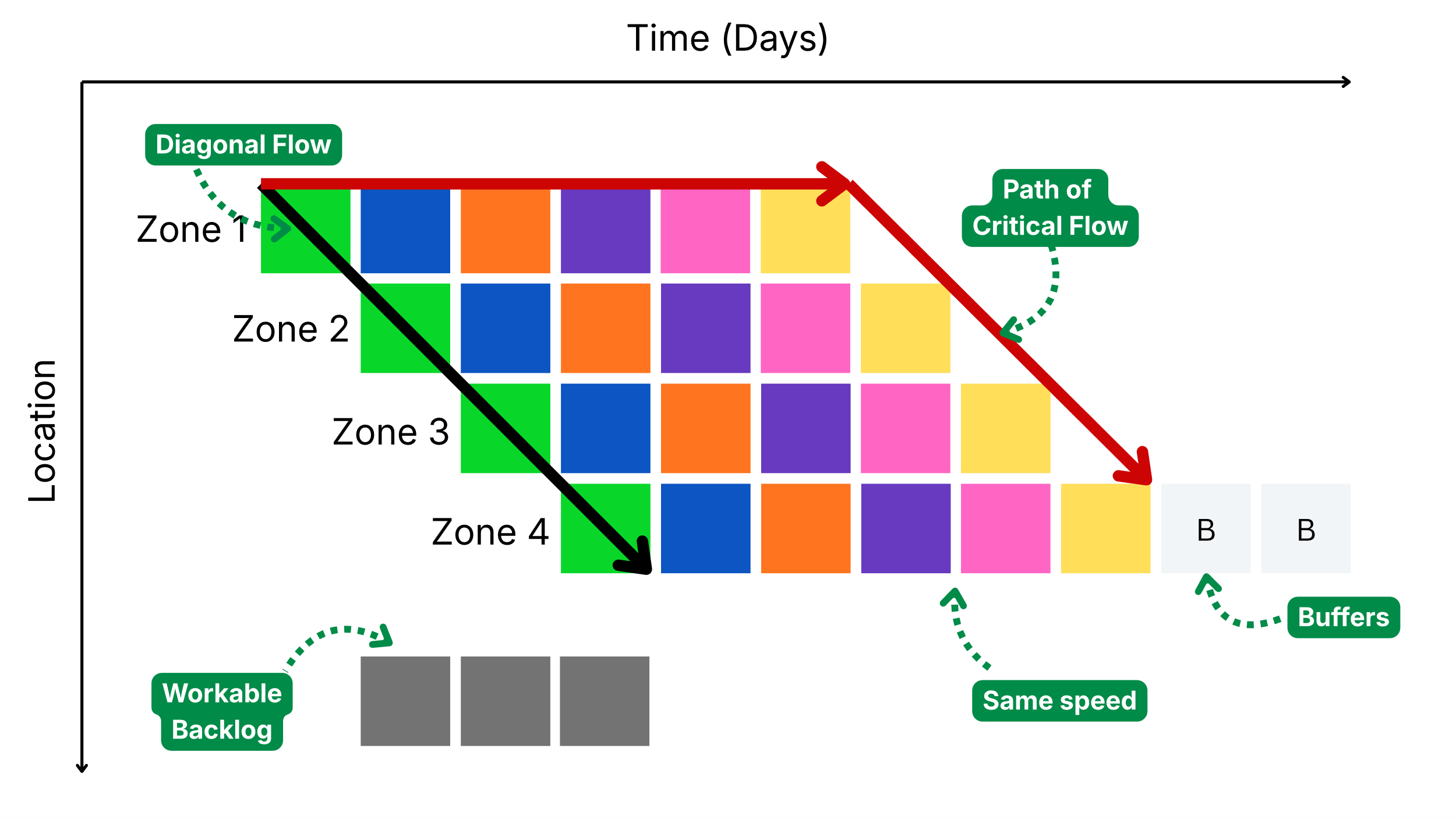
One crew per zone, moving at a coordinated pace with protected spacing and buffers.
Never
- Trade-stack or trade-burden — never expect a trade in two places at once.
- Irresponsibly dissolve logic ties — use real data and adjust them instead of deleting them to make a date work.
- Shorten a trade’s durations without permission — shorten the in-zone cycle time instead, through better design, pre-fabrication, delivery, logistics, and preparation.
- Fix and freeze the plan to align with a baseline.
- Push trades to work faster to make up time — flow by fixing problems instead.
Two of these rules aren’t TPI inventions. Glenn Ballard and Gregory Howell described the same shielding logic in 1998, in “Shielding Production: Essential Step in Production Control” — screening work before it’s released to a crew and holding backup work in reserve. TPI runs that same discipline inside a Takt-paced, zone-based plan instead of a generic weekly work plan — tighter geometry, same principle.
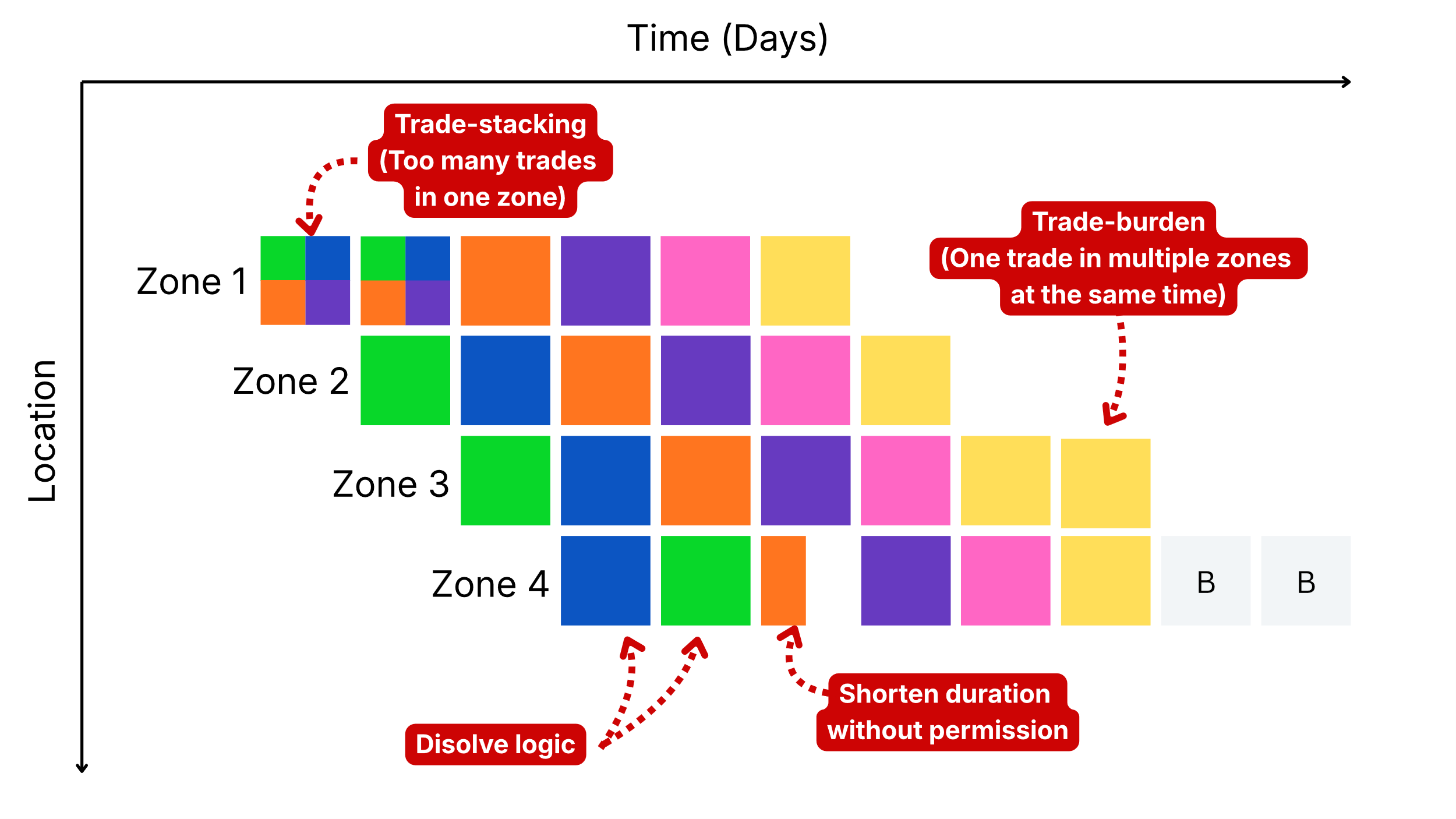
Flow breaks when trades are stacked, crews are burdened across multiple zones, logic is removed, or durations are shortened without changing the work.
Path of Critical Flow, Not Critical Path
This is the rule that anchors all the others. A Path of Critical Flow — not a bare critical path — is what lets you steer the job and defend a delay if it comes to that. Where CPM collapses a project into a single fragile chain of zero-float activities, the Path of Critical Flow carries the full production reality: activity, duration, logic tie, sequence, line of balance, and buffer.
Eliyahu Goldratt, in Theory of Constraints (1990), showed that a system’s output is governed by whatever is actually limiting it, not by an arbitrarily drawn chain of dependencies. CPM can recalculate its critical path with every update — that’s not the flaw. The flaw is what the calculation is blind to: logic ties track sequence, not the spatial reality of crews moving through zones, so the critical path can shift correctly on paper while trade-stacking or broken flow goes undetected in the field. The Path of Critical Flow tracks that production reality directly — zone by zone, train by train — instead of inferring it from a logic diagram.
Why Optimize the Production System Instead of the Schedule?
Here’s the most important mental move in optimization: stop chasing the schedule directly, and start engineering the system that produces it.
A normal schedule says: “Activity A starts here, Activity B finishes there, we are X days late.” That’s the what, not the why. See a project instead as a production system, almost like a factory: work enters, waits, is processed, waits again, and eventually becomes completed work — the result of how much you release, how fast the bottleneck processes it, how much sits unfinished, how variable the work is, and how big your handoff batches are.
This is the domain of Project Production Management (PPM) and Operations Science — the science of why a schedule behaves the way it does. Takt is the practice: how a construction team actually controls those variables in the field. PPM is the why; Takt is the how.
An Operating System for Flow
The Takt Production System isn’t a scheduling trick. It’s a complete operating system aligning time, space, sequence, capacity, procurement, logistics, and control into one whole — built to create stable flow, expose problems early, and deliver predictably, without heroics. A pushed project survives on overtime and luck; an engineered one simply runs.
None of this science is new. Frank Woollard proved flow production could work in low-volume, high-variation manufacturing years before Toyota, laid out in his 1954 book Principles of Mass and Flow Production, drawn from his work at Morris Motors in the 1920s. W. Edwards Deming, in Out of the Crisis (1982), made variation itself the target of management — the same instinct behind holding a stable, 6S’d site instead of tolerating chaos. Ohno’s overburden sits alongside variation and waste as the three things a production system has to eliminate. John D. C. Little, in his 1961 paper “A Proof for the Queuing Formula: L = λW,” gave the industry the mathematical relationship between Work in Progress, throughput, and lead time — the foundation the Takt Rules of Flow build on when they call for keeping Work in Progress aligned to capacity. The work is integrating all of it into one system that holds under pressure on a real jobsite.
Why Not Just Push the CPM?
Push-based Critical Path Method works against flow: it worships early starts and drives Work in Progress up, tempting teams to abandon the plan the moment schedule pressure hits. Real projects run as multiple trains of trades, tightly interdependent — slow one zone and the ripple reaches trains that never touch it on the logic diagram. That sensitivity is what a bare critical path misses, which is why a healthy plan analyzes the Path of Critical Flow instead.
The principle to carry: a bad system beats a good person every time. Optimize the system; don’t just push the plan.
The Field Takeaway
Don’t reread this list on your next job. Run it.
Before your next look-ahead, walk your worst-performing zone and score it against the Six Foundations, in order. Stop at the first one that fails — that’s the crack, and no technique downstream will hold until you go back and fix that one first.
Then check the Takt Rules against that same zone: trade train stacked? Buffer gone? Work in Progress past capacity? Whatever’s broken, restore it — you rarely need to invent anything new.
The Takt Production Institute trains construction teams in Takt planning, Lean production, and the production systems that make projects flow without heroics. Want to build a production system that doesn’t need recovering? [Get in touch].
Sources and Further Research
- Woollard, Frank G. Principles of Mass and Flow Production. 1954.
- Deming, W. Edwards. Out of the Crisis. MIT Press, 1982.
- Ohno, Taiichi. Toyota Production System: Beyond Large-Scale Production. Productivity Press, 1988.
- Goldratt, Eliyahu M. Theory of Constraints. North River Press, 1990.
- Little, John D. C. “A Proof for the Queuing Formula: L = λW.” Operations Research 9, no. 3 (1961): 383–387.
- Ballard, Glenn, and Gregory Howell. “Shielding Production: Essential Step in Production Control.” Journal of Construction Engineering and Management 124, no. 1 (1998): 11–17.
Further reading on Takt, flow, and lean construction
- When the Flow Breaks: How to Recover a Construction Project in Trouble
- How Project Production Management (PPM) and Operations Science Tie to Takt
- The Complete Guide to Buffers in Takt Planning: Vertical, Diagonal, Horizontal, and Independent
- Before-Phase Planning: How to Prepare a Takt Phase So It Runs the Way It Was Drawn
- CPM vs. Takt: Which Master Schedule Should Power Your Last Planner® System?
- The Non-Takt, Pre-Takt, and Post-Takt Fallacies: Why Every Area Is Already Takt