
Quick Answer
Both CPM and Takt can serve as the master schedule at the top of the Last Planner System, but Takt is the stronger foundation for most projects. Takt builds flow, explicit buffers, and a visual Path of Critical Flow into the plan from the start; CPM produces milestones and a critical path, then leaves the team to reconstruct flow underneath it. When a CPM deliverable is contractually required, Takt can still run underneath as the real production system the field executes from.
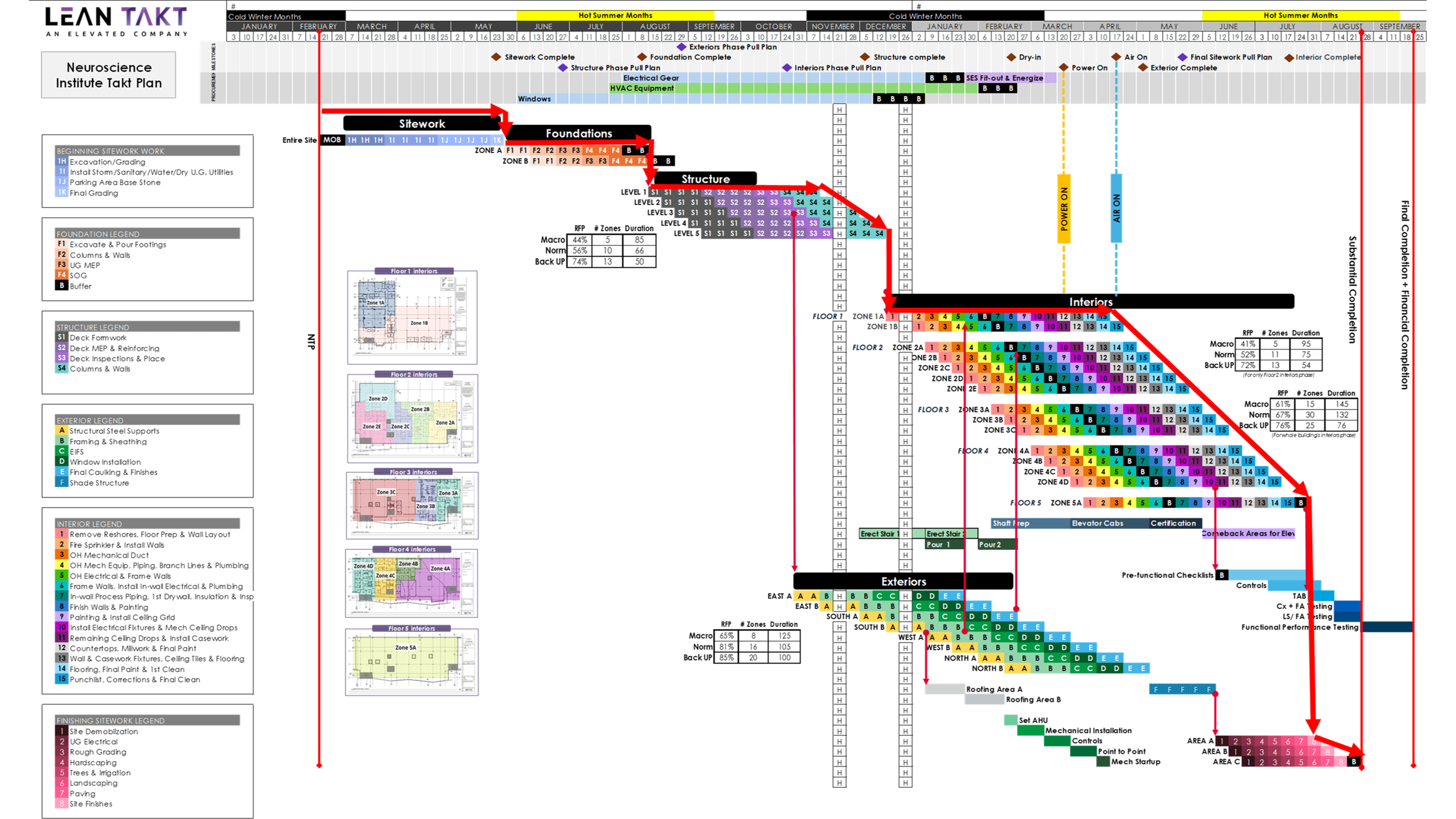
A real Takt plan on one wall: zones down the left, time across the top, and the Path of Critical Flow marked in red. This is the readability a CPM printout can’t match.
Ask ten superintendents how they picked their master schedule and nine will tell you they didn’t. CPM showed up because it always shows up — built into the software, written into the contract boilerplate, assumed before the kickoff meeting starts. Nobody in the room asked whether it was the right foundation for the Last Planner® System commitments that would sit on top of it. That silence is expensive. If you’ve ever felt behind on a project before the first shovel hit dirt, the master schedule you inherited is usually where that feeling started.
The choice matters more than most teams realize, because the quality of the master schedule sets a ceiling on the quality of everything built beneath it.
What Is the Last Planner System, and Why Does the Master Schedule Matter So Much?
The Last Planner® System moves construction planning from command-and-control to an integrated, collaborative process. Instead of one person pushing a plan down to the field, the whole team plans together — with the people closest to the work holding a real voice in the commitments that govern the schedule. Glenn Ballard and Gregory Howell introduced the system in a 1998 paper on shielding production from upstream unreliability, arguing that protecting the workface from bad assignments was the essential move in production control (Ballard & Howell, 1998).
The system gets its name from the people who matter most in the planning cycle: the last planners — trade foremen, superintendents, and crews whose commitment actually makes the work happen. They’re the last link in the chain between the plan and the installation.
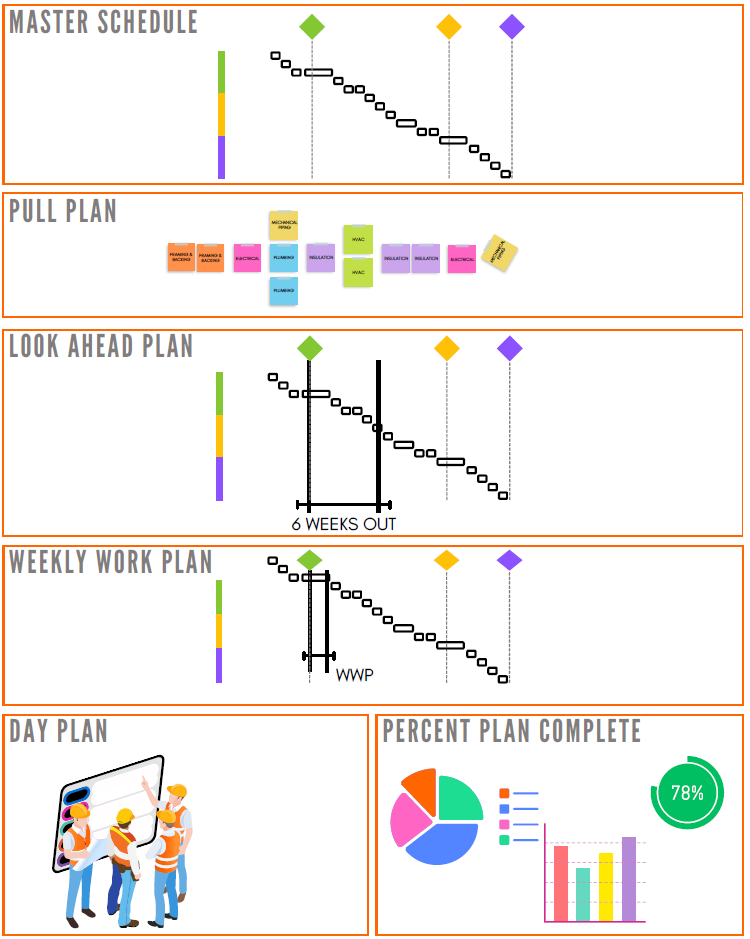
The Last Planner— from top-level milestones down to tomorrow’s executable plan.
Last Planner expresses planning through five formats, each zooming in closer to the work. The Master Schedule plans the whole project and sets milestones. Phase Planning — done through pull planning — lets foremen sequence a phase together. The Make-Ready Look-Ahead aligns resources to real dates and clears what TPI calls Roadblocks: the temporary, removable obstacles — a missing submittal, an open RFI, material not on site — that could stop an already-planned activity. (Ballard and Howell call this look-ahead step constraint analysis. TPI calls those removable obstacles Roadblocks and reserves Constraint for systemic limits addressed earlier, at the pull plan.) The Weekly Work Plan is where foremen commit to each other for the coming week. The Day Plan is tomorrow’s executable plan.
Four of those five formats handle short-interval, detailed planning. Only one — the master schedule — sets the frame. And it’s exactly the one teams put the least thought into.
How Does CPM Work as a Master Schedule?
CPM — the Critical Path Method — relies on logic ties and an algorithm to produce a critical path. A work breakdown structure goes into scheduling software, every activity gets tied to the others, and the system runs a forward and backward pass to calculate float and targeted start and finish dates. When it’s done, there’s a schedule with a critical path and a set of milestones for the Last Planner System to pull from.
Make-ready planning, weekly work plans, and day plans then get managed visually beneath those milestones. This is Last Planner with CPM — the most common setup in the industry. It works, but every lower planning layer must compensate for a master schedule built around logic ties, dates, and float instead of production flow. The milestones exist. The flow does not.
How Does Takt Work as a Master Schedule?
Takt planning is highly visual, shows all three types of construction flow — workflow, trade flow, and logistical flow — and is built with rhythm, continuity, and explicit, intentional buffers. Takt planning applies the same logic Taiichi Ohno used to redesign Toyota’s factory floor: replace batch-and-queue production with continuous one-piece flow, so work moves steadily instead of piling up in queues (Ohno, 1988). TPI calls this discipline One Process Flow, or OPF — one of the Rules of Flow every Takt plan is built to follow: always maintain diagonal trade flow, never dissolve logic, never shorten durations on paper without changing the method, capacity, or conditions in the field, never trade-stack or trade-burden a crew, and always work in OPF.
The build sequence is concrete: break the project into zones, pull-plan representative zones by area type, and package the result into a Takt plan. Zones aren’t split by square footage — they’re leveled by work density, so every zone represents roughly the same amount of effort for the trades passing through it.
Getting the zone count right leans on the same math John Little proved in 1961: the average Work in Progress in a stable system equals throughput multiplied by cycle time (Little, 1961). TPI’s Construction Little’s Law calculator uses that relationship to size the right number of zones and wagons for a given Takt time. CPM does not natively control Work in Progress through zones, wagons, and production cadence, because it was never built to do that.
Every other Last Planner schedule descends from a master schedule that already has flow built in, which makes leveling worker counts, materials, and cost far more achievable than reconstructing flow underneath a CPM frame.
CPM vs. Takt: How Do They Actually Compare?
Every other Last Planner schedule descends from a master schedule that already has flow built in, which makes leveling worker counts, materials, and cost far more achievable than reconstructing flow underneath a CPM frame.
| Dimension | CPM Master Schedule | Takt Master Schedule |
|---|---|---|
| Output & readability | 50+ page printout; not readable at a glance | One-page, highly visual plan the whole team can read |
| Flow visibility | Not shown; must be reconstructed underneath | Shows workflow, trade flow, and logistical flow from line one |
| Buffers | Usually absent, or hidden inside float the owner can claim | Explicit, intentional, and owned by the contractor |
| Trade stacking | Common — the algorithm ignores crew capacity and zone flow | Designed out — zone sequencing and trade flow set the logic |
| When problems surface | Hidden in float until they cascade at closeout | Visible almost immediately, while still cheap to fix |
| Underlying logic | Logic ties and a forward/backward pass | Zone density, one-piece flow, and the Path of Critical Flow |
That is the decisive difference: Takt reveals trouble while it is still cheap to fix. CPM explains it after the float is gone.
Why Is Takt the Preferable Master Schedule Choice?
The case for Takt isn’t a style preference — it’s grounded in production science. Eliyahu Goldratt’s Theory of Constraints holds that a system’s performance is always limited by its slowest, most limiting factor, and that the system runs at the speed of that constraint no matter how hard everything else works (Goldratt, 1984). CPM’s forward-and-backward pass does not identify or manage the production Constraint — it calculates dates and float from the logic entered. Takt is built the opposite way: First Planners identify and design around the project’s real Constraints — the systemic limits, like crane capacity or a single site access point, that can’t simply be removed — during Takt Steering, before the pull plan ever happens. That’s the constraint management half of what TPI’s Efrat Goldratt-Ashlag-influenced Rules of Flow describe: identify the limiting factor, exploit it, and subordinate everything else to it, rather than discovering it after the float runs out.
That discipline produces the outcome CPM cannot — but only when the team actually maintains it: leveled crews, clean handoffs, protected rhythm, and a Path of Critical Flow that exposes disruption before it detonates at closeout.
What Are the Warning Signs Your Master Schedule Is Failing the Last Planner System?
Stop debating the software and inspect the schedule. If any of the following are true, the master schedule is forcing Last Planner to fight the frame above it:
- Durations reflect historical rules of thumb or negotiated milestones — not a zone-level work density analysis.
- There are no intentional buffers, or the buffers that exist are labeled as float and open to owner compression.
- The master schedule can’t be printed in a form the foreman team can read and understand at a glance.
- Trade sequences show trades stacked in the same zones at the same time, with no design to prevent it.
- The team started the project already feeling behind, because the milestones were never realistic against the work required to hit them.
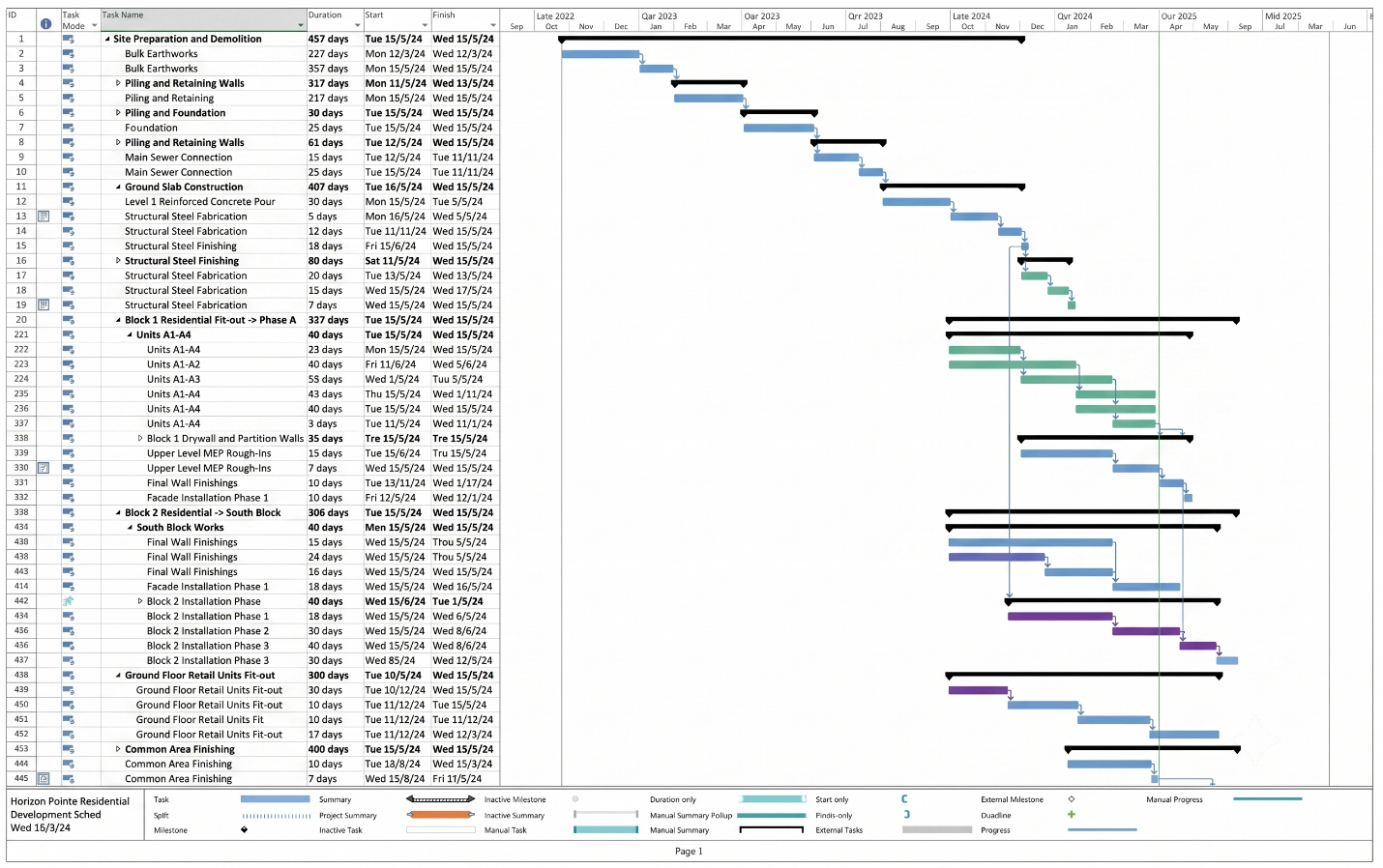
A representative CPM master schedule export — hundreds of logic-tied lines and float calculations, with no visual read on flow or trade stacking.
Any one of those signals means the pull plans, look-aheads, and weekly work plans below it are compensating for the master schedule, not building on it.
When Does CPM Still Make Sense?
To be complete: there are situations where a CPM master schedule is appropriate, or required.
Contractual and Public-Agency Requirements
Many owners, public agencies, and lenders require a CPM schedule as a contract deliverable. In those cases, produce the CPM document the contract requires, and run Takt as the real production system underneath it. The two aren’t mutually exclusive.
Claims and Forensic Delay Analysis
CPM also serves claims and forensic environments appropriately, where delay analysis depends on the logic-tied record CPM provides.
Highly Linear, Low-Repetition Heavy Civil Work
On projects with minimal repeatable area structure, a critical-path view can be the simpler representation.
CPM isn’t always wrong. But when the team has the choice, Takt is the better foundation — and even when CPM is required as a document, it shouldn’t be the production system the field team actually works from.
The Field Takeaway
Before your next Last Planner huddle, put the master schedule in front of the foremen and ask them to point to four things: the zones, the trade flow, the buffers, and the Path of Critical Flow. No explanation. No separate spreadsheet. No scheduler translating it for them. If the plan can’t show those four things on the wall, it isn’t powering Last Planner. Last Planner is surviving underneath it.
As Jason says, “Flow over busyness.”
On we go.
Frequently Asked Questions
What is the Last Planner System and how does the master schedule fit into it?
The Last Planner System moves from the master schedule into phase planning, make-ready, weekly commitments, and day planning. The master schedule sets the frame every lower layer inherits.
Why is Takt preferred over CPM as the master schedule for the Last Planner System?
Takt puts zones, flow, buffers, crew sequence, and Work in Progress control directly into the master schedule. CPM gives the team milestones and a critical path, then leaves them to reconstruct production flow below it.
Can a team use both CPM and Takt planning on the same project?
Yes. CPM can satisfy the contract while Takt runs the field. One is the required document; the other is the production system.