
What Is the Right Order to Improve a Construction Project — Muri, Mura, or Muda?
The rest of this post explains what each of the three M’s looks like on a construction project, and how the sequence plays out inside a Takt Construction rollout.
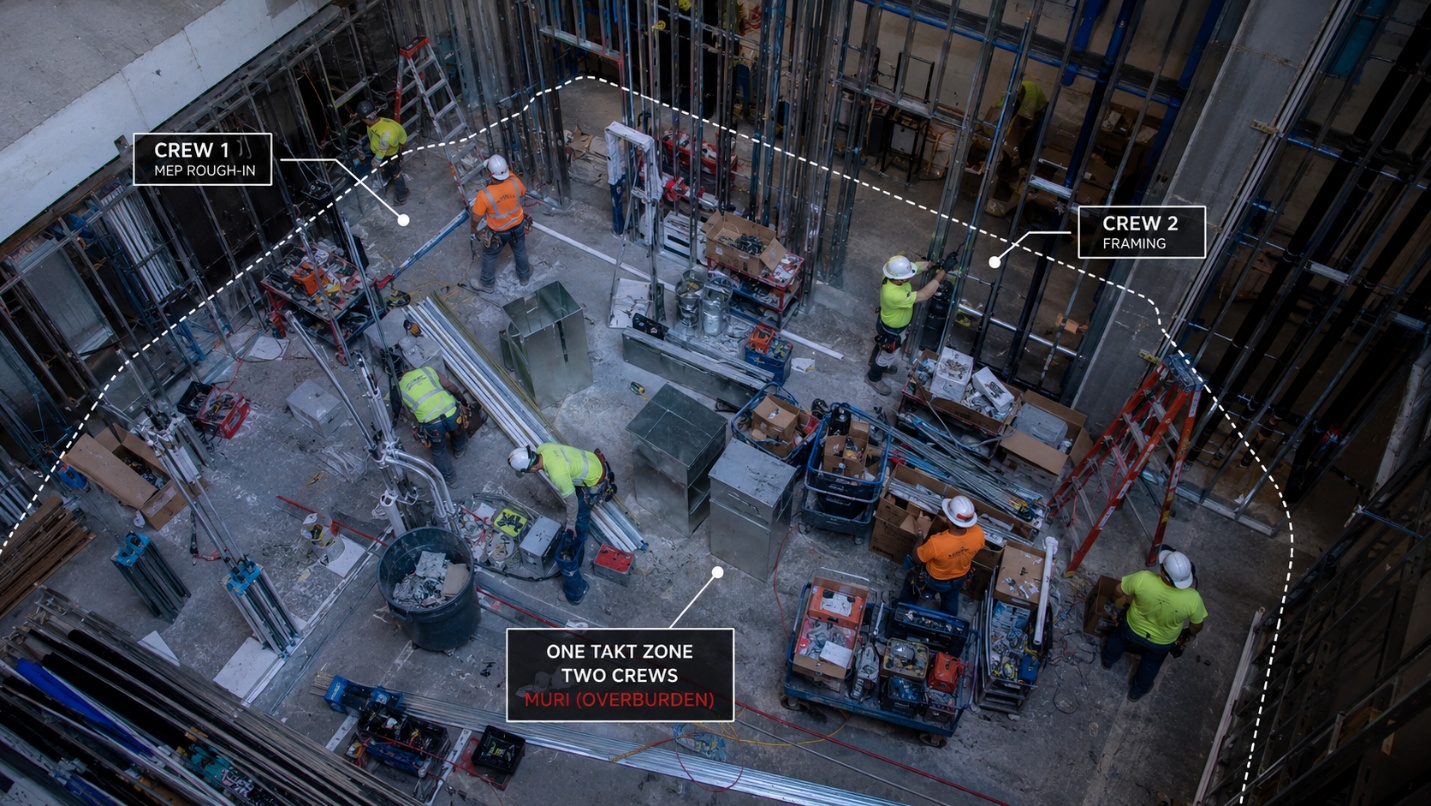
Overburdening begins when the plan demands more than the zone can sustain.
What Are Muri, Mura, and Muda?
Taiichi Ohno named three enemies of a healthy production system in Toyota Production System (1988). Their Japanese names are Muri (overburdening), Mura (variation), and Muda (waste). Most Western lean training talks almost exclusively about the third one — a mistake, and why so many improvement efforts stall.
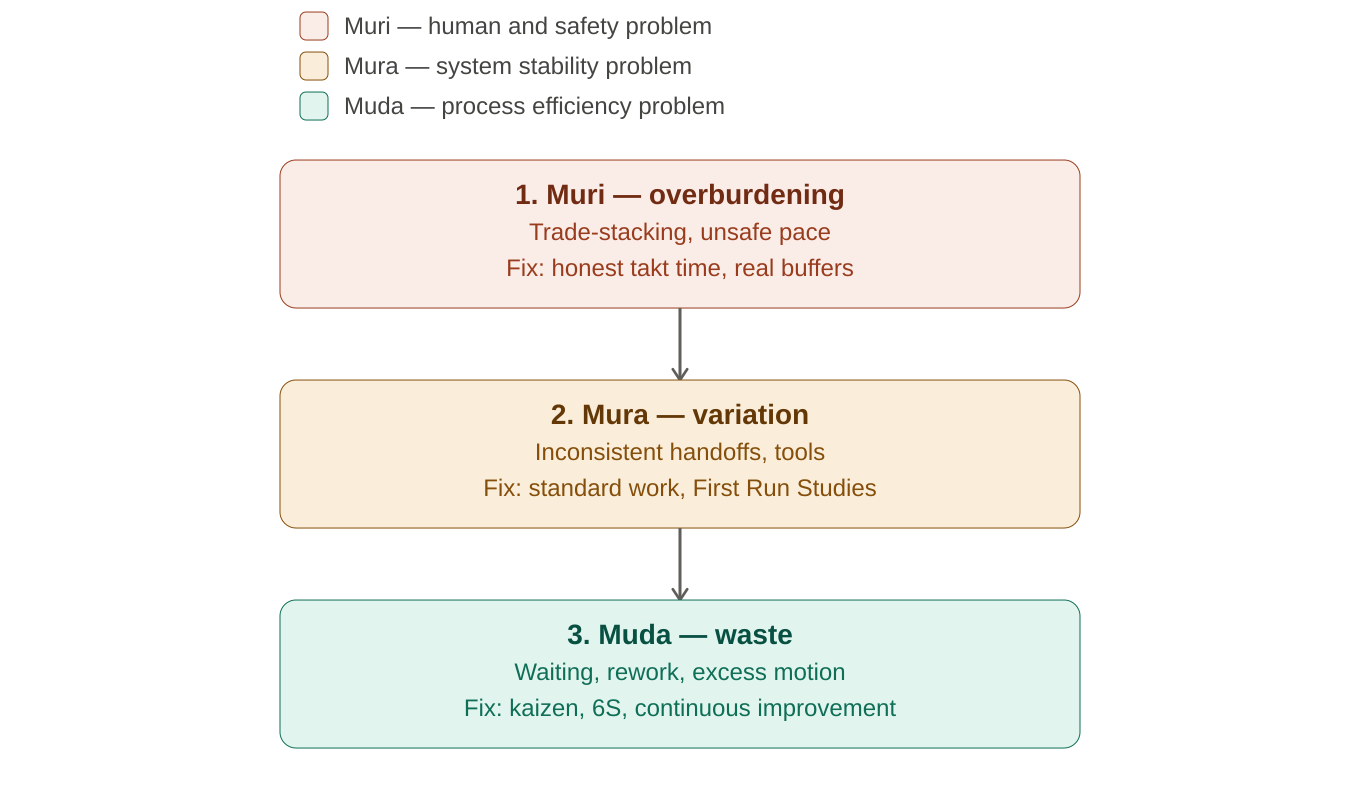
Jeffrey Liker’s The Toyota Way (2004) documents how leveling the workload — heijunka — reduces Mura, and how reducing Mura makes Muri and Muda easier to remove. TPI’s people-first sequence — overburdening, then variation, then waste — is our application of that relationship to construction crews: protect people before you touch the process.
Here they are, in the order you actually attack them:
Why Do You Attack Overburdening First?
Because overburdening is where people get hurt — physically, professionally, and in their trust of leadership. It shows up in specific, recognizable ways on a jobsite (see below) — but underneath every one of them is the same thing: someone being asked for more than the plan can sustainably give.
Every one of those situations burns social capital — and social capital is what pays for every other improvement you’ll ever try to make. A team whose trust has been spent won’t help you reduce variation or eliminate waste, because it’s already learned leadership’s projects come at the crew’s expense.
So the order isn’t arbitrary. You take care of your teammates first. Do it visibly and consistently. Frontline people notice, and that appreciation is what makes every downstream improvement possible.
What overburdening looks like when Takt is misapplied
- Trade-stacking — two or more crews in a zone that can only support one. The Takt Rules of Flow name this as a “never,” and it’s the most common form of Muri on a construction site.
- A takt time set to the fastest trade’s pace — instead of the pace-setting trade’s sustainable rate (the crew whose sustainable cycle time governs the train). It looks like an aggressive plan; it functions as chronic overburden on every trade that can’t hit it.
- Overtime as a hidden production strategy — 60-hour weeks not as a one-time push but as the base assumption. Muri masquerading as “grit.”
- Unsafe work conditions — the ultimate Muri. If you cannot land the plane safely, you cannot land it at all.
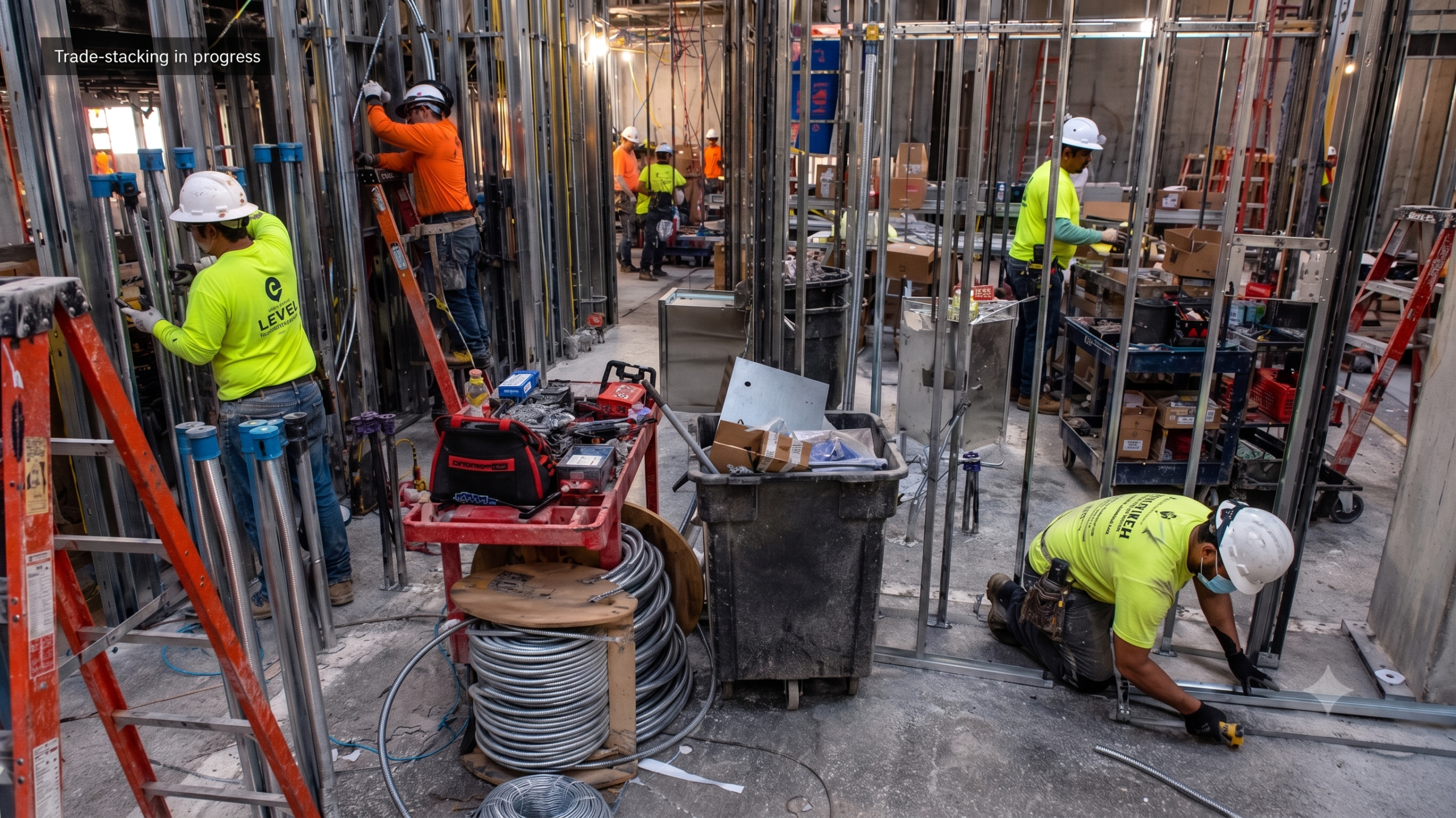
This is what an overloaded production system looks like in the field.
Use buffers deliberately, so the normal variation of the work is absorbed by the plan instead of the people. And reject the culture that treats overtime as a badge of honor — treat it instead as a signal that the plan itself is wrong.
Why Do You Attack Variation Second?
Because variation creates workloads, unreliable handoffs, waiting, rework, and excess Work in Progress. Reduce variation, and the waste starts drying up on its own. Skip straight to the eight wastes, and you’re fighting symptoms while the disease keeps generating more.
W. Edwards Deming put a number on this in Out of the Crisis (1982): on page 315, he estimated that roughly 94% of problems and improvement opportunities belong to the system — management’s responsibility — and only 6% to special, individual causes. Punish the person and you’ve mistaken common-cause variation — built into the process — for a special cause you can discipline your way out of.
Variation in a Takt Construction space has many faces:
- Different tools every week
- Handoffs that mean one thing to the giving trade and another to the receiving one
- RFI turnaround that runs three days on Monday and twelve on Thursday
- Manpower that disappears mid-week
- Materials that arrive clean half the time and damaged the other half
Any one of those creates unevenness. Together they create a system that cannot produce reliably, no matter how hard the crew works. And every hour spent fixing what variation created is an hour stolen from installing the work.
Variation is not variety
This is the single most important distinction inside Mura. Variety is the real diversity of demand a construction project handles — different room types, scopes, finishes, equipment loads across zones. That’s what construction is; a production system is designed to accommodate it.
Variation is unwanted inconsistency inside otherwise stable processes: poorly maintained tools that behave differently crew to crew, sloppy handoffs, undocumented methods with different results depending on who’s on shift. Variety is planned; variation is not. Variety is designed for; variation is designed out.
How you remove variation in Takt Construction
- Standard work per trade — an agreed method, in writing, that produces the same result whichever crew shows up.
- First Run Studies — video the first cycle of a repeating task, improve the method before it hardens into the template for every zone after it.
- Conditions of Satisfaction at every handoff — the receiving trade knows exactly what it’s entitled to expect; the giving trade knows exactly what it must deliver.
- Tool and equipment maintenance rituals — a poorly maintained tool is a variation factory.
- Buffers placed ahead of the constraint — Eliyahu Goldratt’s The Goal (1984) made the case for protecting the pace-setting resource above all else. In Takt terms: the buffer absorbs normal variation upstream, so it never reaches the pace-setter as idle time.
- Predictable back-office cadence — RFI turnaround, submittal approval, and inspection scheduling held to consistent windows, so field variation isn’t compounded by office variation.
Reducing variation is a full-time job that will keep any team busy for months. That’s fine — it’s the highest-leverage work you can do once overburdening is gone.
Why Do You Attack Waste Last?
Not because waste doesn’t matter — it matters enormously. But waste-reduction efforts don’t stick in an unstable system. Overburdened crews don’t have the bandwidth to sustain improvement, and a process riddled with variation swamps any kaizen with the next inconsistency. Teams that skip straight to Muda spend years running kaizen events that quietly reverse themselves — and eventually stop believing lean works at all.
TPI reads James Womack and Daniel Jones’s Lean Thinking (1996) as making the same case at the enterprise level: map and stabilize the value stream, and waste-reduction sticks because the system holds it in place. Once overburdening is gone and variation is under control, waste-reduction becomes what Toyota always intended — a continuous, low-effort, high-yield practice. The eight classic wastes become obvious targets that improve reliably.
This is the continuous improvement step of the Six Foundations of Flow — the sixth step, not the first, for exactly this reason.
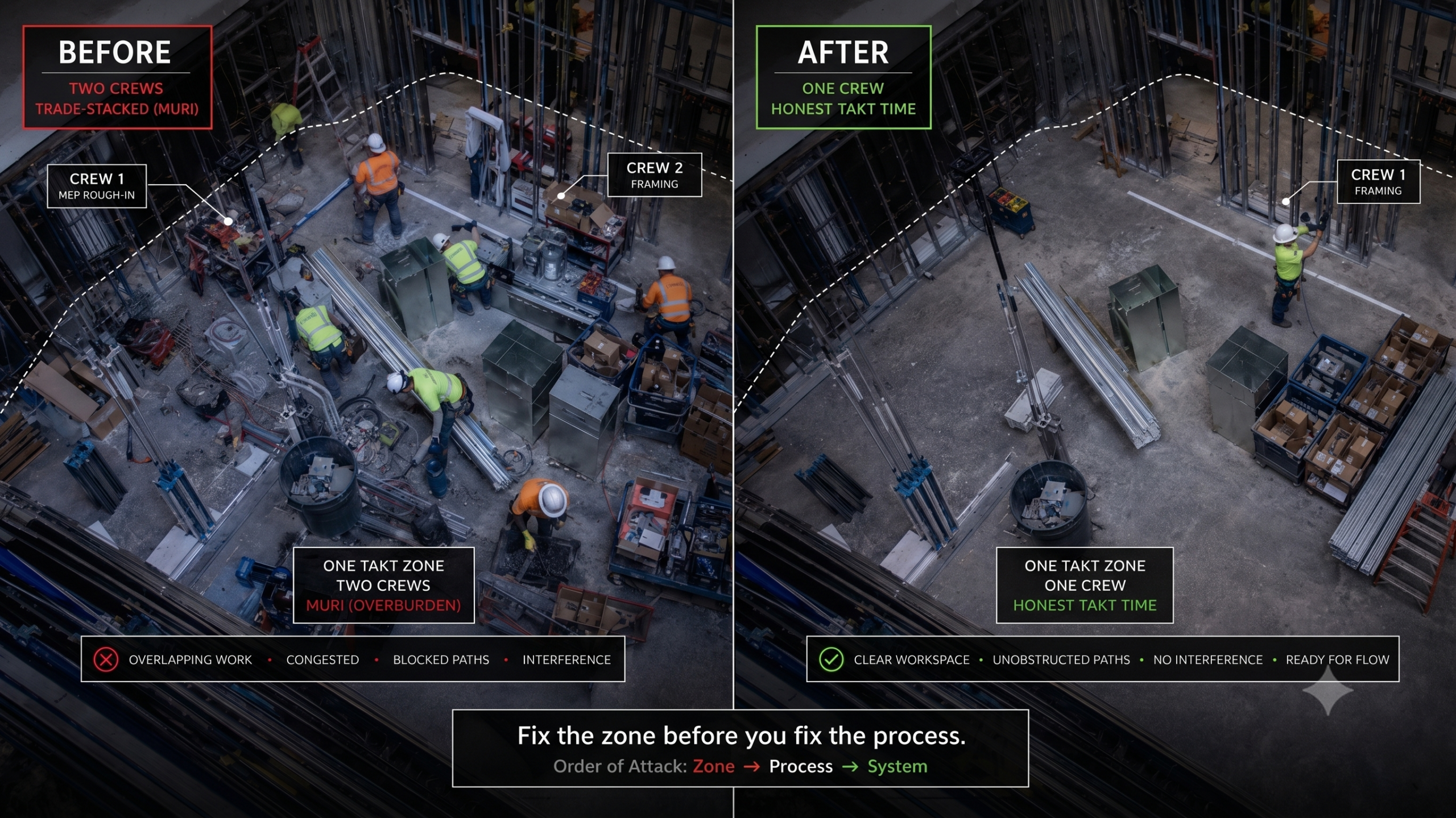
The first improvement is not faster work. It is a sustainable condition for work.
Muri and Mura are not Muda — misdiagnose one as the other and you’ll reach for the wrong fix. Treat each one separately, with its own tools, in its own turn.
The Field Takeaway
Before you touch a process or chase a single piece of waste this week, walk your zones and ask one question: is any crew trade-stacked, or is any trade being held to a takt time it can’t sustain? If the answer is yes, fix that first — not standard work, not a kaizen event, not a waste walk. Nothing else holds until the people doing the work are operating at an honest, sustainable pace. Once that’s true, and only once it’s true, turn to variation: pick the one handoff on your project with the least trust between trades and put a written Condition of Satisfaction on it before your next look-ahead.
The Takt Production Institute trains construction teams in Takt planning, Lean production, and the disciplined order of improvement that holds. Want help removing overburdening before you touch anything else? [Get in touch].
Sources and Further Research
- Ohno, Taiichi. Toyota Production System: Beyond Large-Scale Production. Productivity Press, 1988.
- Liker, Jeffrey K. The Toyota Way: 14 Management Principles from the World’s Greatest Manufacturer. McGraw-Hill, 2004.
- Deming, W. Edwards. Out of the Crisis. MIT Press, 1982.
- Goldratt, Eliyahu M. The Goal: A Process of Ongoing Improvement. North River Press, 1984.
- Womack, James P., and Daniel T. Jones. Lean Thinking: Banish Waste and Create Wealth in Your Corporation. Simon & Schuster, 1996.
Last Planner® is a registered trademark of the Lean Construction Institute. Takt Production System® and First Planner System™ are marks of Elevate Construction.