
Takt Essentials
The Foundation
“The Takt Production System engineers flow into a project on purpose — by laying out the work as a train of trades moving through zones at a steady rhythm, on a visual plan you can see on one page, governed by production laws and lean principles.”
Why This System Exists
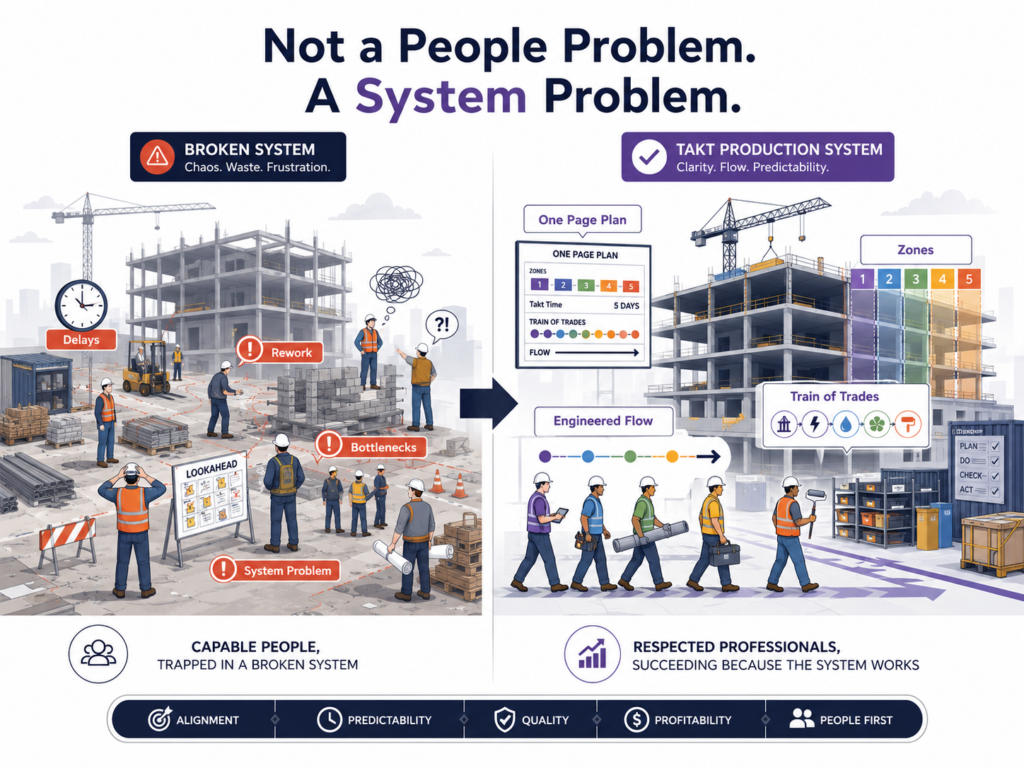
Not a People Problem.
A System Problem.
Roughly half of construction projects finish on or under budget. Less than ten percent finish on budget and on schedule. Only about half a percent finish on budget, on schedule, and to expectations.
Roughly half of construction projects finish on or under budget. Less than ten percent finish on budget and on schedule. Only about half a percent finish on budget, on schedule, and to expectations.
The Takt Production System exists because we have a better way. Manufacturing has used these principles for decades under the Toyota Production System. We are bringing them to American construction in a form you can actually run.
The Outcome
What TPS Delivers
01
Respect
For the women and men in the field. Their time, their bodies, their planning. A project where people are treated like the professionals they are, with everything they need to succeed.
02
Stability
A clean, safe, organized project. Consistent crew sizes. Consistent material inventory. The ability to find and clear roadblocks ahead of the work. The ability to finish as we go.
03
Flow
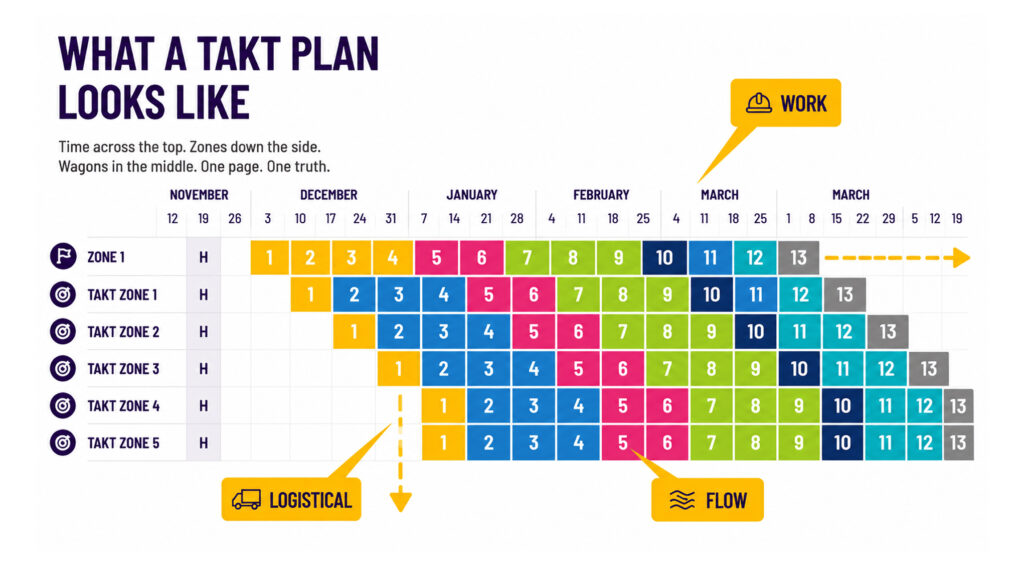
Workflow horizontally through the zones. Trade flow diagonally through the project. A train of trades moving the same direction, same speed, same distance apart.
How the System Operates
The Three Operational Modes
They overlap, but they answer three different questions — and confusing them is how teams end up solving the wrong problem.
Pre-Construction
Takt Planning
How we make the plan. First planners —supers, PMs, and trades involved early in pre-construction. Done right, you have a project built to flow before the first piece of dirt is turned.
Constraints
Takt Steering
How we direct the train. Deals with constraints in the system itself — improper Takt time, varying speeds, wrong zone count, missing buffers. Steering is the train and the tracks.
Roadblocks
Takt Control
How we control the environment. Deals with roadblocks in the way of the train — weather, missing info, failed inspections, materials in transit. Roadblocks are temporary. You remove them.
The Bigger Picture
The Integrated Production Control System
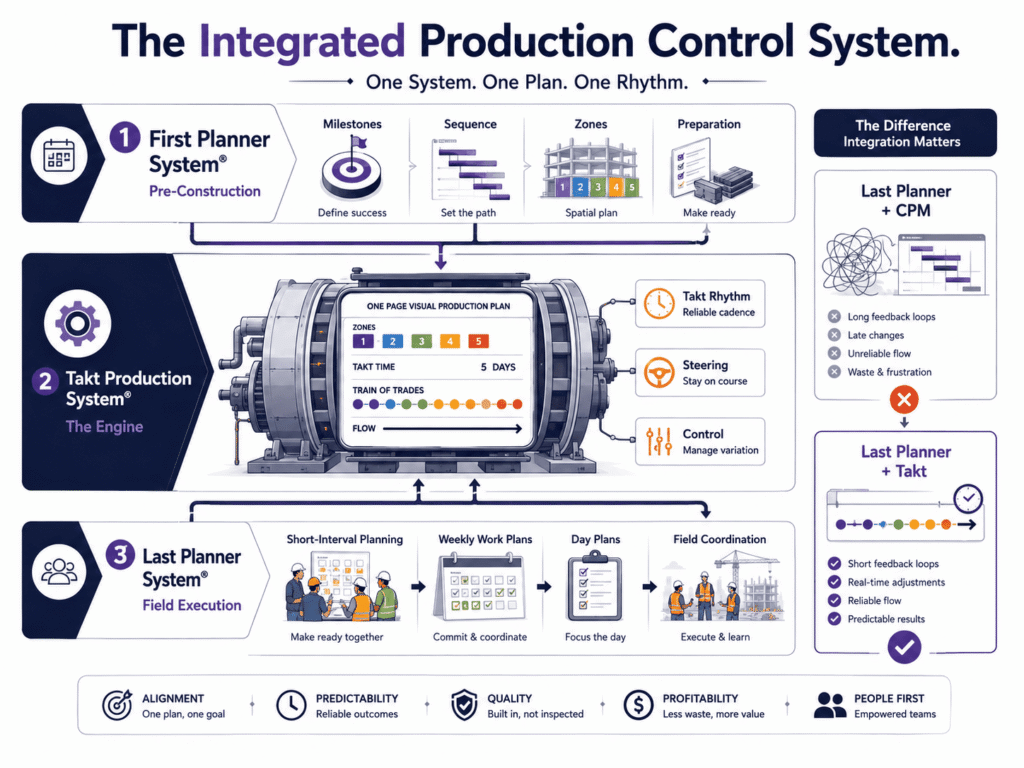
TPS is one piece of a larger framework. Takt is the engine in the middle — First Planner feeds it; Last Planner runs alongside it.
Last Planner + CPM is broken. CPM gives Last Planner the wrong milestones, wrong batching, wrong logic.
Last Planner + Takt is what we are after.
First Planner System®
Pre-Construction
TPS is one piece of a larger framework. Takt is the engine in the middle — First Planner feeds it; Last Planner runs alongside it.
Takt Production System®
The Engine
The production plan itself, plus how we steer and control it throughout construction. The middle layer — everything flows
through here.
Last Planner System®
Field Execution
Short-interval planning by the people doing the work — look-aheads, weekly work plans, day plans. Runs alongside Takt to
complete the system.
The Physics
Six Production Laws TPS Obeys
Not opinions. Mathematically and scientifically fixed. You work with them or you pay the price — there is no third option.
Little's Law
A project will be faster if zones are smaller, work is leveled, and you finish as you go. Violate any one of those three and there is no recovery without changing them.
Law of the Effect of Variation
The more variation a project experiences, the longer it takes. Takt counters this by keeping patterns rhythmic — even delays get absorbed without breaking the pattern.
Law of Bottlenecks
Every project has at least one limiting factor. Takt makes the bottleneck visible. Once you see it, you don't push through it — you optimize it. More resources makes it worse.
Kingman's Formula
Package work as activity time + variation + productivity loss. If your Takt time is 4 days, your trade process should take 3–3.5. Fully loading wagons guarantees you fall behind.
Brooks's Law
Adding excess labor extends duration, especially late. When a project goes red the default is bodies. Every one of those moves makes it slower.
Lucy's Law
When the conveyor speeds up, Lucy stuffs chocolates anywhere she can. Construction does the same — stack, batch, more bodies. Throughput gets longer, not shorter.
The Philosophy
Six Lean Concepts That Make It Work
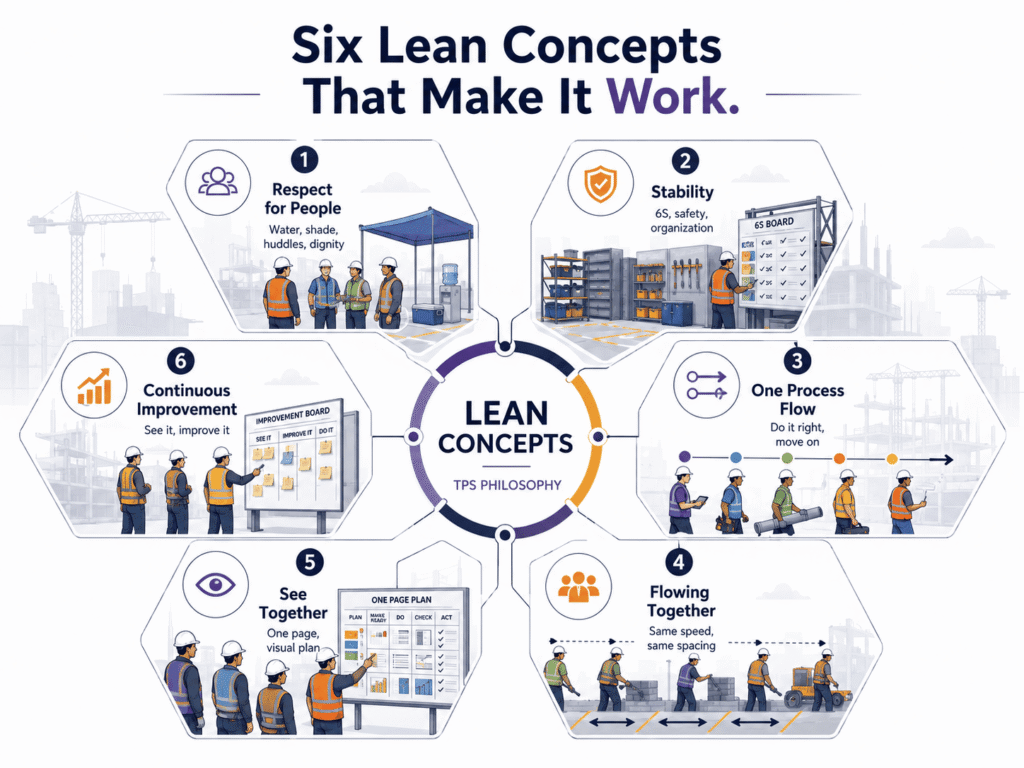
Production laws are the physics. Lean concepts are the philosophy. Six of
them hold the system together — and the first one is the one most teams
skip entirely.
Respect for people — Decent bathrooms, real lunch areas, worker huddles, shade, water, heat. Not perks. Requirements. You cannot have flow on a project where workers are not respected.
Stability — 6S: sort, straighten, sweep, standardize, sustain, safety. You cannot do high-precision work in a chaotic environment. You cannot run a train through a cluttered yard.
One process flow — Trades enter a zone, do the work, finish, reflect, improve, and move on. One zone at a time. Done right, the first time. No coming back. If you apply one concept tomorrow, apply this one.ed.
Flowing together — Every trade on the project flowing at the same speed and the same distance apart. The Takt rhythm is what synchronizes them all.
See together — Plans must be highly visual and easily understood. The team has to see the plan together, on one page. You cannot manage what you cannot measure, and you cannot measure what you cannot see.
Continuous improvement — Once you can see what is happening based on production laws and lean methodology, you can actually improve. Without visibility, every improvement is a guess.
Common Misconceptions
What TPS Is Not
These misconceptions are everywhere — and they have kept this system from being adopted as widely as it should have been.
Not just for repetitive work
Data centers, hospitals, labs, custom commercial, mixed-use — any project. The misconception comes from one residential tower example.
Not a five-day Takt time
Macro plans use 5 days because it's easy. Norm plans almost never stay there. Sticking at 5 days throughout is one of the most common mistakes.
Not locked to the work week
Never use the weekend as your drumbeat. Every delay either eats another week or pushes trades into Saturday — neither is acceptable.
Not one-trade-per-wagon
Wagons hold whatever it takes to level durations and work density. The one-to- one assumption consistently leads to imbalance.
Not CPM with colors
"We're doing Takt in P6" — no. CPM software cannot do what Takt does. Color- coding activities doesn't create flow or enforce production laws.
Not optional once you understand it
Once you understand the production laws and why CPM fails, continuing to use CPM as a master schedule is a choice. A choice to keep doing what doesn't work.