

A buffer in Takt planning is intentionally placed protection — time, space, or capacity — designed to absorb variation so the train of trades keeps flowing. There are four types, named by where they sit on the Takt wall: vertical buffers (non-working buffers that protect the calendar), diagonal buffers (train buffers that protect the sequence), horizontal buffers (milestone buffers that protect the finish), and independent buffers (one-off buffers that protect a specific activity). Buffers are not float — they are owned by the contractor, placed deliberately, and sized through risk analysis.
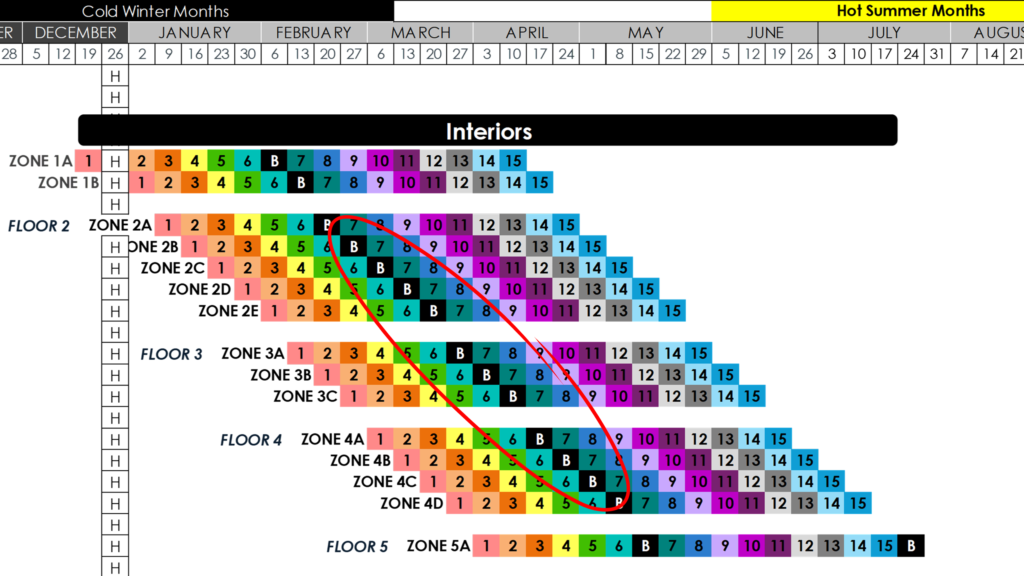
Visible buffers protect the train of trades as it flows through the project and approaches key milestones..
This guide walks each type in detail, explains why buffers are non-negotiable in a real Takt plan, and shows how the framework connects to Critical Chain Project Management and Goldratt’s Theory of Constraints.
Why Do Buffers Matter in Lean Construction?
If you’ve spent any time in lean construction, Takt planning, or the Last Planner® System, you already know the truth that traditional CPM scheduling tries to hide: variation is real, and pretending it isn’t will wreck your schedule.
Weather happens. Inspections slip. Materials arrive late. A crew that ran a 5-day Takt last week needs 6 days on the next zone because the layout changed. None of this is failure — it’s reality. The question isn’t whether to plan for variation. The question is where to put your protection.
That protection is called a buffer: intentionally placed protection located where the production system needs it.
This post breaks down the four types of buffers in Takt planning, using a spatial framework that maps cleanly to how a Takt plan actually flows on the wall. If you’re learning Takt, training a team, or auditing your own schedule, this is the mental model to use.
What Is a Buffer in Takt Planning?
Call it a buffer. Call it Stabilization Time. What matters is the mechanism: it is how a production system survives contact with variation instead of getting flattened by it.
Wallace Hopp and Mark Spearman, in Factory Physics (3rd ed., 2008), proved something every superintendent already knows in their gut: variability degrades performance, and the only way to protect a system against it is to buffer with time, capacity, or inventory. Every stable production system — a factory floor or a Takt wall — is running one of those three, whether the team names it or not.
On a Takt plan, this shows up as:
- Time buffers — non-working time, breathing room in the calendar, extra wagons in the train
- Capacity buffers — crew flexibility, the ability to surge or absorb
- Inventory buffers — staged materials ahead of the work face, or a workable backlog of ready tasks a crew can pull into
This post focuses on time buffers and where they sit on the Takt wall.
The four-type framework below — vertical, diagonal, horizontal, independent — is how Takt planning organizes time buffers spatially: not just that you have protection, but where it lives and what it’s protecting.
Are Buffers the Same as Float? (No — and Who Owns Them?)
This is the most misunderstood part of buffer management in construction, so let’s settle it now.
Buffers are not float. Float is leftover time that happens to exist because of how activities overlap on a CPM network. A buffer is the opposite: intentionally designed protection, sized through risk analysis, placed deliberately in the production system. Treating the two as interchangeable is one of the fastest ways to wreck a Takt plan.
Buffers are owned by the contractor — not the owner. Non-negotiable. Weather, RFIs, design clarifications, inspection turnaround, material delivery, the natural variability of skilled trade work — those risks live with the contractor, so the protection against them does too. An owner who tries to “claim” buffer time as schedule time they can compress is turning a Takt plan back into a CPM plan.
Buffers are not sandbagging. They are a calculated engineering decision — the production-planning equivalent of a safety factor.
The two non-negotiables of a Takt plan
A Takt plan has two truly non-negotiable components:
- Trade Flow — the sequence and rhythm of the train of trades
- Buffers (Stabilization Time) — the protection that lets that flow survive contact with reality
Everything else can be negotiated. Wagon sizes, zone boundaries, Takt rates, durations — these are design choices that can be re-balanced as conditions change. But if you remove Trade Flow, you no longer have a Takt plan. And if you remove buffers, you no longer have a survivable Takt plan.
Grounded in Critical Chain and the Theory of Constraints
None of this is new thinking. Eliyahu M. Goldratt named it first — in The Goal (1984), and more directly in Critical Chain (1997) — where he showed that in any production system, you protect throughput by placing buffers at the constraint and at the end of the chain, not by padding every activity.
Goldratt’s constraint is the bottleneck resource in his production system — not the same use of the word as TPI’s Constraint, a systemic limit addressed at the pull plan. Same throughput logic, different object.
Goldratt’s end-of-chain buffer was a project buffer; his mid-sequence buffers were feeding buffers. Swap the vocabulary and you’re looking at a Calculated End Buffer and a Sequence Buffer — the construction-specific version of a framework that’s been proving itself since 1984.
What Are the Four Types of Buffers in a Takt Plan?
Here’s the spatial framework at a glance:
| Buffer Type | Spatial Location | Also Called | What It Protects |
|---|---|---|---|
| Vertical Buffers | Down a column (a time slot) | Non-Working Buffers | The calendar |
| Diagonal Buffers | Within the flow of the train | Train Buffers | The sequence |
| Horizontal Buffers | At the end of a row or phase | Milestone Buffers | The milestone |
| Independent Buffers | Anywhere, attached to a single activity | One-Off Buffers | A specific risk |
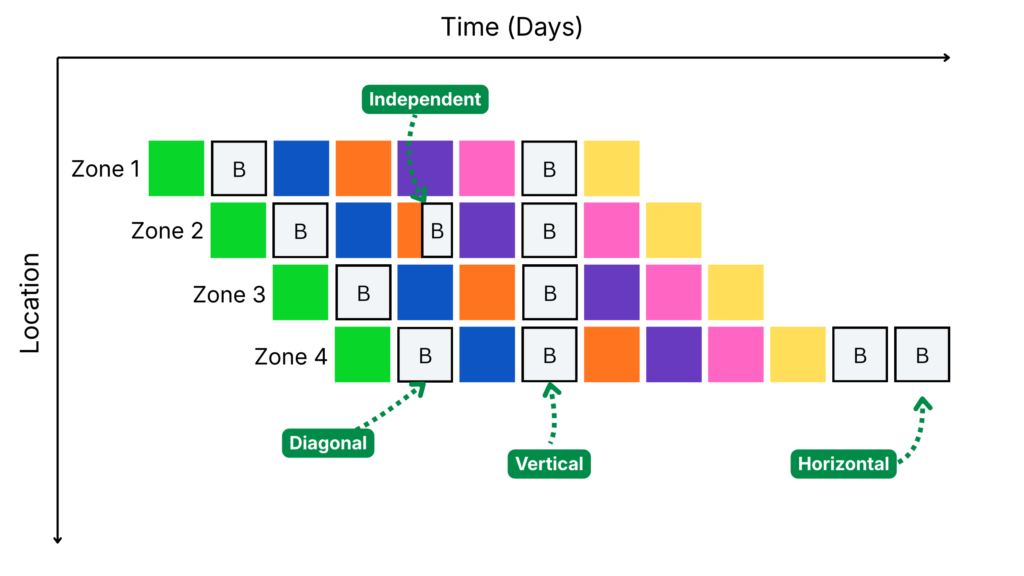
Now let’s walk through each one.
1. What Are Vertical Buffers (Non-Working Buffers)?
Vertical buffers run down the Takt wall — they occupy an entire time slot where no work is scheduled. Think of them as columns of dead air built into the calendar on purpose.
The most common form is the Takt Time Buffer, used for:
- Holidays — Thanksgiving week, the Christmas shutdown, federal holidays
- Rain days — built into the plan based on regional weather patterns
- Shutdowns — owner-driven, jurisdictional, or company-wide
- Stand-downs — safety stand-downs, all-hands meetings, training days
- General non-working days — anything where, by policy, crews simply aren’t on site
About 95% of the time, crews simply aren’t working during a vertical buffer — that’s the whole point. Unlike diagonal or horizontal buffers, these don’t absorb impact; they acknowledge time the calendar was always going to take from you.
Naming note: Some teams use vertical buffers as schedule “resets” — a place to reorganize the train mid-stream. If you strip out the reset function and just use them for non-working days, the cleaner name is Non-Working Buffer. Either is fine — just be consistent on your project so the team isn’t confused about what each buffer is doing.
Where vertical buffers go wrong
Traditional project controls answer one question: are we on plan or off plan. PPM asks a different one: what’s limiting completed output, and what must change to raise it. A progress curve can tell you that you’re late. It can’t tell you whether the Constraint is overloaded, whether too much WIP has been released, or whether adding people will help or make things worse.
Two common failure modes:
- Forgetting them entirely. Teams build aggressive Takt plans against a 250-working-day year, then act shocked when 11 holidays and a 2-week winter shutdown eat their schedule.
- Using them as hidden contingency. If you’re “calling it a holiday buffer” but really planning to push work into it whenever the train slips, you’re not buffering — you’re lying to yourself about the actual Takt rate.
Vertical buffers should be visible, labeled, and respected.
2. What Are Diagonal Buffers (Train Buffers)?
Diagonal buffers live inside the train of trades itself. They run diagonally across the Takt plan because the train moves diagonally — wagon by wagon, zone by zone, day by day. These are the buffers that absorb impact between trades inside the production sequence.
There are three sub-types worth naming:
Wagon Buffer
A wagon buffer is a buffer inside a wagon. The wagon is sized with intentional breathing room so that the crew assigned to it has room to absorb minor variation without falling behind. If your framing wagon is sized for 4 days of work but the Takt is 5 days, you’ve built a 1-day wagon buffer into it.
This is the most granular form of buffering in a Takt plan. It’s how you set the Takt rate honestly — by sizing wagons with enough room that an average week works, not just a perfect one.
Buffer Wagon
A buffer wagon is an entire wagon used as a buffer. No trade is permanently assigned to it. It sits in the train as protection — an empty slot in the sequence that the train can flex into when an upstream wagon runs over.
Because buffer wagons are visible, consuming one immediately signals that the train is under stress.
Last Planner’s workable backlog — a concept from Glenn Ballard and Greg Howell’s Last Planner System research (1998) — follows a related protection principle, but stores ready work rather than an empty time slot in the train. What their look-ahead literature calls a “constraint,” TPI names a Roadblock, reserving “Constraint” for the systemic limits addressed earlier at the pull plan.
Sequence Buffer
A sequence buffer is a buffer placed between two parts of the train — typically separating two groups of trades whose handoff is high-risk. If your MEP rough-in needs to fully clear before drywall starts, and the transition is historically painful, a sequence buffer between those wagon groups creates breathing room.
This is where risk analysis pays off: not every handoff needs a sequence buffer, but the ones that do? They keep the whole train from cascading into chaos.
All three — wagon buffer, buffer wagon, sequence buffer — exist for one reason: to absorb impact inside the train of trades, before it reaches anyone downstream.
3. What Are Horizontal Buffers (Milestone Buffers)?
Horizontal buffers sit at the end of a row — at the end of a phase, or at the end of the entire project. They protect milestones, not sequences.
Two sub-types:
End-Phase Buffer
An end-phase buffer absorbs impact for a specific phase before its milestone. A phase usually contains multiple trains of trades — say, a structure phase with concrete, steel, and skin all running their own Takt sequences. The end-phase buffer sits between the last wagon of that phase and the phase milestone.
It’s sized based on risk analysis: how variable were the trades inside the phase? How firm is the milestone? How much downstream work depends on hitting it on time?
Calculated End Buffer
A calculated end buffer sits at the very end of the project. This is where the majority of milestone protection should live on a well-built Takt plan.
A calculated end buffer sits at the very end of the project. This is where the majority of milestone protection should live on a well-built Takt plan.
Why? Because individual phase buffers, used carelessly, hide problems. If every phase has a fat buffer at the end, the team learns to consume them quietly and the project still finishes late. A calculated end buffer, sized through actual risk analysis of the whole project, gives leadership one honest number: here is how much protection we have left, and here is how fast we are burning it.
This is the buffer leadership watches every week: the project’s remaining capacity to absorb variation.
4. What Are Independent Buffers (One-Off Buffers)?
The first three buffer types cover almost everything you’ll need. Independent buffers exist primarily to accommodate the unique situations a Takt application throws at you — the times when a buffer is genuinely needed but doesn’t fit cleanly into the vertical, diagonal, or horizontal categories. They are the catch-all, used surgically.
Think of a one-off buffer as safe following distance between two cars: it belongs to neither activity, but protects one specific interaction whose timing cannot be predicted precisely.
Examples of when a one-off buffer makes sense:
- A long-lead piece of equipment whose install is on the path of critical flow
- A permit or inspection whose timing is outside your control
- A weather-dependent activity (a roof tie-in, a major crane pick) that can’t be moved
- A single subcontractor with a history of variation specific to their scope
- A Takt-specific situation where flow requires protection but no other buffer category fits cleanly
Use these sparingly. Sprinkling one-off buffers all over the schedule usually means a deeper problem — a wrong Takt rate, an unbalanced train, or risk that belongs at the phase level instead. One-offs are surgical tools, not a habit.
Macro vs. Norm: Why Norm Takt Plans Always Have Buffers
Takt planning works with two views of the schedule, and they handle buffers very differently. Confusing the two — especially with the owner in the room — is how a Takt project quietly turns back into a CPM disaster.
The Macro Takt Plan
A Macro Takt plan is the high-level, contractual view of the project. It’s the slowest responsible pace at which the work can be promised — the major phases, the milestone dates, the schedule that goes in front of the owner and becomes part of the contract.
A Macro plan can be shown without explicit buffers, because the Macro itself is already a conservative, contract-grade representation of the work. The buffer logic is baked into how the Macro was sized in the first place.
The Norm Takt Plan
A Norm Takt plan is the production-level view — the actual train of trades, wagons, zones, and weekly flow that crews work to.
A Norm Takt plan always has deliberate buffer protection. Always. If the plan has no visible, intentional protection, it is not a survivable Norm plan — it is a CPM schedule with Takt-shaped boxes drawn on it.
Path of Critical Flow — Not Critical Path
Here is the most important mindset shift in this article: we are not trying to manage a critical path. We are trying to protect a path of critical flow.
A critical path is a CPM artifact — the longest chain of dependent activities with zero float. Slip into critical-path thinking and you start chasing individual activities, pulling buffers because “we have float on this one,” and having defensive conversations about whether the schedule “really” needs that contingency.
A path of critical flow is the train of trades moving rhythmically through zones, protected by deliberate buffers. We do not want a fragile critical path; we want a protected path of critical flow.
The CPM Trap to Watch For
Here is the failure mode every Takt team should know by heart:
The owner sees the end date of the Norm plan and fixates on it — before the buffers.
When the Norm end date becomes the “real” finish date in the owner’s mind, buffers start looking like extra time to harvest. Compress them away, and the next disruption blows straight through the plan.
How to prevent this:
- Always present the contractual milestone (the Macro end date) as the project finish — never the end of the Norm plan
- Make buffers visible, named, and located on the wall: “Calculated End Buffer,” not “extra time”
- Educate the owner up front that buffers are part of the production design, owned by the contractor, and not on the table for negotiation
- Frame buffer consumption as a risk indicator the whole team watches — not a schedule opportunity to be harvested
Common Mistakes Teams Make with Buffers
Even teams that adopt Takt planning sometimes mishandle buffers. The patterns are predictable:
- Padding every wagon “just in case.” This destroys the signal. If everything has hidden padding, you can’t tell when the train is actually in trouble. Size wagons honestly; put protection in dedicated, named buffers.
- Burning end-phase buffers silently. If you consume buffer without telling anyone, you’re stealing from the project’s resilience. Every buffer consumption should be visible, logged, and discussed in the weekly planning meeting.
- Letting the Norm end date become the contractual deadline.
- Skipping the risk analysis. Buffers without a risk basis are just guesses. Run the analysis, document the assumptions, and revisit when conditions change.
The Field Takeaway
Before your next look-ahead meeting, go find your Calculated End Buffer and write down one number: how many days of it are already gone.
Not a percentage. Not a status color. A day count, in your handwriting, that you could show an owner without flinching.
If you can find that number in under two minutes, your Norm plan is doing its job. If you can’t find it at all — if nobody on the team can tell you, right now, how much protection is left at the end of the project — you don’t have a buffer. You have wishful thinking with a name on it.
Buffers are not waste. Hidden buffers are waste. Intentional, visible, risk-based buffers are what let Trade Flow survive real variation and protect the path of critical flow.
That’s the difference between scheduling and production planning. That’s the work.