
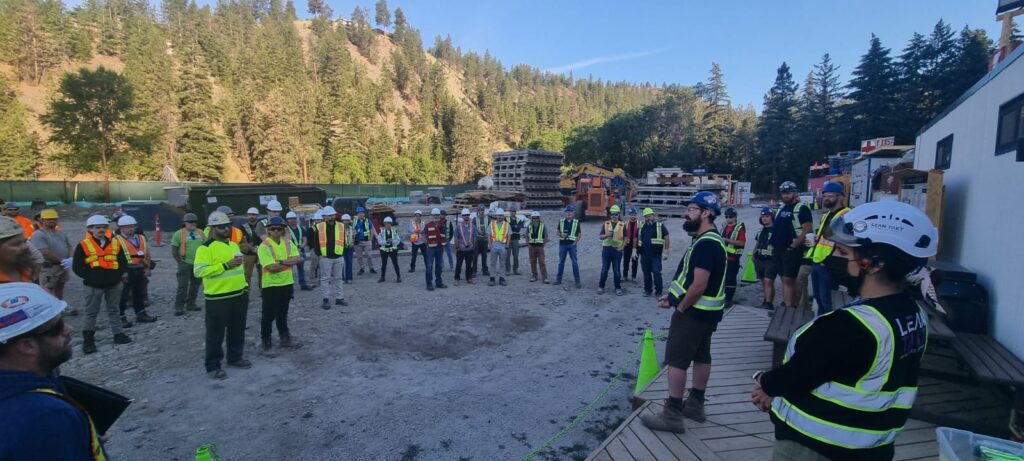
Agency becomes visible when the people closest to the work help shape the plan.
Takt Construction is a sociotechnical system: half technical — takt time, zones, buffers, flow — and half human — dignity, respect, and agency at the workface. During adoption, the technical half is reliably imperfect. What makes Takt work anyway is the socio half: leadership that treats the workforce with dignity, respect, and agency, and that builds the work around sound production theory. Get the people side right and the technical side catches up.
A foreman is standing at the huddle board with a change he wants to make to tomorrow’s sequence. He has watched the plan long enough to see the problem coming before it arrives. Does anyone ask him? On most projects, no — the schedule was built somewhere else, by somebody else, and his job is to follow it. That gap is the difference between a Takt plan and a Takt culture, and it has nothing to do with takt time.
The Technical Half Will Be Imperfect — And That's Not the Problem
Here is an honest line every team adopting Takt should hear out loud: Takt Construction will not work because the technical side was done right during adoption. It won’t be. Takt time will be off. Staffing will be inconsistent. Kitting and prefab will be an experiment that doesn’t quite work yet. Partner firms may fall short as early as design. There will be overburdening and variation in places nobody predicted, and production will stall.
That’s the honest shape of an adoption year, and it isn’t a Takt problem — it’s how every production system learns. Steven Spear and H. Kent Bowen’s 1999 study of the Toyota Production System described it as a continuous series of controlled experiments: every specification acts as a hypothesis tested through action, not a fixed answer handed down complete.
A Takt rollout learns the same way. The wobble is the method testing itself, not the method failing.
What Actually Makes Takt Construction Work
The socio side becomes real through three conditions at the workface: dignity, respect, and agency. The people at the workface set every wagon in motion and close every handoff. They are not implementing Takt for leadership; they are Takt.
It’s the original claim behind the term “sociotechnical” itself. Eric Trist and Ken Bamforth’s 1951 study of British coal mining showed that a technical improvement failed when it disrupted the crews’ social system. Performance recovered only when the technical and social systems were redesigned together. Construction runs the same physics: a perfectly sequenced Takt plan imposed on a crew with no dignity, respect, or agency will fail exactly the way that coal face did.
By this point you’ve already done the hard analytical work:
- Dignity — treating the people doing the work as the professionals they are, with facilities to match, communication that respects their time, and decisions made in their hearing rather than over their heads.
- Respect — for trade knowledge, for the foreman’s read of the workface, for what the people closest to the work actually see.
- Agency — giving the last planners real authority to plan, commit, and improve their own work, not cosmetic permission to nod at a schedule someone else built.
None of this is soft. Dignity, respect, and agency are structural preconditions for a production system to function. A crew with them can save a project the schedule said couldn’t be saved.
Takt makes readiness visible — and that's the gift
Saying “we respect our people” is not the work. These five commitments turn dignity, respect, and agency into operating practice.
1. Study human nature
The people doing the work are skilled adults, not resources to be allocated by a Gantt chart. Leadership owes the team a real study of how people respond to stress, ambiguity, fatigue, recognition, and purpose — and a plan designed accordingly. A leader who hasn’t thought seriously about human nature is guessing about the most important variable on the job.
Jeffrey Liker’s 2004 study of Toyota, The Toyota Way, names this directly: Continuous Improvement and Respect for People are Toyota’s two structural pillars, not one pillar with the other as decoration.
2. Design Takt practices informed by human nature
Every Takt practice should be designed around human behavior, not abstract optimization: huddle structures that respect time, boards that respect literacy and language, handoffs that respect the receiving trade, buffers that respect variation instead of punishing it. A Takt plan built without human nature in view will be technically defensible and operationally hated. Built with it, the plan is both correct and willingly carried.
3. Build everyday, always conditions for continuous self-growth
Not occasional training. Not an annual workshop. Everyday, always. The conditions for continuous self-growth — for every person on the project, including partner firms — have to live in the daily fabric: the morning huddle that surfaces a learning, the first-run study that improves the method, the look-ahead that pulls roadblocks into view a week early, the retrospective that asks what the team would do differently. A project that learns every day finishes smarter than it started.
4. Adopt sound production theory — and stop running CPM thinking
The socio side cannot survive on top of bad production theory.
Why CPM thinking undermines the socio side. A team told to respect one another while the master schedule stacks trades, hides slippage in float, and dissolves logic ties is being asked to live inside a contradiction. Under stress, CPM thinking has a small, predictable playbook: stack trades into the same zone, push a proven, trained, fully onboarded crew into 17-hour days, and treat people as inputs to a forward pass instead of professionals with a read on the work. W. Edwards Deming named the mechanism decades ago: his eighth point for management, from Out of the Crisis (1982/1986), is to drive out fear, because a frightened workforce stops reporting the truth about the work — and a schedule built on fear-distorted data eventually collapses on itself.
What sound production theory looks like. Takt, the Theory of Constraints, the Last Planner® System, Operations Science — these are the frames where flow, dignity, and learning are mutually compatible. One precision note: Ballard and Howell’s original Last Planner literature (1998) calls removable look-ahead obstacles “constraints.” TPI calls them Roadblocks, reserving Constraint for the systemic limits addressed at or before the pull plan. The Takt Rules of Flow — diagonal trade flow, one-process flow, buffers placed deliberately, no trade-stacking, the Path of Critical Flow instead of a critical path — are themselves expressions of respect for the people doing the work. A healthy production system and a healthy human system, on a real jobsite, are the same system.
5. Practice gratitude throughout the process
Leadership shows gratitude during the work — not only at ribbon-cutting or closeout.
Gratitude on a project is a leadership practice, not a feeling. It looks like naming the foreman who cleared a roadblock two weeks before it reached the workface, the trade partner who improved a difficult handoff, and the laborer who kept the floor clean during a crunch. It looks like meals when the team has been carrying weight, and genuine thanks at the end of a hard week. A team that never hears gratitude is being asked to give more than it’s getting — and that math collapses every culture eventually.
Gratitude check: Can you name three specific moments from the last project week when leadership recognized someone publicly and specifically? If not, the socio side of your Takt rollout is undernourished, regardless of how clean the wall plan looks.
A Better Name for What We're Doing
“Takt Steering and Control” describes what we manage. It does not fully describe what the system produces.
Learning and Improving Resulting in Improved Flow and Benefits for All Stakeholders.
The point is not merely to control work. It is to create learning, improve flow, and produce benefits without sacrificing the people doing the work.
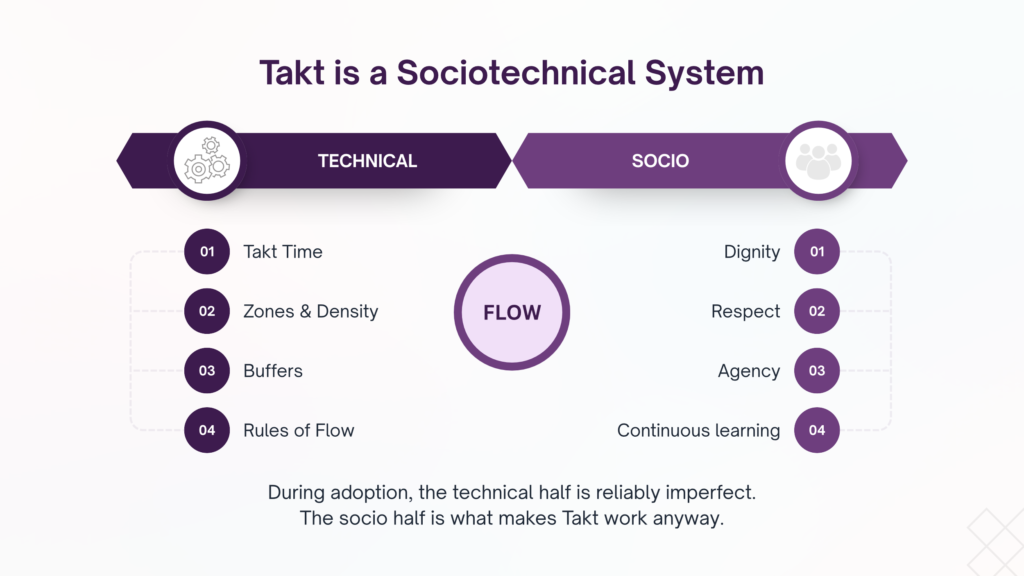
Takt creates flow when its technical and social systems are designed to work together.
The Field Takeaway
Before your next look-ahead meeting, ask one foreman a single question: “What’s one decision on this schedule you’d make differently if it were entirely up to you?” Write the answer down. That’s your baseline reading of agency on this project. Ask the same foreman the same question again in a month. If the answer hasn’t changed, agency isn’t growing — it’s just being tolerated.
The Takt Production Institute trains construction teams in Takt planning, Lean production, and the sociotechnical practices that make Takt actually work on a real jobsite. Want help building the socio side of your Takt rollout? Get in touch.
The catalog above is a menu, not a mandate. A simple, low-risk phase needs a handful of these moves; a complex, first-of-its-kind phase with a new trade needs most of them. The skill is matching preparation to risk.