
A temporary certificate of occupancy is not a finish line. It’s a hall pass — and too many teams don’t learn the difference until the week they were supposed to hand over the keys, when a building that looks done turns out not to work.
Why Must Commissioning Be Represented in the Takt Plan?
Commissioning is the disciplined act of proving that a building works — not just that it’s installed.
That discipline belongs on the Takt plan from Day 1: as a named section, with all seven commissioning levels sequenced like any other trade, and every major system tracked through all eight states of readiness on a visible board. Skip that, and the finish gets decided by accident.
Putting commissioning into the Takt plan means three concrete things:
- It is a named section of the Macro Takt plan from the start — not a stub at the right edge of the bar chart.
- Each commissioning level (Plan It, Factory Acceptance Test, Site Verification, Startup, Functional Performance Test, Integrated System Testing, Turnover & Operations) is a sequenced train with its own wagons, prerequisites, buffers, and roadblock-removal cadence.
- Every major system is tracked through all eight states — installed, inspected, started, pre-functionally tested, functionally tested, integrated, trained, turned over — on a visible System Readiness Board.
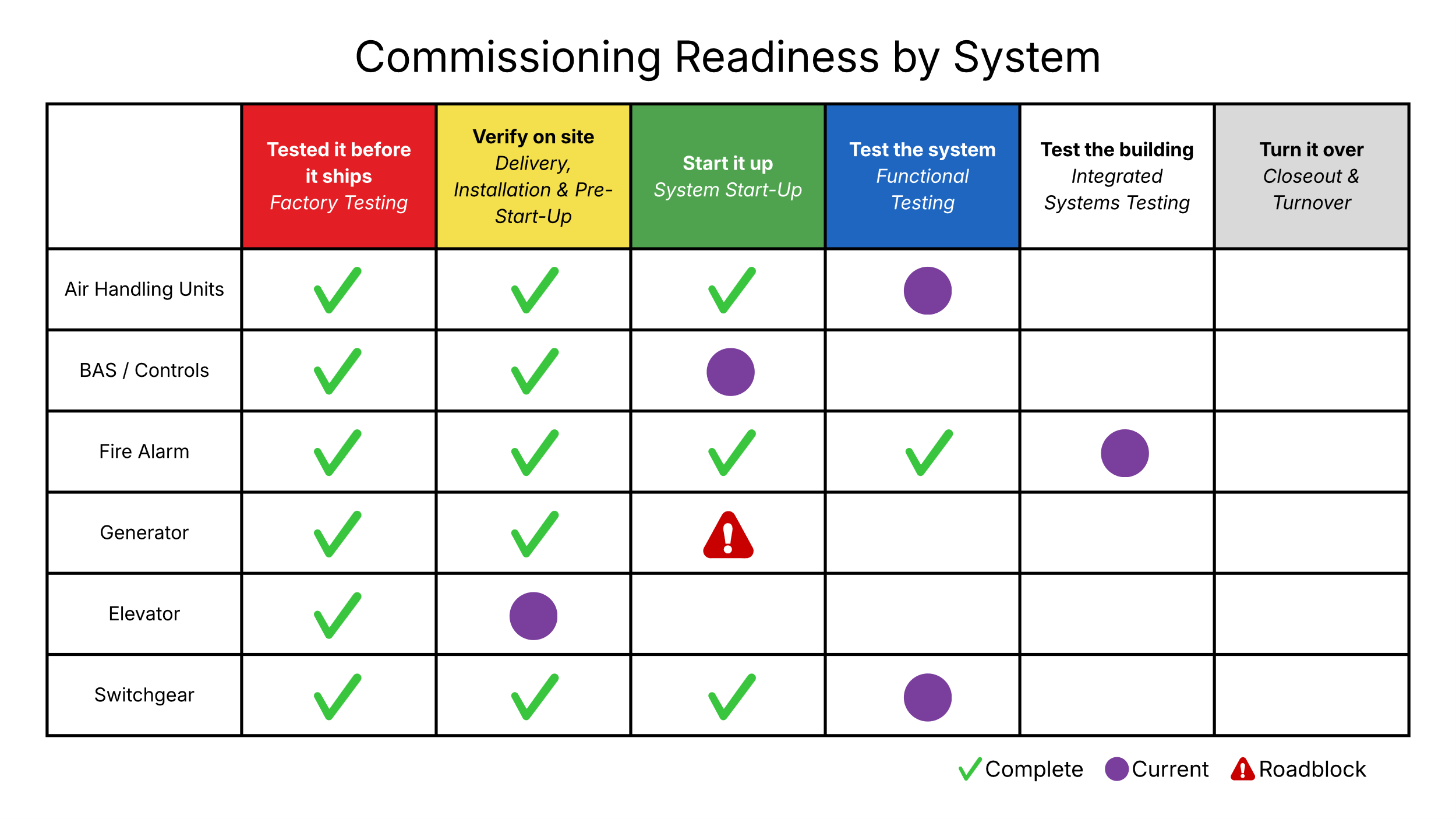
A visual commissioning status board shows where each major system stands and makes stalled progress visible before turnover.
Commissioning Is the Disciplined Act of Proving the Promise
Every contract carries a promise: a building that works — holds temperature, ventilates safely, alarms correctly, integrates cleanly, and can be run by people who weren’t on site during construction. Commissioning proves that promise.
The industry’s habitual mistake is treating commissioning as something that starts after construction ends. Commissioning is a parallel production system with its own zones, trains, buffers, prerequisites, and handoffs.
Steven Spear and H. Kent Bowen’s 1999 Harvard Business Review study of Toyota found that every specification inside a well-run production system functions as a tested hypothesis — defined, then proven true through action. A pre-functional checklist, a startup procedure, an FPT script: these aren’t paperwork. Each is the test of a hypothesis the design team wrote into the drawings. Installed only confirms the hypothesis was buildable. Commissioning confirms it was right.
What Are the Seven Levels of Commissioning, and How Do They Sit in a Takt Plan?
Think of the levels as locks on a canal. Each lock lifts the project to the next stage of readiness through a gate, and you cannot skip a lock — skipping doesn’t save time, it pushes the cost downstream where it’s more expensive and more visible. The Takt plan is what makes those gates visible and sequenced, instead of buried in someone’s spreadsheet.
| Lvl | Name | The question it answers | How it shows up in the Takt plan |
|---|---|---|---|
| 0 | Plan It | Do we know what success means? | Commissioning is a named section of the Macro Takt plan from Day 1; OPR/BOD owners listed. |
| 1 | Factory Acceptance | Can we verify quality before equipment ships? | FAT events anchored to procurement milestones in the Takt plan; witnesses scheduled. |
| 2 | Site Verification | Is the installation actually ready? | Pre-functional checklists ride the install train, one zone at a time; a hard gate to Level 3. |
| 3 | Startup | Can the equipment start and operate safely? | Startup train follows install zone by zone; the readiness checklist is the entry gate. |
| 4 | Functional Performance | Does the system perform as designed? | FPT wagons are a Takt train against named prerequisites (air-on, permanent power, TAB). |
| 5 | Integrated Systems | Do all systems work together under real conditions? | IST is its own short train with command-center sequencing — not a footnote. |
| 6 | Turnover & Operations | Can the owner operate and maintain what we built? | Training, manuals, attic stock, and warranty activation are sequenced wagons, not a list. |
Each level is scheduled production work — wagons, zones, prerequisites, buffers — the same way installation is. That’s what “on the Takt plan” actually means in practice.
Functional Performance Testing Is Its Own Takt Train
FPT deserves its own train because several hard prerequisites must converge before testing can begin: enclosure, permanent power, air-on, TAB readiness, and controls connectivity. Show those prerequisites as predecessor wagons, run testing by floor or by system, and make retests visible instead of buried in a spreadsheet.
Integrated Systems Testing
IST runs as a short, dedicated train with command-center sequencing: stop-work authority is named, the test lead is named, the comms protocol is written, and the trades on call are scheduled into the wagon. IST’s stop-work authority applies a jidoka-like principle from Taiichi Ohno’s 1988 book, Toyota Production System: Beyond Large-Scale Production: stop the test the instant a defect appears, rather than passing it downstream.
Owner Training
Training is sequenced wagons per system — operators identified by name, walking the building two months before turnover, trained inside the equipment rooms, recorded as they go. Training is commonly under-planned when it is treated as a series of meetings instead of scheduled production work.
What Are the Eight States of a System?
The seven levels describe the commissioning process. The eight states describe the readiness of each system moving through that process. Installed is only one of eight states, not the finish line. The single most useful question a superintendent can ask in a status meeting is “What state is each major system in?” — because the answer is a fact, not an opinion.
| State | What it means on the Takt wall |
|---|---|
| 1. Installed | Equipment in place. One of eight states — not the finish line. |
| 2. Inspected | Pre-functional checklist signed by the trade and the CxA. |
| 3. Started | Powered up, runs safely under manufacturer's startup procedure. |
| 4. Pre-functionally tested | Point-to-point checks and component-level verification complete. |
| 5. Functionally tested | FPT passed against the design intent and sequence of operations. |
| 6. Integrated tested | Verified to work with adjacent and dependent systems under real conditions. |
| 7. Trained | Owner operators trained on this system, with recordings in hand. |
| 8. Turned over | Manuals, attic stock, warranties, and acceptance complete. |
The visual control.
Build a System Readiness Board on the trailer wall within the first 90 days. Rows are major systems; columns are the eight states. Walk it weekly. If a system hasn’t moved in two weeks, treat it as a blocked card — find the blocker and clear it.
The Takt plan says what should be happening in which zone this week. The Readiness Board says what state each system has actually reached. Together, “are we ready?” becomes a verifiable answer instead of a hope.
When Does Commissioning Go on the Takt Plan? (Day 1.)
If you only do one thing differently, do this: include commissioning as a named section of the Macro Takt plan inside the first two weeks of Notice to Proceed. Not the Norm plan, not a separate schedule — the Macro plan that everyone sees.
Day 1 — Within Two Weeks of NTP
- Commissioning agent identified and named on the project org chart.
- Commissioning plan read cover to cover; OPR and BOD read and understood.
- Controls contractor identified.
- Standing weekly commissioning sync on the calendar — NTP through handover.
- Macro Takt plan includes commissioning as a named section.
- Air handlers landed, building enclosed, and permanent power named as project milestones.
- System matrix posted in the trailer.
End of the First Third — Topped Out and Tied In
- Commissioning plan, schedule, and team confirmed; kickoff complete or imminent.
- CxA introduced — and lunched; AHJ relationship established and walked together.
- Controls contractor on board and working on BAS graphics.
- Pre-functional checklists released; readiness checklists drafted for every major system.
- Exterior commissioning agent engaged — performance mockups, not just material mockups.
- Long-lead items (elevators, curtain wall, switchgear) tracked in detail.
- FAT list built and witnesses confirmed.
End of the Middle Third
- PFCs being executed on installed equipment; floor-by-floor commissioning on the Takt plan.
- Meeting cadence locked; issues log answered within one working day.
- Air handlers landed; vertical comms backbone live (temporary acceptable, paid for if needed).
- Path to air-on, permanent power, and FPT mapped on the Takt plan.
- Sequence walk-through held with BOD, CxA, controls contractor, and owner.
- System Readiness Board live on the trailer wall.
The Two-Thirds Pivot
At two-thirds you pivot: move the project engineers and PMs off coordination and onto close-out.
Track submittals on a log, start warranty documentation, start collecting manuals, attic stock, and training videos. The team will resist. Pivot anyway — the final drive isn’t driving work in the field; it’s getting documentation ready.
Final Third / Pre-Substantial Completion
- Yellow-brick roads built — elevators, fire sprinkler, fire alarm, dampers, TAB, engineers’ walks, state elevator inspection.
- Day-by-day map for the remaining months printed and walked weekly.
- Daily standup running — CxA, controls, MEP coordinator, superintendent.
- FPT prerequisites complete: enclosed, clean, filters in, vertical controls connectivity, permanent power, TAB.
- FPT, IST, and AT scheduled with no conflicts with fire alarm testing.
- Punch list owner identified; systems manual compiled in real time, not at the end.
- O&M manuals and attic stock collection underway.
- Operators identified by name — walking the building two months before turnover.
- Owner training scheduled by system, with a recording plan.
Substantial Completion Gate
- Preliminary balancing report delivered; engineer sign-offs collected.
- Architect’s punch list issued; inspector green tags from the AHJ.
- Fire alarm testing complete (floor and whole-building); sprinklers operational and inspected.
- Elevators operational and state-inspected.
- ADA and life-safety walks complete; signage and egress confirmed.
- FPT substantially complete; IST scenarios run and signed off.
- Operations team trained — sessions recorded; systems manual delivered.
- Temporary or full certificate of occupancy received.
Final Completion Gate
- Punch list closed; building flush complete; final FPT passes complete.
- Final commissioning report delivered; systems manual finalized and turned over.
- Owner training delivered and recorded; attic stock turned over.
- Warranties activated; post-occupancy support cadence active.
- Seasonal and deferred testing scheduled.
- Final certificate of occupancy received.
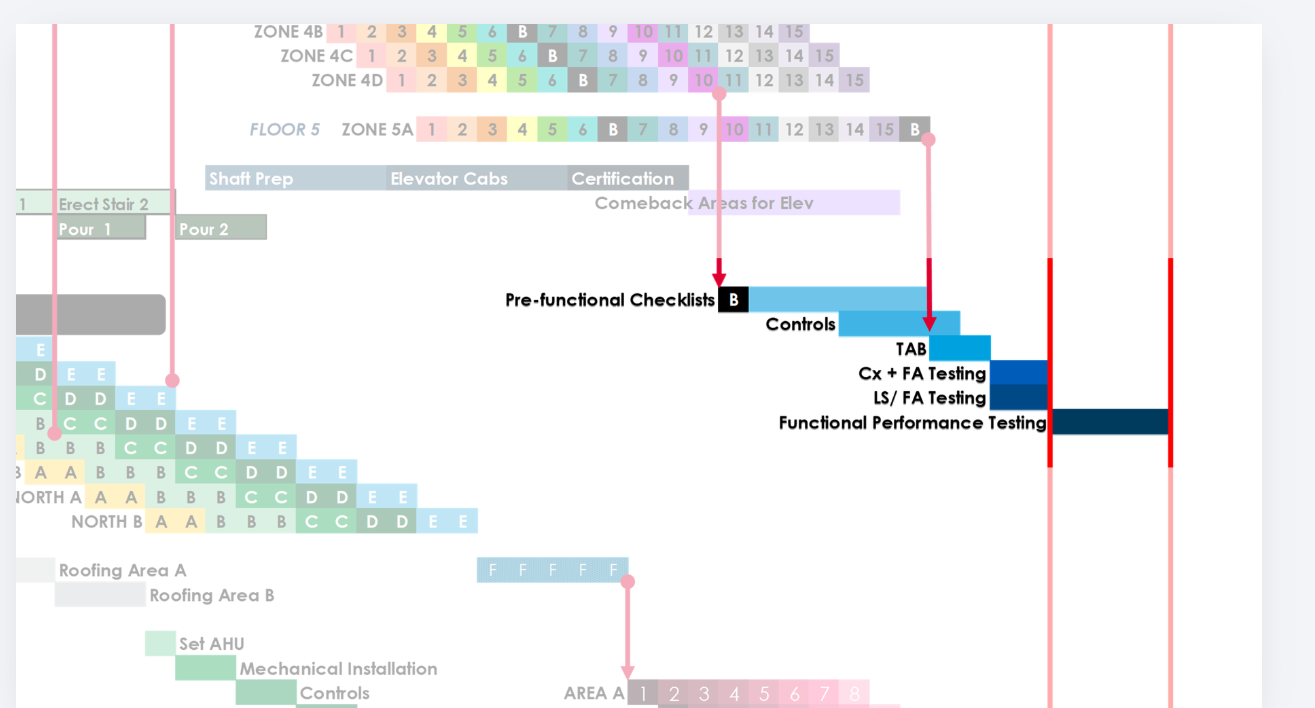
Commissioning is sequenced inside the Takt plan, with installation, controls, testing, and completion gates visible before turnover.
Final Completion GThe Rhythms That Carry It ate
Putting commissioning on the Takt plan only works if a rhythm holds the work to the plan.
Daily Commissioning Huddle — 15 Minutes, Standing
Every working morning during Levels 3–5, held in front of the boards. Start on time, end on time, use names not titles. Problem-solving goes offline.
- Yesterday’s closure — what tested, pass/fail, deficiencies closed.
- Today’s tests — prerequisites, trades on site, safety controls, witnesses.
- Blockers — deficiencies, materials, decisions needed today.
- Retests — closure verified, witness assigned.
- Look-ahead — tomorrow’s tests and what must be true by end of day.
Glenn Ballard and Gregory Howell’s 1998 paper, “Shielding Production: An Essential Step in Production Control,” describes this screening function as constraint analysis — clearing the near-term plan so only ready work reaches the crews. A translation matters here: Ballard and Howell’s Last Planner® literature uses “constraint” for what TPI calls a Roadblock — a removable obstacle blocking one specific, already-planned activity, cleared in a huddle like this one. TPI reserves “Constraint” for the systemic limits (crane capacity, permit sequencing, an unfinished design) that get planned around at the pull plan, well before any huddle happens.
Weekly Commissioning Meeting — 60 Minutes
Same time, same day, every week, from NTP through handover — superintendent, PM, MEP coordinator, controls lead, CxA, and the PE who owns the documentation. Walk the System Readiness Board and the deficiency log every time.
Common Commissioning Failures the Takt Plan Prevents
If a commissioning effort is going sideways, the symptom almost always traces to one of these failure modes — beyond what the Day 1 timeline already covers.
- Checklistsaspaperwork. Prevention: PFCs are quality gates. Trade walks with the CxA. Pencil-whipping returned.
- Skipping installation verification.Prevention: Level 2 is a hard gate. Readiness checklists signed before any startup.
- Starting before prerequisites.Prevention: Readiness checklist signed before the startup tech is even scheduled.
- Weak IST communication.Prevention: Test lead, comms protocol, command center, stop-work authority — all clear and named.
- Ignoring unresolved deficiencies.Prevention: Closure means verified by theCxA — not “someone said fixed.” Jeffrey Liker’s The Toyota Way (2004) names this as Principle 5: build a culture that stops to fix problems rather than inspecting them in later. A failed PFC can function like an andon signal when it visibly stops progression until the issue is corrected.
- Confusingsubstantial withoperational. Prevention: Substantial completion is a date. The goal is operational readiness.
Why a CPM Schedule Cannot Carry Commissioning
A CPM bar labeled “Commissioning — 60 days” hides the production system inside the work: readiness states, prerequisite convergence, retests, training, and turnover gates. By the time the schedule shows commissioning slipping, the slippage already happened — and there’s no information in the bar chart about why.
A Takt plan exposes those dependencies early enough to act on them: a named section, sequenced wagons, named prerequisites, visible buffers, a System Readiness Board on the wall. A healthy plan reveals problems early; a bad plan hides them until they detonate.
The Field Takeaway
Before your next look-ahead, do this: open your Macro Takt plan and find commissioning. If it’s a bar at the right edge with no zones, no wagons, and no named levels, that’s your finding — not a surprise you want to discover at month eleven.
Then build the eight-state board for just your three most complex systems and walk it once with the CxA. Ask one question about each row: what state is it in, and what’s kept it there for the last two weeks? If nobody in the room can answer both halves of that question, you’ve found your next roadblock to clear — today, not at substantial completion.
Prove it before you promise it’s done.