
Building a Takt Plan
The Foundation
Understand the Two Plan Levels
Every Takt project runs on two plans — not one. They are the same plan going different speeds. The gap between them is your engineered buffer — the space that protects the owner’s deadline from the inevitable disruptions of the field.
The Promise
Macro Level Production Plan
Built in pre-construction. 5-day Takt, larger zones, conservative. What you commit to the owner. Built early enough to protect budget and duration before decisions are locked.
The Target
Norm Level Production Plan
Built with trade partners from a pull plan. Day-by-day, optimized zones, faster pace. What the field actually runs on. Look-aheads and weekly plans filter from the Norm.
The Architecture
Define Programs, Projects, and Phases
The Takt Production System scales using one logic repeated at every level — same rules, different sizes. Big things only work when they are made of small things that work the same way.
A program is a collection of projects moving in rhythm
A projectis a collection of phases moving in rhythm
A phase is a collection of zones and work packages moving in rhythm
The Takt Production System scales using one logic repeated at every level — same rules, different sizes. Big things only work when they are made of small things that work the same way.
Truth Points
Set Milestones and Phase Boundaries
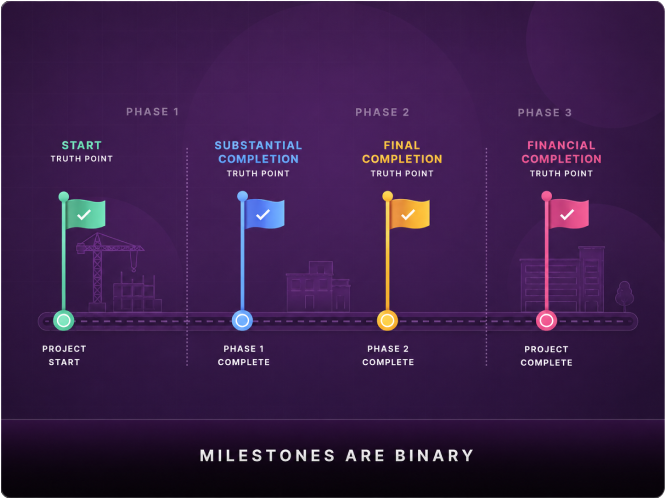
Milestones are not decorations on a schedule. They are commitments, boundaries, and truth points. A real milestone is binary — you are either there, or you are not.
Every project must have a start milestone and three end milestones:
End Milestone 1
Substantial Completion
Building usable for its intended purpose. Life safety systems operational. Egress complete and approved. Owner can legally occupy.
End Milestone 2
Final Completion
Punch list done. All contract scope closed. No loose ends. No “we’ll come back later.” Systems turned over. Operationally complete.
End Milestone 3
Financial Completion
Job stops costing money. Time is not free. General conditions are not free. Too many teams ignore this milestone and regret it.
The Tracks
Design Your Zones
Equal area does not mean equal work. Equal effort is what creates flow.
Zone by work density — not square footage. A corridor is not the same as an exam room. An open office is not the same as a mechanical room packed with systems. When zones are unleveled, one crew becomes the bottleneck every single time.
- Study the drawings — understand physical flow direction before drawing any boundaries
- Perform a work density analysis — score each area on a scale by level of effort
- Shape zone boundaries so each zone carries roughly equal effort, not equal square footage
- Test with the formula: (Wagons + Zones − 1) × Takt Time = Duration
- Adjust until the Macro plan lands in a competitive, responsible range
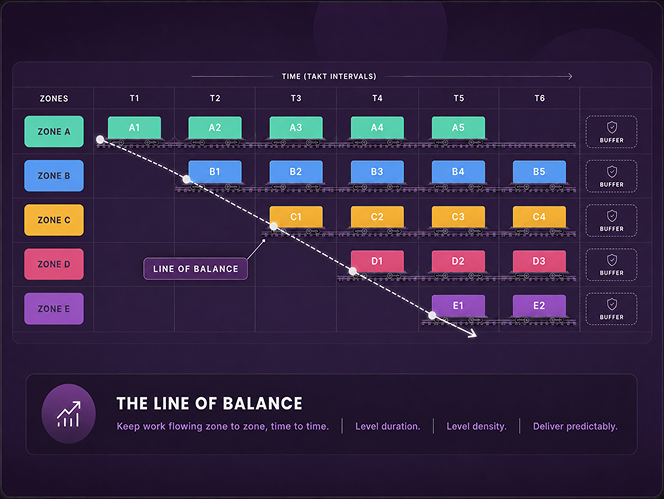
Horizontal Zones
Flowing across the floor. The most common zone type. Defined by work density, not the floor plan grid.
Vertical Zones
Stairs, elevators, stacked restrooms, chases running through levels. May function as independent vertical flows.
Workable Backlog
Work ready but not on the critical flow path. Acts as swing capacity if the train stalls — strategic flexibility.
The Rhythm
Set the Takt Time
Takt time is the drumbeat of the project — the defined duration each trade spends in a zone before moving to the next. It is not how fast you hope crews move. It is the pace the entire system is designed around.
The Fundamental Formula
(Takt Wagons + Zones − 1) × Takt Time = Duration
Never lock Takt time to the work week — rhythm is based on work, not the calendar. When the week resets every Friday, flow breaks by design.
Start at 5-day for the Macrobecause it's easy. Optimize at the Norm level — it rarely stays at five days.
Multiple Takt times are allowed 3-day interiors and 5-day exteriors can coexist as separate trains within the same project.
If a delay hits midweek, shift the rhythm by that amount. Do not push crews into Saturday to reset the week.
Readiness
Apply the Full Kit Rule
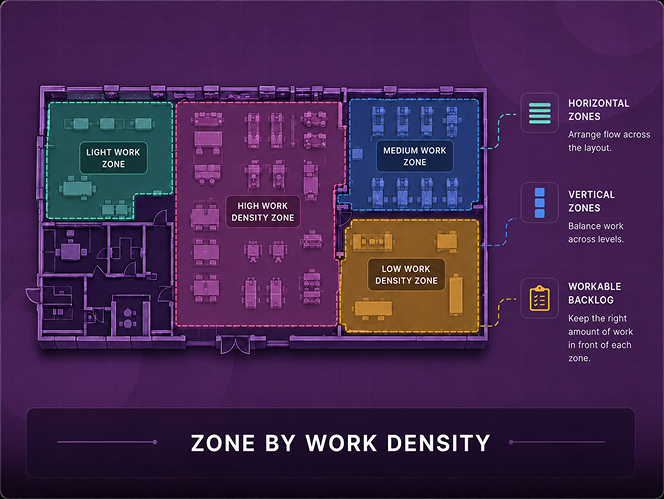
Each Takt wagon = one zone × one Takt time. Wagons hold whatever it takes to level duration and density. Never assume one trade = one wagon.
Never lock Takt time to the work week — rhythm is based on work, not the calendar. When the week resets every Friday, flow breaks by design.
Wagon buffers: 5–20% within the sequence so trades finish well and don't feel rushed
Never place crews overhead and below in the same zone at the same time
The diagonal line connecting wagons across the time-location plan is the line of balance — the visual proof that flow exists.
Readiness
Apply the Full Kit Rule
Never start a task unless you have everything needed to complete it.
A crew is Full Kitted when all six conditions are true. If any one is false, the work does not start.
Materials on site
Not on the way. Not arriving Tuesday. On site, right quantity, right location, ready today.
Information in their hands
Stamped drawings. Answered RFIs. Change orders reflected. Settled— on paper.
Tools and equipment present
Right hoist, right scaffold, right power. If they'll need it, it is here.
Scope and "done" is clear
The foreman knows exactly what counts as finished. Quality criteria specified, not vague.
Right people present
Right size crew, right skills, right leadership — not two helpers and a foreman pulled elsewhere.
Previous step genuinely done
Not 90%. Not "they'll wrap up while you start." Done. Inspected. Signed off. Accepted.
The Architecture
Build In Buffers
No production plan should ever be made without buffers. Buffers are not padding. They are not laziness. They are planned, visible, intentional time reserves placed strategically inside the plan. They belong to the production team — not the owner, not contingency.
Calculated End Buffer
50–75% of phase buffer at the end, protecting the completion milestone directly. Take the largest realistic risk — not the sum of all risks — as your buffer target.
Takt Time Buffer
Pause the whole train for known interruptions — holidays, weather shutdowns. The entire train pauses and restarts together, protecting synchronization.
Takt Wagon Buffer
5–20% inside individual work packages. Gives trades time to finish well, reflect, clean, and prepare. Too little and work waits on workers.
Sequence Buffer
Empty buffer wagons inserted when front-end risk is elevated. Used strategically — not scattered everywhere as an excuse for poor planning.
Supply Chain Buffer
If you buffer the plan but not the supply chain, materials arrive late relative to the new start. Buffer both. Flow and supply chain must move together.
The Spine
Identify the Path of Critical Flow
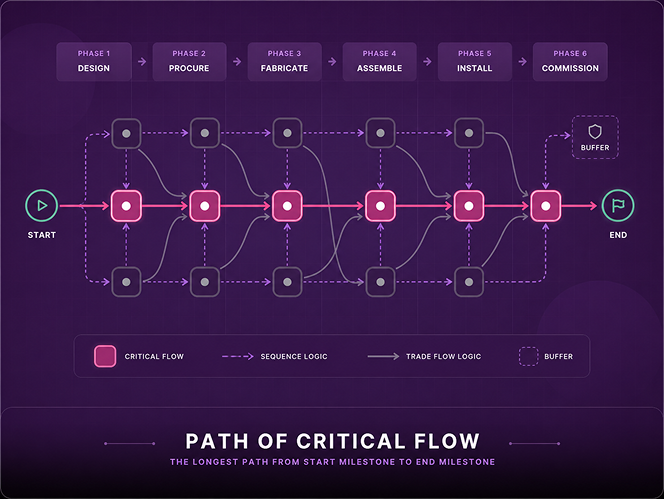
The Path of Critical Flow replaces what CPM calls the critical path. It is the longest path through the plan — phases, lines of balance, buffers, and interdependence ties — from start milestone to end milestone.
You can verify it by looking at the plan — it is visible, unlike a CPM chain buried in thousands of lines no one in the field believes in
You can submit a delay claim against it defensibly — it represents how work actually flows
Three logic layers: overhead and below in the same zone at the same time
A Macro Takt plan typically has 10–30 interdependence ties — more logic than CPM, not less
The diagonal line connecting wagons across the time-location plan is the line of balance — the visual proof that flow exists.
The Architecture
Advanced Work Packaging
Prepare work so completely that a crew can pick it up and build without hunting, waiting, or guessing — like an IKEA flat-pack box where every part is counted out, the right tools included, and instructions are in the order things go together.
| Packaging Term | → | Takt Equivalent | What it Means |
|---|---|---|---|
| Construction Work Area (CWA) | → | Takt Phase | A large, logical division of the project with its own production logic and railway of work |
| Construction Work Package (CWP) | → | Takt Wagon | A buildable scope a discipline can construct, moving through the phase at one Takt cycle |
| Installation Work Package (IWP) | → | Standard Work in a Zone | The repeatable, fully prepared unit of install a crew performs in one zone — the flat-pack box |
Four verbs in order: Design → Make → Transport → Build. The package that gets designed is the same package that gets bought and built — carved from one model, delivered as one complete box.
Watch Out For
Common Ways to Fail at Building a Takt Plan
Takt planning doesn’t fail because people don’t care. It fails because people think they are doing it right. These are the most predictable failure modes.
Locking into 5-day Takt everywhere — even at the Norm level. Work must match rhythm, not the calendar.
Using the weekend as the drumbeat — every delay forces overtime or breaks the rhythm. Never.
Not leveling work packages — unleveled wagons create hidden queues, waiting, and shortcuts that kill quality.
Skipping buffers — a plan with no buffer is not a plan. It is a wish. The first delay proves it.
Planning too late — Macro planning happens at schematic design, not after design is mostly done. The damage is baked in.
Excluding builders from the plan — crews follow plans they helped create. They resist plans they were handed.
Not managing procurement from the start — a Takt plan without material planning is optimism in grid form.
Treating Takt as a mechanical tool — Takt is a socio-technical system. Flow is created by people, not diagrams.
A Takt plan that does not respect human limits, learning curves, and psychological safety will never produce flow. It will only produce quiet resistance.